What the Mayor Achieved for New York City's 4-Year-Olds
Four years ago, Mayor Bill de Blasio ran on a campaign promise of expanding pre-kindergarten to any 4-year-old in the city who wanted a seat. He pledged to do it quickly, with a focus on quality.
And, by most all accounts, it happened.
When de Blasio came into office, the city was offering full-day pre-k to just 20,000 children. (Parents of older public school kids will recall how coveted these spots were). By the fall of 2015, the city had begun to offer seats to nearly 70,000 youngsters.
"For me it's not about swooping in from City Hall and trying to do a bunch of good stuff for people," said Deputy Mayor Richard Buery, the architect of what the city calls Pre-K for All. "It's really about responding to what people have been asking for for decades.”
The expansion was a big economic win for families who were paying out of pocket for private programs. And, from an educational standpoint, investing in early childhood made sense. There is ample research on how high-quality programs benefit children, even in the long-term. Plus, New York City was, in a sense, catching up to other parts of the world: overall, the U.S. lags behind many developed countries when it comes to spending on early childhood and enrolling kids.
There was also a belief that more low-income children needed access to the same types of programs that wealthier families sent their kids to.
"They deserve to have a chance to play in beautiful environments, with new friends, under the supervision of teachers who have the skills and experience to guide their development," said Buery.
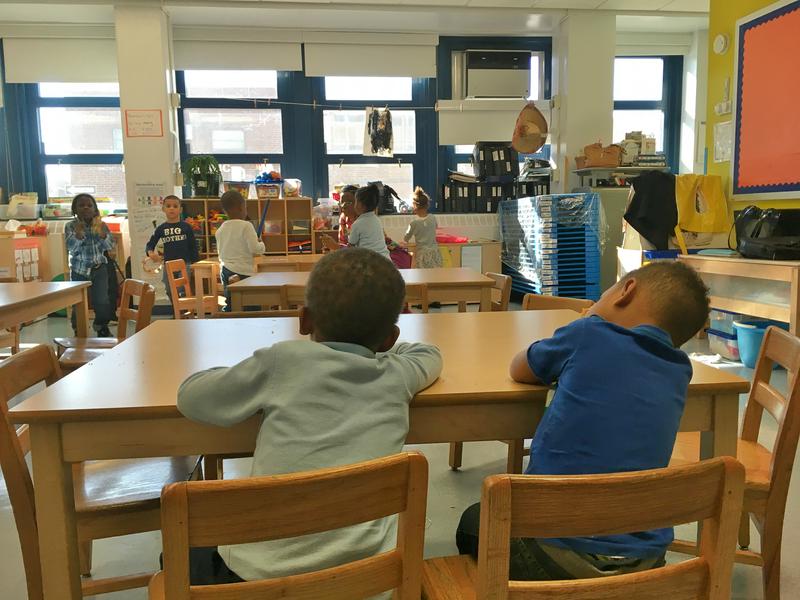
In neighborhoods with high-concentrations of poverty, like Brownsville, Brooklyn, the expansion of pre-k came with high stakes. About 40 percent of Brownsville residents fall below the federal poverty line, according to data from the Citizens' Committee for Children. Many families contend with homelessness, a problem that has worsened under de Blasio. Educational outcomes, by traditional measures like test scores, trail citywide averages.
But Brownsville has a lot of children. According to the Citizens' Committee, nearly one in every 10 residents there is under the age of 5. And scaling up pre-k has had positive results in the neighborhood enrollment-wise. In the first year of the city's expansion, the number of children enrolled in full-day pre-k increased by 70 percent.
To hear more about pre-kindergarten in Brownsville, click the audio player.
Citywide, education officials know there are children not enrolling in pre-k of any kind, though it is unclear just how many. Principals and early childhood providers will speak anecdotally about children who show up to kindergarten, sometimes even first grade, without having had any previous schooling.
(Education officials said that, last school year, 72 percent of kindergarteners attended one of the city's pre-k programs. That number doesn't include students who attended private pre-k or programs outside of the city, in instances where families may have recently moved to New York.)
But the Education Department has paid close attention to the quality of its pre-k programs, providing instructional oversight in each classroom. It collects data on the quality of teacher-student interactions and on parent satisfaction. It will soon embark on a study, alongside New York University, to examine the impact pre-k may have on student achievement and attendance in later years.
While pre-k is on the right track, the swift expansion of programs did come with a cost.
The city relies heavily on community-based organizations to make such widespread access to pre-k possible. In fact, about 60 percent of classes are in community centers, while about 40 percent of classes are in public schools.
But teachers in the public schools receive higher pay, and have better benefits and work hours, because they are part of the United Federation of Teachers. Many experienced teachers left their jobs in community organizations for positions in public schools.
Directors of community organizations have been supportive of the expansion of early childhood programs, while trying to call attention to their struggle at the same time.
"I give the mayor high marks for doing a lot of things," said Jim Matison, executive director of the Brooklyn Kindergarten Society, which has five early childhood centers. "It’s just the fallout from having such a rapid expansion has been negative to everyone in the community-based organization community. We’ve just lost too many teachers."
The city increased funding to help shrink the pay gap, but the disparity still exists.

WNYC is funded by sponsors and member donations