When it Comes to Police Misconduct, Body-Worn Camera Videos Are Slow to Come
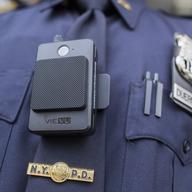
The New York City Police Department is lagging behind other cities across the country when it comes to sharing video from body-worn cameras. In some cities, police departments provide direct access whether you are law enforcement investigating a crime or a civilian oversight body investigating police misconduct.
It can take weeks and sometimes months for investigators from New York City's Civilian Complaint Review Board to receive video evidence shot from the body-camera of an officer. As WNYC reported last month, more than a third of the CCRB’s investigations have pending requests for video from body-worn cameras.
The board kept after the issue at its meeting on Staten Island on July 10.
"In a three-month span from March 2019 to May 2019 alone, 734 requests for BWC(body-worn camera) recordings were not fulfilled which was a 338 percent increase in unfulfilled requests from previous months," said Olas Carayannis, Director of Quality Assurance and Improvement, told audience.
The NYPD requires the CCRB to request video from a liaison who then takes it to the Internal Affairs Bureau, which then reviews the request with NYPD lawyers.
The public goes through a similar process. But their requests were put on hold after the police union sued to stop the body-worn camera video from being shared, and the NYPD says that's the reason for the backlog. The hold was lifted after a state judge ruled against the union.
But the problem extends beyond the backlog. More than sixteen-hundred times in the past two years, the NYPD said there was no video, according to the CCRB. And in 147 cases, the CCRB was told no video existed but found out later that was false. In one case, they saw the video in the Daily News; in several others, the accused officers mentioned the videos during interviews with investigators.
"The NYPD’s current practices are inhibiting the CCRB’s ability to adequately provide civilian oversight," Carayannis said.
He said cases are also being denied outright when there is a seal on an arrest. Cases are supposed to be sealed to protect people from the stigma of a criminal record when charges against them get dismissed or if they are a minor. But in CCRB cases, the seal has the effect of hindering a misconduct investigation.
The NYPD said the CCRB could get the person with the sealed arrest to sign a waiver or get a court order from a judge as they have in the past. But in the meantime, Carayannis said officers accused of misconduct are allowed to view it prior to being interviewed by an investigator — while the investigator is not.
"This places the CCRB at a distinct disadvantage," he said. "Investigators may never receive that video evidence and thus cannot verify claims made by officers about what is depicted in the BWC (body-worn camera) footage."
WNYC did a spot check of more than half a dozen cities around the country with civilian oversight boards. In Los Angeles, Chicago, Houston and Philadelphia the oversight bodies lack direct access to body-worn camera footage. But in places like San Francisco, videos can be accessed by investigators directly.
Russel Bloom is the Independent Police Auditor for the Bay Area Rapid Transit District, which was created after the high-profile death of Oscar Grant, who was unarmed when he was shot to death at Fruitvale Station.
"There's nothing that we are unable to access," Bloom said of the videos. "If it was recorded by an officer and uploaded to evidence.com, we're able to view it."
Videos get stored on evidence.com in many cities, including in New York. Susan Hutson, the Independent Police Monitor for New Orleans, said her office also has direct access to the video storage system.
"I can go and check myself," she said. "I can search by officer, I can search by location, I can search by date and time."
Hutson said independent investigators should not rely on police departments to say whether videos exist or not. Her investigators search for videos themselves.
"And then I can say to the public, 'Yes, I got a chance to search and look for everything,' " she said. "If not, I just have to tell the community, 'Look, this is what the NOPD gave me. I don’t know if it’s all the information or not.' "
Hutson’s oversight body also monitors whether officers are using the cameras properly.
"So for instance, the New Orleans police department does its own body-worn camera audit to see if their officers are turning it on and if they’re turning it on for the length of time it’s supposed to be on," Hutson said. "We are meta-auditing their audit."
In New York City, there is no double-check. But the NYPD does audit itself, through the Department's Risk Management Bureau. They say they've looked at 60,00 videos out of more than 3.5 million. Supervisors at precincts look at 15 percent of videos too. The Department said it routinely finds both positive and negative issues and either retrains or disciplines officers when there's a problem.
The NYPD started using body worn cameras in 2017 as a result of a massive federal lawsuit over the department’s stop and frisk tactic, which targeted mostly black and Latino men. More than 4 million stops occurred over an eight year period. They were supposed to get guns off the street but the majority of people frisked had no weapon on them. Federal Judge Shira Scheindlin ruled the practice unconstitutional and said the NYPD knew that but did nothing. Prior to the lawsuit, there were no plans to use the cameras. The cameras were her idea.
"She talked about how it could benefit both sides of the encounter, particularly for these kinds of street encounters which are often at night time and there’s no one else around," said Darius Charney, from the Center for Constitutional Rights, one of the attorneys who brought the lawsuit. Charney said Judge Scheindlin thought of body-worn cameras as a third unbiased witness when it was an officer’s word against a civilian’s.
In her final opinion, Scheindlin wrote about several alleged illegal stops, including one that involved Leroy Downs, an African-American man who lived in Staten Island.
She described how Downs was talking on his cell phone outside his house when two white police officers jumped out of their Crown Victoria, pushed him against a fence, accused him of smoking pot, frisked him and then let him go. Downs complained to the Civilian Complaint Review Board, but when the officers were interviewed they claimed to have no recollection of the encounter.
"They said, 'We don’t know who he is, ' " Charney said. " 'We’ve never seen him. We don’t remember that encounter.' "
The CCRB ruled the case unsubstantiated due to a lack of evidence. The cameras were supposed to bring clarity to situations such as this one.
There's some proof they are having an impact. As of May, the CCRB substantiated 42 percent of police misconduct cases with video evidence, compared to 7 percent when there was none.
"In order for the CCRB to perform its core function of providing civilian oversight of the NYPD, we need access," said Jonathan Darche, the CCRB's executive director.
Another complication arises when the NYPD blurs out parts of the video before turning it over. In Washington DC, there are no redactions.
"It really doesn’t make a whole lot of sense to be redacting evidence before it gets sent to the investigating agency," said Mike Tobin, director of the Office of Police Complaints in Washington DC. "That type of behavior should have gone out about 50 years ago in policing."
The NYPD says they only redact the faces of patients receiving medical treatment to protect their privacy; prisoners in a cell in case their cases are sealed; and the personal effects of police officers like cell phone numbers. Tobin agreed that certain people and information should be protected from the public view. But he said a civilian oversight body isn’t an extension of the public, it’s an investigative government agency.
"The police department certainly would not be accepting of any type of video or documentary evidence that’s been redacted before they get it," he said. "Because that would inhibit their investigation of any type of criminal offense. Why wouldn’t you want to have an uninhibited investigation of a misconduct offense?"
As in San Francisco and New Orleans, Tobin’s investigators also don’t have to request videos from the police department. They have direct access and can look for footage themselves.
"You can click on a map anywhere in the city and narrow your search to say June 24th, 2019 between the hours of noon and 1PM and uh the system will give you all body worn camera video footage taken during that time frame," he said.
The NYPD said several state laws require them to protect people’s privacy and if the CCRB was to get direct access and then violate those rules, the department could be held liable.
But if the cameras are supposed to help build trust, the CCRB said the delays are having the opposite effect of making the public even more suspicious.

WNYC is funded by sponsors and member donations