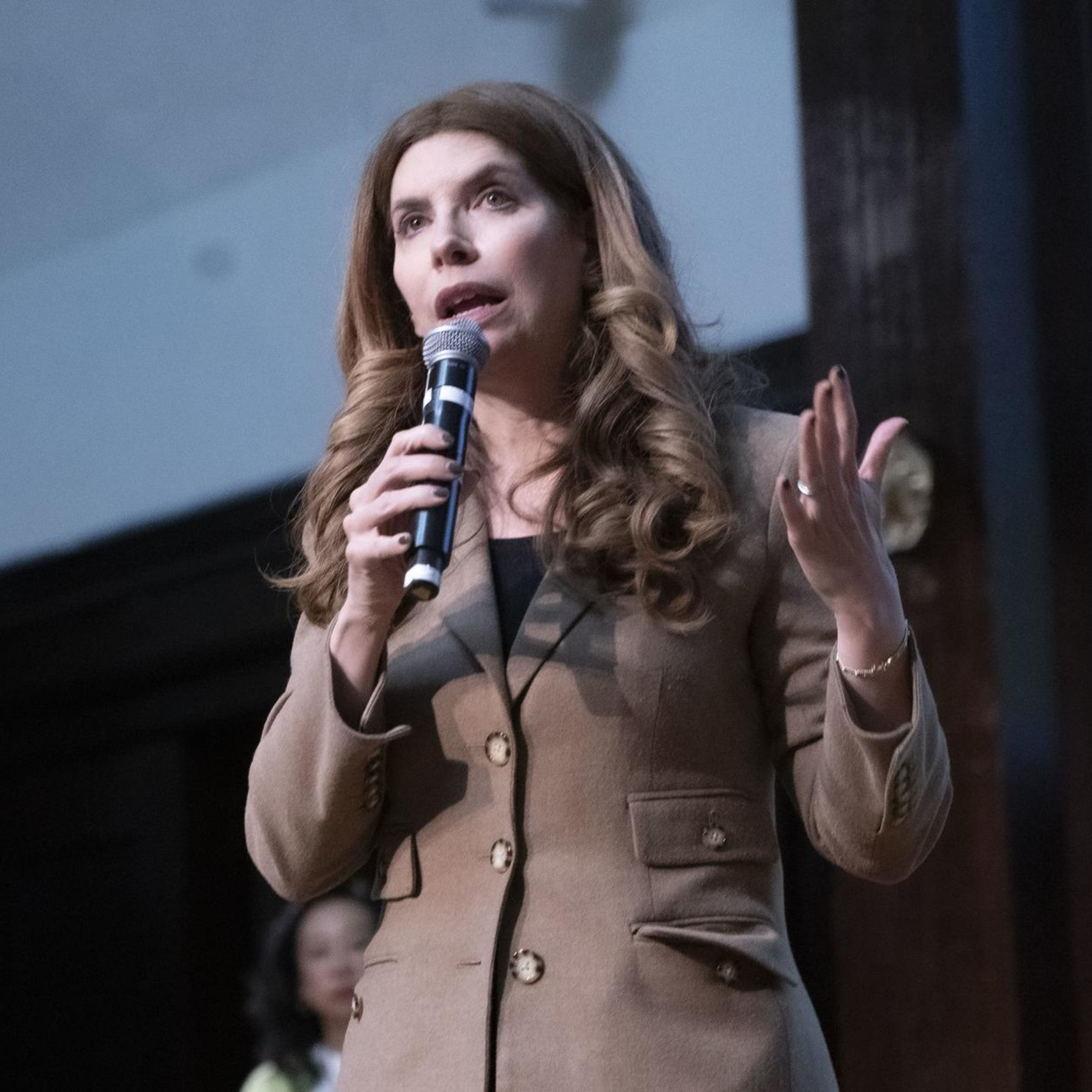
Speak to Speaker Menin
Transcript
[music]
Brian Lehrer: It's The Brian Lehrer Show on WNYC. Happy Monday morning, everyone. We will begin the week by allowing you to speak with the speaker. It's my questions and yours for New York City Council Speaker Julie Menin. We've started our Ask the Mayor Series with Mayor Mamdani, right? Well, today, you can speak with the speaker about anything you would like City Council to address in your neighborhood or citywide, and of course, ask any questions. I've got some of my own lined up. 212-433-WNYC, 212-433-9692, call or text for Speaker Julie Menin. Speaker Menin, we really appreciate that you're doing this with us today. Welcome back to WNYC.
Speaker Julie Menin: Thanks, Brian. It's so great to be with you today.
Brian Lehrer: I'd like to start with the Legionnaires' disease outbreak on the Upper East Side, and now a cooling tower has tested positive at The Ardsley on Central Park West, 91st Street and 92nd Street. You started out critical of the Health Department for some of its early response. Are they getting it right yet, according to you?
Speaker Julie Menin: I'm still extremely concerned, Brian. The issue is that with Legionnaires', it can be obviously fatal in approximately 10% of the cases. As of yesterday, there were 46 positive cases. What I have asked the Health Department to do from the beginning was, rather than wait for test results to come back, proactively disinfect the towers, order the building owners to disinfect the towers rather than continue to wait for this information to come back, because every single day that they wait, more and more people become sick.
We have to remember that this outbreak is on the east side of Manhattan, and on the east side of Manhattan is actually one of the densest districts in the city of New York with a very large senior population who are incredibly susceptible to Legionnaires'. My criticism of the Health Department is, first of all, that they did not proactively disinfect these buildings, that they actually are continuing to wait for test results. They still have buildings back where there are no test results, and so those towers have still not been disinfected.
In addition, they only, over the weekend, released what buildings there were positive cases on. Everything from certain residential buildings, Asphalt Green, where you've got many kids play on Asphalt Green, the Guggenheim Museum, a lot of different facilities throughout the East Side. Why not release those buildings as soon as there are positive cases? Then my third criticism is they know where the epicenter is. Why not release that data as soon as they know that? These are all proactive steps that were not taken, and that is my concern.
Brian Lehrer: Just to be clear, I see that the Health Department, and correct me if this news story that I saw is wrong, but I see the Health Department ordered 31 buildings that tested positive for Legionella to disinfect their buildings by Saturday, two days ago. Those are mostly residential buildings. Also, I read the Guggenheim Museum. Do you know if they have all complied with the Saturday deadline?
Speaker Julie Menin: Well, this is the issue, Brian. It's not only those 31 buildings. My concern with what the Health Department is not doing is what about all the buildings where we don't have the test results back yet? We have hundreds of buildings in these three zip codes, and we don't have test results back for many, many buildings. There, we have a big question mark. We don't know if they're positive or not. Instead of waiting the days on end for the test results to come back, just proactively order the buildings to disinfect. It's not a complicated or expensive process to do so. You basically use bleach and other materials.
Of the 31 buildings that they have ordered, we do not yet have that information. Tonight, there will be another town hall, and we expect to hear the information as to whether or not those 31 buildings complied, but what about all the other buildings where we don't know what the test results are? Every single hour and every single day that those buildings are not disinfected, more and more residents become infected and can potentially die as a result of this.
Brian Lehrer: I read that The Ardsley on Central Park West between 91st and 92nd Streets tested on their own and found the problem. Do you want more buildings to do that in a certain geographical area?
Speaker Julie Menin: Absolutely. Last year, the City Council passed a bill sponsored by Councilmember Schulman, the Health Committee chair, that basically ordered buildings to test once a month for Legionnaires' in the summer months. That bill went into effect, Brian, on May 8th. Not all buildings have complied with that. The other thing that we really need is we need the Health Department to be doing aggressive enforcement to make sure that buildings are complying. If they're not complying, they need to be fined.
Brian Lehrer: Last thing on this. Why is the cluster there? For people outside the area and people inside the area, they may think, "Well, gee, these are relatively affluent areas of New York City." What is it about the Upper East Side, and now at least one building on the West Side, that these cooling towers would get infected with Legionella? We're not talking about any other neighborhood of the city.
Speaker Julie Menin: Well, any cooling tower can become infected with it. That's exactly why the City Council passed Councilmember Schulman's bill last year to make sure that every single building is testing, particularly in the summer months, where we know this can be a problem. Every single building can be susceptible to this. The problem is that as you're walking down the street, if the cooling tower is spraying that mist, anyone can inhale it. Some people become sick with it; some do not, but certainly those that are immunocompromised or seniors are far more susceptible to contracting Legionnaires', and far more susceptible to having severe complication and potentially even fatalities.
We shouldn't be getting to that point. I have been disappointed by the response of the Health Department. This is a time to be aggressive and proactive and not to just wait and wait and wait for these test results to come back, such that more and more people continue to get sick.
Brian Lehrer: All right. Listeners, you may speak with the speaker this morning. 212-433-WNYC, call or text for New York City Council Speaker Julie Menin. 212-433-9692. Our first one's going to come from that Upper East Side, which is also your district, but on another topic. Rachel in Manhattan along Park Avenue, you're on WNYC. Hello.
Rachel: Oh, good morning, Brian. Thank you for taking my call, and thank you for all you do for the city. Compared to Legionnaires' disease, this is minor. I was curious about the plan to alter the space from 57th Street and Park Avenue to 46th by narrowing the lanes available for traffic, adding a bike lane, and widening the center strip. I don't understand the rationale for doing that in one of the most traffic-congested areas of the city.
Speaker Julie Menin: Yes. Well, thank you for the question. The administration, the City Department of Transportation, announced this plan. We have heard a number of different concerns about it. Some concerns against, as you were saying, some in favor of it. This is something, obviously, we are giving that feedback back to the Department of Transportation. Look, we know that this is a very congested area, and I think we need to make sure that we, of course, are protecting pedestrians who are walking, we are protecting cyclists. We need to be moving forward with good traffic flow for drivers, so it's really about all of the above, but I appreciate the concern.
We are hearing other concerns from folks in the neighborhood as well, and we pass those on to the Department of Transportation that is looking at the issue.
Brian Lehrer: Do you have a kind of organizing principle on when bike lanes or other such renovations are a good idea? Because I have at least two texts on other spots that have similar complaints. Here's one that says, "What are you doing to stop the bike lane on East 72nd Street?" That's north of the area that the caller was talking about. It says at the east end of 72nd are the most prestigious hospitals, which have thousands of employees and patients that need full access. Another one. "What is the speaker's position on the proposal to pave over part of Mount Prospect Park in Brooklyn for a skateboard area?" You could address those individual situations, but also, when do you think these kinds of things are right or wrong?
Speaker Julie Menin: First of all, I try to take cues from listening to local community groups, the community board. Obviously, our community boards, and look, I was the chair of a community board for over seven years, are usually where these issues start, so that if we're hearing a lot of concerns from the community board and other residents, that's something obviously we take seriously. In terms of the bike lane on 72nd Street, we have heard a lot of concern from Community Board 8, which is the local community board on the east side of Manhattan, about that. That's something that we are definitely looking at before any final decision is made.
Again, these decisions are made by the Department of Transportation and the mayor's office. We view our job as making sure that we are listening to constituents and passing those concerns directly on to the Department of Transportation. I just did a walkthrough with the DOT commissioner to deal with a number of issues around bike lanes, around traffic flow on the east side, about speeding e-bikes, and concerns we have about that. I appreciate this, and we encourage everyone to please reach out to us and tell us if they have concerns about particular hotspots, particular areas, so we can make sure that that feedback is being heeded.
Brian Lehrer: About Mount Prospect Park, that's across the street from the actual Prospect Park, but called Mount Prospect Park for that skateboard area.
Speaker Julie Menin: Yes, that one has not-- I'd have to check in on that. I'd like to talk, obviously, to the local councilmember there to see, talk to the community board. I've not heard directly specifically about that project, so I'd really need to check on that.
Brian Lehrer: A question from a listener about Legionnaires' and the spread. You mentioned the word epicenter. Listener just writes, "Does the city actually know the epicenter?"
Speaker Julie Menin: The Health Department has indicated that they know the epicenter, and so I have been pressing them to release the epicenter because it is, in my view, unconscionable that they know where the epicenter is and they're not publicly disclosing that. In addition, they have known where the positive cases are in the over 30 buildings where there are positive cases, and they've known that for many days, but that information also was only just released over the weekend. This is part of my concern.
My last concern I told you about that I believe all the buildings should have been proactively disinfected from the beginning, but I'm also concerned that the Health Department is not really giving people any kind of assurance about what precautions they should take. We had a ton of questions at our town halls that we've had about wearing masks. The Health Department has said that masks are not helpful in this situation, but what precautions can New Yorkers take?
Obviously, the Health Department is saying that it's safe to drink the water, to shower, to use the air conditioning in people's homes, but when should immunocompromised individuals or seniors who are particularly susceptible, should they, to the best of their ability, limit contact outside? These are the kinds of questions where we're not getting guidance, and we need to get guidance. There's, I think, immense frustration from residents who are saying, "Wait a minute, we don't even know what type of precautions to take because no precautions are being given." That is another source of immense frustration.
Brian Lehrer: Does epicenter mean this started in one particular building and it's spreading from there to other buildings as opposed to independently in each affected building?
Speaker Julie Menin: I asked the commissioner that question, and the answer that I got back from him was not necessarily. The epicenter can just mean that that is where the most cases are. It doesn't necessarily mean that that is the origin. Nevertheless, that is salient information that I believe the public is warranted to know. Once they knew where the epicenter was, that information should have been disclosed immediately.
Brian Lehrer: Next topic, and my guest is New York City Council Speaker Julie Menin. You and Mayor Mamdani agreed on a budget for the fiscal year that began on July 1st after what The New York Times called "a heated disagreement that involved tense phone calls over an expensive rental assistance program." That, of course, is the CityFHEPS program, as it's known, which you wanted to expand to more renters facing eviction, but the mayor said the city couldn't afford your version; you both compromised. Tell our listeners who might be able to apply for this rental assistance who couldn't before.
Speaker Julie Menin: Thank you for the question, Brian. Look, this is a situation where this was the right thing to do, to do an expansion to help more vulnerable New Yorkers so that we can keep them out of the shelter system and get them into supportive housing, which, by the way, is not only the right thing to do, it's also the fiscally prudent thing to do. That was really where I had a disagreement with the mayor on that issue, because it's $54 a day for the city of New York to house someone with a FHEPS voucher versus $270 a day that it costs the city to house someone in the shelter system.
What we were able to accomplish in the budget, which I'm incredibly proud of, is yes, we did an expansion of FHEPS for this year and next year to help vulnerable New Yorkers. We keep them in housing and out of the overcrowded shelter system, but at the same time, we also got the mayor to drop the lawsuit against the council, because the mayor was suing the council over the FHEPS litigation. This is something that started in the administration where Mayor Adams sued the council, and then Mayor Mamdani continued that lawsuit against the council.
We were able to get him to drop the lawsuit against the council and also to reach a settlement, because we do understand that the cost of FHEPS each and every year was ballooning to unsustainable levels. We agreed on that assessment. We wanted to come up with a new program to basically take it from a entitlement program to a program that is subject to appropriation. At the same time that we passed the budget, part of our settlement was we did a new city council bill sponsored by Councilmember Pierina Sanchez, carried that bill. That bill basically sets a new program that makes the voucher program one of appropriation so that we can make sure that it's sustainable.
That's very important as well. It was a win-win in that we kept more people in supportive housing out of the shelter system. We also created a more permanent and sustainable program around the voucher system that overall contains the costs, which were ballooning to unsustainable levels, and we got the mayor to drop the litigation against the council. We viewed that really as a big win overall.
Brian Lehrer: By the way, we just got this text, which, in the interest of fairness, I will read after the phone call that we took. It says, "Just to balance the bike lane conversation, I'm super excited about the new Park Avenue redesign and the bike lane on 72nd Street. I'm much more likely to stay living in the city with good bike infrastructure." We acknowledge the ongoing multiple points of view about that.
The Times article on CityFHEPS and your budget negotiations generally also said, "The mayor's opposition may seem to contradict his core ambition to expand the social safety net for working class Americans, but Mr. Mamdani has also shown himself to be a pragmatist, keenly aware that his management of the nation's largest city is under close scrutiny from bipartisan skeptics who doubt that a 34-year-old Democratic socialist can effectively govern the financial capital of the United States," from The Times. Were you more socialist than the socialist mayor on CityFHEPS housing vouchers and this budget?
Speaker Julie Menin: Brian, look, I don't view this as an ideological issue. I view this as the right thing to do. You do not want people to be in the shelter system. We want to move them to long-term supportive housing. That is the right thing to do. It also is the right thing to do fiscally. As I said, it is far cheaper to have someone in supportive housing than in the shelter system. I viewed this as the right thing to do for a whole variety of reasons. Look, there are other issues as well where we're focused on trying to do the right thing. This Thursday, we have a bill coming before the council on paraprofessionals. Paraprofessionals work in the classroom to help largely special needs students.
We have over 1,500 vacancies of paraprofessionals in our school system. That is really a crisis. The paraprofessionals' starting salary is $32,500. It's completely unsustainable. One of the things that we're focused on is lifting the pay for the paraprofessionals, which is, again, the right thing to do to, but it's also fiscally the right thing to do, because right now, if you're the parent of a special needs student and you're having issues that you're not satisfied with, that we are seeing an explosion of lawsuits against the city, so-called Carter cases, which are billions of dollars for the city of New York. We'll be able to reduce the cost of the Carter cases once we address lifting the pay for paraprofessionals.
Brian Lehrer: The mayor is in the DSA. You are not. Here's a clip of the mayor from your joint news conference when the budget deal was announced.
Mayor Zohran Mamdani: Throughout this process, I have been reminded of the words of the Austrian economist Friedrich Hayek. "If socialists understood economics, they wouldn't be socialists." If these past months have shown us anything, it is that socialists not only understand economics just as well as the capitalists who came before, but that we can solve their years of mismanagement through an embrace of our principles.
Brian Lehrer: Do you agree with what he said there? About socialist ability to govern?
Speaker Julie Menin: Look, I'm not here to be a pundit in terms of that issue. I was asked about the mayor's comments at the press conference, and I said, "I don't believe there's really an ideological way to pick up the trash or to clean the streets, which former mayor Fiorello La Guardia famously said. Our job is really just to make sure that we are delivering a budget and services that work for New Yorkers." It's not about ideologically where one is on the spectrum. You talk, Brian, about FHEPS. Again, I felt very, very strongly on the FHEPS issue. When the mayor was running for mayor, he said that he would drop the lawsuit against the City Council on day one and expand FHEPS.
That was something that, as you just said, he actually, now that he's mayor, sort of resisted that. Again, these things are not about ideological issues. I think it's just about governing and making sure that we are doing the best job for New Yorkers.
Brian Lehrer: By the way, why aren't you in DSA? What are your differences with the mayor on that?
Speaker Julie Menin: Look, I believe on a lot of different things in terms of entrepreneurship. I believe that entrepreneurship and capitalism has lifted up many immigrant communities. My mother and grandmother came here with nothing as immigrants and moved into a rent-controlled apartment on the East Side, the district that I now represent. Through their hard work, they were able to build their life and the American dream. I am not a socialist. That is not something that I subscribe to. I'm also not an ideologue. I've always tried to govern.
I've been commissioner of three city agencies. I served as commissioner of the Department of Consumer Affairs. I served as the city census director. I don't view things through that ideological prism. I really try to focus on how, again, we can do the best job for New Yorkers. Also, I think about, Brian, how I got involved in public service. I never set out to run for office. I am a lawyer and a former small business owner. My former small business, which was a restaurant and catering business, was absolutely decimated on 9/11. It's located a couple of blocks away from Ground Zero.
That's how I first got involved politically and chairing the local community board after 9/11. I viewed those issues just through practicality and pragmatism.
Brian Lehrer: One more follow-up on this, and it relates to something that I believe you're announcing today. I see you're making an announcement of two bills designed to cut red tape for small businesses. Mayor Mamdani, maybe despite what you said about commitments to immigrants building a life for themselves through business development here, Mayor Mamdani has also spoken about cutting red tape for small businesses. I'm curious if you have advance buy-in from the mayor on the bills that you're introducing, because as I read the sketches of them, it seems like it's consistent with things that he's been saying, too.
You tell our listeners what's in these bills, and if you think you and the mayor might see eye to eye on them from the jump.
Speaker Julie Menin: Sure. I definitely think that we'll see eye to eye on this because it's imperative that we help small businesses. We've got to remember that more small businesses closed last year than opened in New York, Brian. That's a terrible, terrible statistic. I'm a former small business owner. I know how difficult it is to own and operate a small business in New York. What we are doing is we are passing the Red Tape Relief Act that is sponsored by Councilmember Susan Zhuang. That bill basically requires the mayor to establish a program to coordinate inspections and to plan reviews among city agencies to reduce the time it takes to open a new business.
The bill does many other things to cut red tape as well, but opening up a small business in New York can be very, very onerous. It's that small business owner that has to front those costs, waiting for city agencies to do inspections, waiting for city agencies to do the necessary approvals, which sometimes can take years, or oftentimes, many, many, many months. That is what is proven to be a real impediment. The other bills we are introducing this Thursday are my bills to reduce fines on small businesses. When I served as commissioner of the Department of Consumer Affairs, I introduced 25 reforms to cut fines on small businesses, and basically give small businesses 30 days to cure a violation as long as it wasn't a major safety violation.
Now I'm taking that same approach to all fine-assessing agencies. To the Department of Health, to FDNY, to the Department of Environmental Protection, to the Buildings Department. Again, as long as it's not a major safety issue, let's give these small businesses 30 days to cure the violation before they ever get a fine. I think that is mission-critical, and it's incredibly, incredibly important. I think that we'll get real alignment on that issue.
Brian Lehrer: Listener asks in a text about the CityFHEPS voucher program that you got the mayor to agree to expand more than he wanted. Listener writes, "Amazing concept, the voucher program, but there isn't nearly enough housing for these folks and lots of discrimination. What's the good of a voucher if there is no housing?" What would you say to that listener?
Speaker Julie Menin: I'm so glad to get that question because I believe that, obviously, the City Council has to play a role in the creation of new affordable housing. Traditionally, what the City Council has done is we wait till we have ULURPs, land use actions that come before us; we negotiate, the local councilmember negotiates, and we then weigh in on that. I have believed for a long time that it's incumbent upon the City Council to be a partner and to be more proactive in coming up with our own ideas about affordable housing. That's exactly what we're doing.
I brought in a new team that's focused on land use here. One of the things that we did is we announced we are going to be building 100% affordable housing on top of certain public library branches. There are 215 public libraries in the city of New York. We studied all of them, and we announced that we are building on top of some of them. That's going to be 100% affordable housing. The other new way that we're building housing that we announced is there are thousands of what are called small lots. Those are those little slivers of vacant land that you see in between buildings that are often overgrown with weeds and sometimes large rats.
We mapped them out, and we found that there are 2,850 of them that we can develop on. We are amending the building code to allow construction on them. That will unlock 35,000 units of new housing. That is how we in the City Council are trying to be proactive in terms of building more affordable housing, because yes, we have a true affordability crisis, and it's incumbent upon us to use every tool in our toolbox and to think outside of the box on how we, the City Council, can be a partner in addressing the affordability crisis.
Brian Lehrer: On the other part of the listener's question, am I remembering correctly that a New York State court said that landlords can continue to discriminate on the basis of source of the rent payments? In other words, if they don't want to take people paying part of their rent or all of their rent with vouchers, they don't have to?
Speaker Julie Menin: One of the things that we are looking at in the City Council is a number of new bills around the voucher system. That is one issue that we are looking at to see if legislatively, we could do something about that. More to come on that, but we are very laser-like focused on that issue.
Brian Lehrer: All right. We'll continue in a minute with the speaker segment, New York City Council Speaker Julie Menin, today. Next listener up wants to ask you about the horse carriage business. I think City Council may be about to do something new on that after many, many years of debate. Listeners, stay with us.
[music]
Brian Lehrer: Brian Lehrer on WNYC as we continue with New York City Council Speaker Julie Menin. Listener writes, "Has the speaker been asked about banning the horse carriages in New York City, passing Romanch's Law? Hearing is on Wednesday, July 16th." They asked, "Has the speaker been asked?" The answer is now you have. Are you for that? Tell us about the hearing, and do you have a position on this? Are you ready for abolition?
Speaker Julie Menin: Yes. Thank you, Brian, for the question. I am very pleased to have scheduled the hearing on Wednesday. This is an issue that, as we all know, has gone on for decades, and certainly the unnecessary and tragic death of Romanch, which, by the way, was completely preventable, is a real turning point and has to serve as a wake-up call to the city. That is why I scheduled the hearing. We have hundreds and hundreds and hundreds of New Yorkers who've already signed up to testify, which we are very excited about. It is clear we need to take some action.
That is why I scheduled this hearing on Wednesday to determine a path forward that, obviously, addresses the real concerns around this issue, and that also addresses the workers and finds a path forward for the workers as well. That is what we're going to be doing. Since I scheduled the hearing, I've been working around the clock, meeting with stakeholders on this to chart the path forward. That is exactly what we're going to do.
Brian Lehrer: The death of a human in a runaway horse incident really put this on the front burner, obviously, but it's the alleged cruelty to the horses that's been the perennial issue. It sounds like from your answer that you're still considering whether that's reason enough to abolish it. The industry, for their part, says this is generally safe for the horses. Just walking carriages through Central Park is not generally a high-risk job, but you've been in council for a while. You were the Consumer Affairs commissioner. Do you have a position?
Speaker Julie Menin: I absolutely have a position, which is we're going to take action. That's why I scheduled the hearing. We're 100% taking action. The status quo is not acceptable, and that is very, very clear. I have been speaking with all of my council colleagues over the course of the past few weeks. You're seeing more and more members sign on to the legislation. I think we're going to have an incredibly productive hearing. I will have more to say very soon on that as we continue to work out a path forward to address this issue, but I want to be crystal clear. The status quo is unacceptable.
Brian Lehrer: Right, but it sounds like it's possible that taking action would be something short of abolition if you found some more effective way to regulate or something like that?
Speaker Julie Menin: No, that's not what I'm saying, Brian. I don't want to be misconstrued. I want to be very, very clear. We are going to take action. The hearing is on Wednesday, and I will have much more to say at this hearing. We are on top of this. What has happened here is very, very tragic. I guess the other issue that really was not-- You talked about, obviously, the safety and welfare of the horses. We talked about the need for workers to be able to get jobs that are meaningful, but we also didn't talk about the park. The Central Park Conservancy has strongly come out against continuing the horse carriage industry in the park.
They have raised real safety concerns about this, not only with the tragic incidents of what happened with Romanch, but also what's happened with other horses that have broken free, and pedestrians that have been injured. There's a whole host of reasons of why this requires action.
Brian Lehrer: It probably won't surprise you to know that when we open up the phones for anything to ask a city official, a really striking proportion are on things about the roads. I asked you a few from, I think, three different ones from listeners earlier about bike lanes and things like that, and we're getting multiple ones on. One wants to know if you'll put speed cameras on the FDR Drive because there's much too much speeding and the person doesn't feel safe. Here's one more that I'm going to let the person ask for themselves. This is David in Manhattan. You're on WNYC. Hello, David.
David: Hi, Brian, and hi, Julie. My question is in the weeds about congestion pricing. I'm a huge advocate of congestion pricing. I live on the Upper East Side, but there are some real negative incentives that defeat the purpose of congestion pricing. Two of them are coming off the upper roadway versus the lower roadway. On the upper roadway, you don't pay a congestion pricing fee for coming into the city. On the lower roadway, you do, coming down 2nd Avenue to get on the 59th Street Bridge. To get out of the city and out of the congestion zone, you have to pay a congestion fee for the half a block between 60th and actually getting on the bridge between 59th and 60th.
Brian Lehrer: David, I'm going to leave it there. I know this came up several times on the program when congestion pricing was first being implemented with MTA Chair Janno Lieber. Is there a solution to that? Because the caller is right about that weird situation where you can go a half a block on 60th Street and have to pay the congestion as you're just coming in or leaving Manhattan.
Speaker Julie Menin: David brings up a very, very good point. It's something I will certainly discuss with Janno Lieber. I think one of the things that I had urged MTA to do from the beginning with congestion pricing is we need more of an ability to provide that kind of input now that congestion pricing is in effect. Really to do an assessment of are there any changes, like sensible changes like the one that David is mentioning that need to be done here? I think you bring up a very good point, and I will certainly raise that directly with Janno Lieber.
Brian Lehrer: Other transportation ones just flooding in. "Traffic on the Staten Island Expressway is ridiculous. 10 years ago, so-called improvements did nothing." Another one that I mentioned about speed cameras on the FDR. Did you see the speed camera legislation that came out of Albany that the automatic speed limiters will get installed against the car owner's will after 16 speed camera violations? 16. I was thinking it should be maybe three. I'm curious if you have an opinion about that.
Speaker Julie Menin: The council has been very, very supportive of speed cameras. We passed home rule bills that expanded the use greatly of speed cameras all throughout the city to make sure that repeat violators, there was a real deterrent around that. We have to remember that pedestrian deaths, and when Vision Zero was first announced, unfortunately, we are still seeing a tremendous number of pedestrian deaths. We have to work on that, particularly speeding around school zones where there are young kids and other vulnerable areas. We have greatly increased the use of speed cameras in the city. The City Council has been supportive of it. In terms of the number, 16, yes, that is very high, Brian. I certainly agree with you on that.
Brian Lehrer: Question from probably a landlord on the rent freeze that the Rent Guidelines Board passed. It says, "When the rents have been frozen, did New York City analyzed the impact of increasing utilities and insurance on landlords? It can lead to units being under-maintained and held off the market." Do you support the Rent Guidelines Board two-year freeze?
Speaker Julie Menin: First of all, obviously, in an affordability crisis, freezing the rent is going to help those 1 million rent-stabilized tenants, but the issue is what are we going to do about repairs? We've got to make sure that these units are being repaired. Many of them are completely run down, filled with mold, and in urgent need of repairs. We have to create a path for them to be repaired. I'm also very concerned that HPD has raised the rent of Mitchell-Lama. For example, we're having a hearing on Wednesday afternoon because Tracey Towers and Mitchell-Lama complex in the Bronx, HPD is raising the rent over the next couple of years 31%, Brian. That's totally unacceptable. We have real questions around that.
In terms of the caller's questions around insurance, I agree, the insurance costs are too high. The City Council is about to pass my bill to create the insurance affordability office. It's a new office that will lower insurance prices because insurance prices for housing, and particularly around affordable housing, are too high. If you're a small business owner in New York, you are paying four to five times the insurance costs of another small business owner in another state. Car insurance is 52% higher in New York than in other states.
Insurance is one of these cost drivers on affordability. By creating this insurance affordability office, it is going to shine a light on the cost of insurance and work to create more transparency and accountability to lower those costs.
Brian Lehrer: I know you've got to go in a minute. I just want to note that some of the items in the budget that I know you're the most proud of include a stepped-up college savings program for families, an increase in who can qualify for the Fair Fares, reduced bus and subway fares. People should know how to apply for those. Reinvigorating cultural institution funding. A lot of support for that. As we approach the 25th anniversary of the September 11th attacks, new transparency provisions around what happened in the aftermath.
Would you talk about that one as your last thing? I know that you first became a public figure then around your advocacy for the safety of the downtown community. Do you still have questions?
Speaker Julie Menin: I absolutely still have questions, Brian. As I mentioned, I got involved in public service after 9/11 when my small business was decimated. I lived a couple of blocks away from Ground Zero. My business was a couple of blocks away from Ground Zero. On the morning of September 11th, my husband had a 9:00 AM meeting at the World Trade Center. Thankfully, he was okay. My mother, who lived with us, went out that morning to a doctor's appointment. She didn't come back till 4:00. We finally found her covered in the white, grayish ash. She ended up dying of a 9/11-related cancer.
The federal EPA, Christine Todd Whitman, told us that the air was safe to breathe. We all stayed downtown, and thousands of people died of cancer as a result. The first responders worked on the Pile day after day after day, oftentimes without protective equipment. The City of New York told them as well that the air was safe to breathe. When I chaired Community Board 1 in Lower Manhattan for seven years, we pushed to create the World Trade Center Health Registry and the Zadroga Act to make sure that first responders and downtown residents had their health care facilities covered.
Now we are finally, finally going to hopefully have justice. I was able to get funding in the budget for the 9/11-related files to fund the Department of Investigation to finally release those files. It is 25 years in the making that the City of New York has sat on these files. It's shameful, it's unconscionable, and it is finally going to come to an end.
Brian Lehrer: New York City Council Speaker Julie Menin. We always appreciate when you come on with us. Thanks very much for today.
Speaker Julie Menin: Thanks, Brian. Great to be with you.
Copyright © 2026 New York Public Radio. All rights reserved. Visit our website terms of use at www.wnyc.org for further information.
New York Public Radio transcripts are created on a rush deadline, often by contractors. This text may not be in its final form and may be updated or revised in the future. Accuracy and availability may vary. The authoritative record of New York Public Radio’s programming is the audio record.
