WNYC and the NYPD: In Search of Criminals
WNYC, the city-owned and operated station, maintained a good relationship with the New York City Police Department, serving early on as part of its communications apparatus for locating both criminals and missing persons. In fact, WNYC continued the progress initiated by WLAW, the police department's first fully functional broadcast facility, operating between September 1922 and August 1924.[1].
Radio Bloodhound
Long before Fox's America's Most Wanted and the FBI enlisting of the national media to apprehend The Ten Most Wanted List, the NYPD used WNYC to help track down criminals. In January 1925, magazine writer James C. Young described it this way:
"The mission of WNYC is not always entertainment or instruction. It has a grim purpose, in part. Every night at 7:30 and 10:30 a man in a blue coat and prominent brass buttons sits down at the microphone. 'WNYC broadcast,' he says, 'for the New York Police Department. General alarm for Harry Martin, age 30, 5 ft. 6 in. tall, weight about 140 pounds. Dark face with bold features and frowning eyes. Has a slight limp. Dangerous man. Escaped from Welfare Island early today. Believed traveling west.' The listener rather catches his breath at such use of radio. It is an eerie thing--this pursuit of a man by air. An observer wonders what chance there will be of detecting Harry Martin among all the other men in the country of that general appearance. But his speculations are cut short by a new description, which the officer is spreading far and wide. This time another man is wanted. And presently it is another, until the department has sent out the particulars of some twelve or fifteen men whom the law demands." [2]
The writer claimed the programming worked and that "no quicker method is known to criminal procedure, and it has the power of drama." Similarly, he added, stolen automobiles were tracked down and missing persons found. [3]
As late as December 1994, WNYC, the NYPD, and the New York City Police Foundation were planning a regular half-hour show to broadcast the mug shots and criminal records of accused murderers, thieves, and violators of parole and probation over WNYC-TV, Channel 31. The program was scheduled for weeknights and offered viewers rewards of up to $1,000 for information that would lead to the arrest and conviction of suspects. [4]
Police Booth & Station House Communications
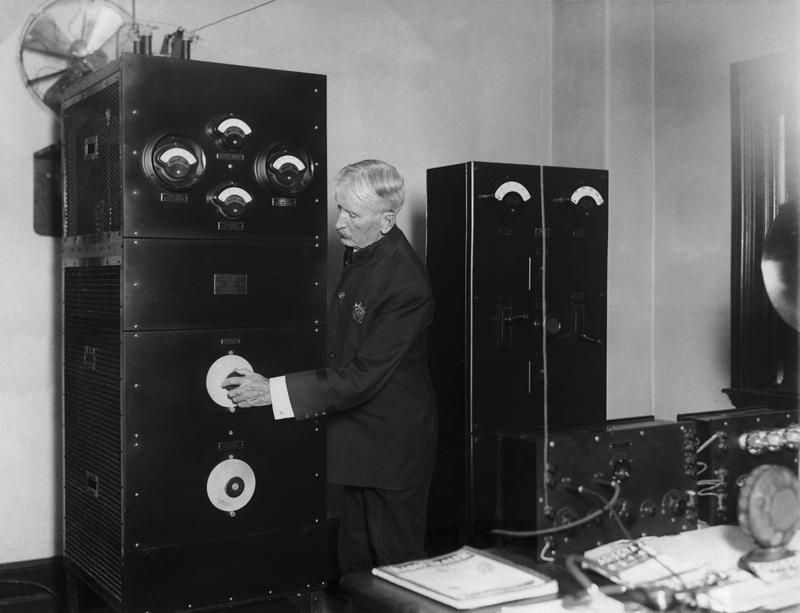
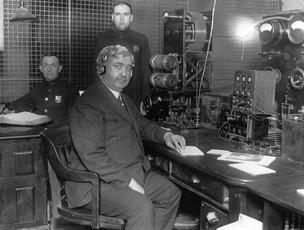
In June 1925 The Christian Science Monitor reported on a soon-to-debut special police frequency using WNYC "to light a signal light at any police station or booth in the city,...all of them simultaneously or...in any number of selected precincts at once." The paper explained, "the signaling is accomplished by sending dot and dash combinations of musical tone over the wavelength...The radio police alarm system is believed to mark an advance in rapid communication for the prevention of crime and the arrest of criminals..." [5] The Bell Labs-developed system (pictured above in part) became a model for other departments. It was described in great detail in Scientific American and the October 1926 Bell technical journal, which noted the NYPD planned to "equip the precinct houses and police booths located in various parts of the city with receiving sets with which they could listen in on communications from the headquarters station WNYC."[6]
In outlining its operation, however, Scientific American noted that the signaling mechanism would be apparent to listeners, suggesting that this probably not such a great idea from a programming perspective.
"The group of dots and dashes, with definite pauses between, is then automatically sent into the ether by WNYC, directly coupled with the lever device. The operation of calling each station resembles that used by a train dispatcher when he calls the various tower men along his line. The levers are arranged in a small box on the send operator's desk and, when a call is to be made, they are set to the number of the station wanted. As soon as these levers are in the proper position a corresponding number of pulses of 3,000-cycle alternating current are sent into the broadcast transmitter. This modulates the radio carrier current, like other frequencies in the audible range, and any listener turned-in on WNYC's wave hears at intervals a series of high-pitched tones, which mean that the police alarm is on the air."[7]

NYPD Commissioner Richard Enright presented the innovative new police radio system to the International Police Conference held in New York May 12-16, 1925. Although, at the outset, you can see that the $50,000 communications and signaling system would run into some conflicts with Enright noting at the conference:
The city has a very powerful radio plant. It will be used by the Police Department to a very large extent, and when the Police Department needs it, all other departments are excluded. We have the right of way of the time, no matter what else is taking place on the Municipal Radio, and our Municipal Radio is perhaps the most powerful station in America...
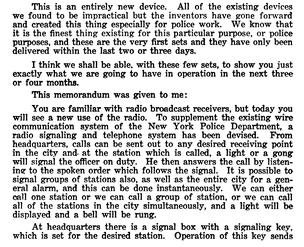
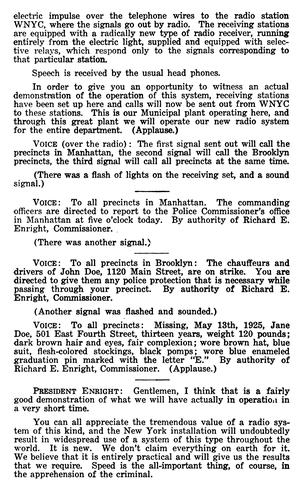
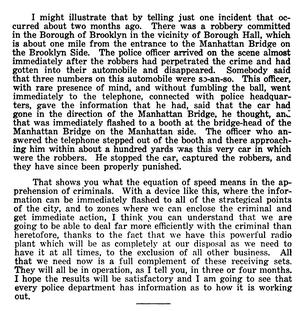
Enright went on to describe the Police/WNYC interconnectivity in the conference transcript:
Cooperation between WNYC and the NYPD extended to various public relations and community-oriented programs as well. These included Pals of the P.A.L. a youth variety show and a singing safety policeman on The Police Safety Program, a show for younger children. The police and WNYC also worked closely on most issues around civil defense and on Election Day with the communications involved with the release of polling returns through the police department's facilities.
_________________________________________
[1] Jaker, Bill, Frank Sulek and Peter Kanze, The Airwaves of New York, "WLAW," McFarland & Company, 1998, pg. 109.
[2] Young, James C., "Radio-Voice of the City," Radio Broadcast, Vol. 6, No. 3., January 1925, p.446. Editor's Note: WNYC was among the earliest, but not the first. Our research indicates Municipal station WRR in Dallas, Texas was the first licensed radio station to be used by the police to capture suspected outlaws.
[3] Ibid.
[4] "N.Y.P.D. Blue" is about to face some new competition -- from the N.Y.P.D. itself," The New York Times, December 21, 1994.
[5] "Radio Police Signal Perfected, Christian Science Monitor, June 5, 1925, p.12.
[6] Anderson, S.E., "Radio Signaling System for the New York Police Department," The Bell System Technical Journal, October 1926, pg. 529.
[7] Dunlap Jr. Orrin E., "An Invisible Police Alarm," Scientific American, November 1925, pgs. 308-309.

WNYC is funded by sponsors and member donations