Why New York Pols Are Key to Puerto Rico's Recovery
New York City politicians have long been champions of Puerto Rico, which is sometimes referred to as the sixth borough. That role has become more pronounced as the island struggles to recover from Hurricane Maria.
Almost two months after the storm hit Puerto Rico, the island’s residents are still reeling, most without power and many without access to potable water. While many Democrats have been fiercely critical of the federal government’s response, New York City politicians have been some of the most vocal.
That role dates back to the 1930s, starting with Vito Marcantonio, an Italian-American who represented East Harlem in Congress for seven terms. Part of his advocacy on behalf of Puerto Ricans was simply a matter of representing his constituents. When he was first elected in 1934 most of the voters in his district were Italians and Jews, but residents from the island started settling in the neighborhood above 96th street — which was dubbed “el Barrio” — soon afterwards.
“He did what he could to help them with their housing problems, language problems, problems in the schools,” says Jose Sanchez, chair of the Urban Studies Department at Long Island University.
Marcantonio was a self-proclaimed socialist and he became a supporter of Puerto Rican independence. As activists pushing for the island to separate from the United States were jailed in the 1940's, he became the de facto voice for the movement. “He had a platform,” Sanchez says. “He had the ability to make speeches, even have declarations passed into law.”
That dynamic — where U.S. representatives serve as a political force on behalf on the island — persists today. As more Puerto Ricans moved to New York, most coming from the 1950's through the 70's, politicians couldn’t afford to ignore their concerns. Puerto Ricans are U.S. citizens; once they are on the mainland, they can vote.
Herman Badillo first came to political prominence when he helped organize the Latino vote on behalf of then-Senator John F. Kennedy’s presidential campaign in 1960. Ten years later, Badillo became the first Puerto Rican to serve in the U.S. House, representing the South Bronx. Today, two members of the New York City congressional delegation are of Puerto Rican descent: Jose Serrano and Nydia Velazquez.
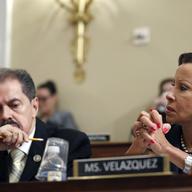
After Hurricane Maria struck Puerto Rico, Rep. Velazquez laid into Secretary of Housing and Urban Development Secretary Ben Carson during a congressional hearing. She was particularly critical of President Trump’s tweets suggesting the feds might not provide aid over the long term.
“Those tweets are unpresidential,” she told Carson. “The most basic responsibility of the president of the U.S.A., the president of the most powerful country in the world, is to show up and provide the assistance and relief that American citizens need. They don’t need this kind of insult.”
The advocacy of representatives like Nydia Velazquez fills a void that originates with Puerto Rico’s unusual political status. Residents of Puerto Rico are U.S. citizens and can vote in presidential primaries, but not in presidential elections. And the island’s representative to congress cannot vote on legislation. New York politicians with sizable Puerto Rican populations in their districts often see themselves not just as advocates for their constituents, but for Puerto Ricans living on the island as well.
Demographics could shift the power center away from New York. The Puerto Rican community in Florida is growing faster than in New York City. Last year, Florida elected its first congressman of Puerto Rican descent, Democrat Darren Soto.
New York City Council Speaker Melissa Mark Viverito grew up in Puerto Rico. She thinks the fact that tens of thousands of Puerto Ricans relocated to Florida in the aftermath of the hurricane could have a transformative effect in U.S. politics. “You’ve seen well over a million Puerto Ricans in that state,” she said. “In the next cycle, they are going to be the deciding vote.”
For now, though, with the very real and immediate challenges facing Puerto Rico, it has fallen largely to New York representatives to agitate on its behalf, just as they have done for the last 80 years.

WNYC is funded by sponsors and member donations