Where Have All The Protest Songs Gone?
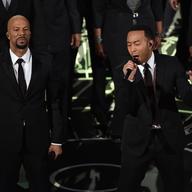
When John Legend and Common performed their Oscar-winning song “Glory” on Sunday night’s Academy Award telecast, it wasn’t just a genuinely stirring moment in an otherwise tedious evening: it was a reminder that the protest song still lives.
Yes, it’s different from the 1960s, when protest songs were everywhere and popular musicians were at the forefront of the movement for social change. Our media landscape is utterly changed -- fragmented, digitized, balkanized. When Peter Paul & Mary recorded “Where Have All The Flowers Gone?” in 1962, it was heard on radio stations across the country. When Common rapped the line “That's why we walk through Ferguson with our hands up” on national TV, it was the first time a lot of viewers were hearing it. In fact, I know several people who were wondering whether Common inserted that line just for this performance. The answer is no: that line, referring to the shooting death of Michael Brown by police in Ferguson, Missouri, is in the original. But even this song, featuring two name-brand stars and attached to the high-profile movie, Selma, flew under many people’s radar.
This is on my mind now because today, I got my first chance to hear the forthcoming Marcus Miller album. The jazz bassist has long moved easily in R&B and hip-hop circles, and his Afrodeezia (out March 17) ends with a collaboration with Chuck D, the Public Enemy frontman and a rapper for whom the protest song has never been an endangered species. The song, called “I Can’t Breathe,” is a response to the death of Eric Garner at the hands of police in Staten Island. It’s got a funky bass line, of course, and a deep groove complete with Moroccan metal castanets; but even with Chuck D aboard, and the producer Mocean Worker, it is not likely to be a big radio hit. So how will it gets its message out?
It’s tempting to say that this is the big difference between now and the 1960s: for the most part, if you want protest songs now, you have to go looking for them, when in the '60s, they would come to you. But remember, even at the height of the protest movement, you had to dig deeper to hear something like Bob Dylan’s acidic “Masters Of War” or Nina Simone’s outraged “Mississippi Goddam” – two songs whose legend grew through word of mouth rather than mainstream media attention. And digging deeper is much easier now – Google and YouTube have seen to that.
YouTube is where the rapper J. Cole released "Be Free," his heartfelt response to the Michael Brown shooting last summer. The song is sung, rather than rapped, and its plaintive melody is accompanied only by keyboards. Tellingly, the original version he posted does not come close to the number of views he got for the live version he did (with rapping) on the Late Show With David Letterman. And even more tellingly, neither version comes close to the tens of millions of views for his various commercial tracks.
You’ll also find L.A. rapper The Game’s collaboration with… um, everyone it seems. “Don’t Shoot” features a who’s who of hip-hop glitterati, including Diddy, Rick Ross, 2 Chainz, and Wale. It too is a response to the Michael Brown shooting.
Sometimes protest singers turn out to have been hiding in plain sight: Bruce Springsteen is a notable example. He will occasionally remind us of this, dedicating a live performance of his song “American Skin (41 Shots)” to Trayvon Martin, the Florida teen shot to death in 2012; but he’s often content to let a song like “Born In The USA” burrow its way into the culture, its path greased by an easily misinterpreted title.
And then there are angry young men who somehow manage to become slightly older angry men. Here I’m thinking of Tom Morello, the guitarist from Rage Against The Machine and a solo artist in the Woody Guthrie mold. Morello is not pop radio fodder – you have to know to look for his music. But it’s worth it. “Marching On Ferguson” is his reply to the death of Michael Brown, and it is as different from the grace and quiet determination of “Glory” as it can be. With its ominous marching tread and distorted electric guitar, and its passing reference to “a blowtorch and gas mask,” this is protest music with a hint of violence.
Dr. King might not have approved; but Morello’s song is a reminder that anger is an essential fuel of protest.