How Geopolitics Shaped WNYC’s Iconic Station Identification
Every radio station has a government-mandated station identification - a host is required to announce a station's call letters every hour, on the hour. Here's a look back at some of WNYC's station IDs from the past 90 years.
This station ID is from November 25, 1936.
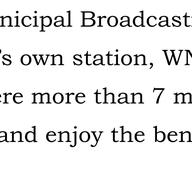
Change came in 1938. With the storm of World War II less than a year-and-a-half away, the fascist governments of Italy and Germany were bombarding resource-rich South American countries with shortwave radio broadcasts with the hope of gaining new allies. Mayor La Guardia and then Station Director Morris Novik decided to counter this propaganda. On May 27, 1938, WNYC initiated a series of half-hour programs extending 'goodwill greetings' to South America through General Electric's shortwave station (W3XAF)[1] in Schenectady, New York. Each program ended with this statement[2]:
"This program comes from WNYC, New York City's own station, where seven-and-a-half million people, who have come from all parts of the world, are now living in peace and enjoying the benefits of democracy."
On January 22, 1940, it was modified and the City Hall chimes were incorporated as part of WNYC's regular station identification. Motion Picture Daily reported, "Not to be outdone by the British Broadcasting Corp., which regularly broadcasts the chimes of 'Big Ben' as a symbol of unity, WNYC will broadcast the chimes of the City Hall clock at noon each day, starting this noon."[3]
This is from the 12-noon broadcast of January 15, 1941.
This was heard on February 22, 1941:
Following the Japanese attack on Pearl Harbor in December 1941, the phrase "in peace" was dropped. [4] It remained absent until the end of World War II. Here is what listeners heard on August 15. 1943:
Sometime after the war, the station ID was reworked to include the chimes hourly from the clock at New York City Hall[5]. It sounded like this through much of the 1950s:
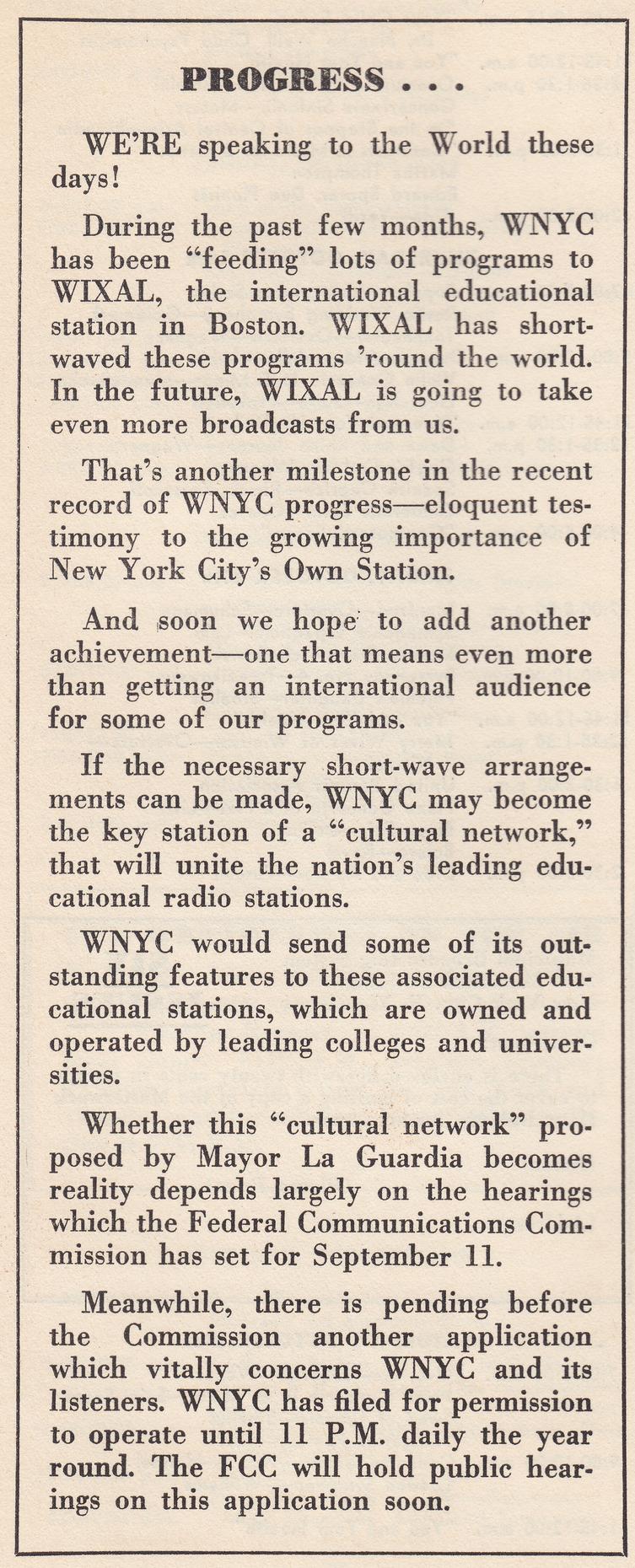
It is interesting to note that WNYC continued its international outreach in 1939 by regularly feeding programs to W1XAL, (becoming WRUL), the international educational station in Boston. At that time The Masterwork Bulletin announced, "If the necessary short-wave arrangements can be made, WNYC may become the key station of a 'cultural network,' that will unite the national leading educational radio stations."[6]
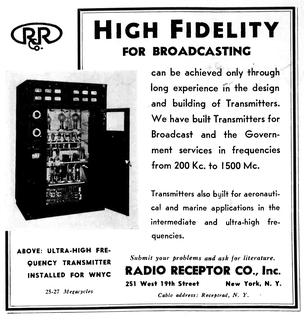
As a consequence of WNYC's effort to respond to fascist broadcasts, Station Director Morris Novik decided to set up its own shortwave station W2XVP, operating with 1,000 watts of power at a frequency of 26.1 megacycles. The original idea was to broadcast programs in Spanish or Portuguese to South America.[7] Broadcasting magazine announced the "high fidelity" transmitter's testing by Chief Engineer Isaac Brimberg in their March 1, 1940 edition saying, the unit was built by New York's Radio Receptor Company.[8] But it appears that by January 1941 the notion of WNYC successfully countering the shortwave punch of the Axis powers was a bit over-extended. The facility instead went on the air for a couple of hours a day following WNYC-AM's regular sign-off at sundown, repeating the classical music program The Masterwork Hour, along with other selected music, news, and commentary.[9] WNYC, however, continued to have a relationship with the Boston shortwave outlet. Radio Daily reported that on October 15, 1942, WRUL launched Opposite Numbers, a series of goodwill broadcasts with American cities saluting sister cities in Britain. The opening program was a WNYC production with Mayor La Guardia praising the Lord Mayor of London and a dramatic sketch about New York at war. [10]
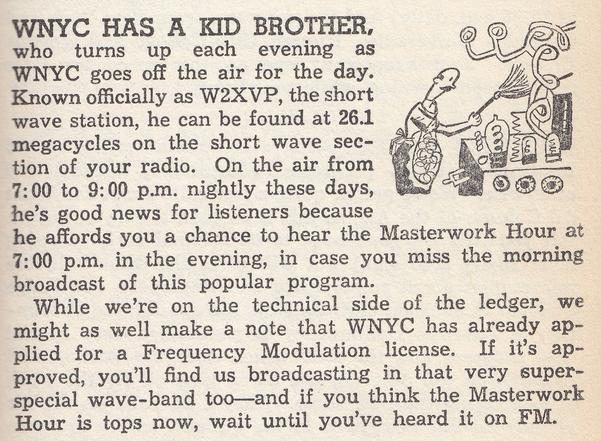
These shortwave broadcasts continued for about a year before the transmitter was dismantled and efforts to get a frequency modulation facility up and running were well underway. WNYC-FM went into regular service in March 1943 as W39NY.
___________________________________________________
[1] According to the September/October, 1939 WNYC Masterwork Bulletin, WNYC was also sending programs to the international shortwave station WIXAL in Boston, (later WRUL).
[2] The New York Journal American, May 26, 1938.
[3] "Radio Brevities," Motion Picture Daily, January 22, 1940 pg. 9.
[4] Associated Press report, December 13, 1941.
[5] The February 1, 1940 edition of Broadcasting noted that WNYC had begun using the City Hall chimes for its "noonday time signal."
[6] The Masterwork Bulletin, September/October 1939, pg. 19. It should be noted that this notion of WNYC becoming the lead station of a non-commercial network of cultural stations had been articulated two years earlier by Mayor La Guardia at the launching of WNYC's new WPA-built transmitter facility in Greenpoint, Brooklyn. The plan was based on the distribution of content via shortwave rather than expensive landlines. In September 1939 La Guardia's call for program distribution via shortwave was endorsed by the National Association of Educational Broadcasters (NAEB) and the Mayor personally appealed to the FCC at a Washington, D.C. hearing on October 23, 1939, but was ultimately turned down by the commission.
[7] A History of WNYC, unpublished drafts of 1940 WPA manuscript, New York City Municipal Archives microfilm.
[8] Broadcasting, March 1, 1940, pg. 63. Note: The news brief incorrectly indicates the station call letters as W2RVP.
[9] "WNYC on Shortwave," The New York Sun, January 4, 1941. p. 20.
[10] "New Overseas Series Inaugurated Over WRUL," Radio Daily, October 15, 1942, pgs. 1 and 6.

WNYC is funded by sponsors and member donations