Volunteers Step Up For Immigrant 'Friends' in Need
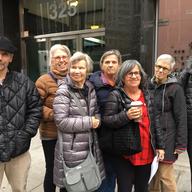
At 8:30 on a weekday morning in December, about 40 people bundled in coats were waiting in the back of a coffee shop in Lower Manhattan. Each was reporting to a group leader so they could accompany a total of eight immigrants to the Federal Building.
"OK, tell me your name?" Marisa Lohse asked a tall, slender woman with wavy gray hair and rectangular glasses.
Jean Hale was volunteering for the first time with the New Sanctuary Coalition, a network of congregations and individuals who accompany immigrants they call friends. The 73 year-old retired English as a Second Language teacher said she didn't know what to expect.
"I think it may be just emotional support and perhaps a big hug," Hale said. "I don’t know yet."
New Sanctuary Coalition has been around for a decade, and started its accompaniment program in 2010. The group organizes volunteers to join immigrants who have been identified by Immigration and Customs Enforcement (ICE) for possible deportation and must go to the Federal Building to attend immigration court hearings or check-in with officials.
"It’s a big thing to give support to our friends because they’re very lonely," said Lohse. The 66 year-old Argentinian native and former chemist said she started volunteering with New Sanctuary Coalition four years ago after she retired. Last year, she said there were about 100 volunteers. But this year, after President Trump took office and implemented tougher immigration policies, Lohse said hundreds of new volunteers joined the cause.
"I cry when I think about it," she said, explaining that check-ins with ICE that were once routine have now become frightening events. An immigrant can suddenly be detained without warning.
"I’ve seen horrible things happening," she explained. "People just disappear through the door. I’ve been one time when I was with a wife of a guy that then the ICE agent came out with a pair of glasses and a wallet. 'Your husband wants you to have this...' They didn’t give her a chance to say goodbye."
Not for the Faint of Heart
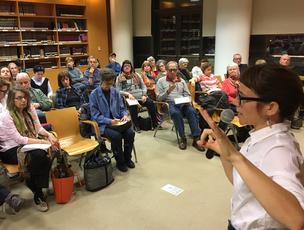
This type of volunteering isn't for everyone. Two nights before the meeting in the coffee shop, Hale attended a training session at the Jewish Community Center on the Upper West Side for those interested in accompanying immigrants.
The crowd was largely white, retired and politically active. Several said they wanted to get involved because they were concerned about Trump's immigration policies.
"I’m just horrified at much of what is going on," said Hale, who was once a Peace Corps volunteer and speaks Spanish and French.
"I feel very strongly about this," said Fred Reichman, 74, a psychologist. "As a Jew in the history of what happened in the Holocaust, there were too many people who just turned their back on what was happening."
Sara Gozalo, supervising coordinator for New Sanctuary Coalition, explained the basics of immigration law and how people can get deported. The Obama administration used to focus on those convicted of crimes, but the Trump administration also prioritizes immigrants merely charged with crimes. As a result, there's been a 40 percent increase in the number of immigrants arrested this year.
When accompanying immigrants to the Federal Building, Gozalo told the volunteers to always respect immigration agents and security guards. Then, she warned that some of the immigrants, or friends, they accompany may have criminal records. But she said that's not relevant.
"We don’t care because we recognize the criminal system is unjust and racist," she said. "We won’t be asking our friends why did you go to jail. We don’t care. It doesn’t matter."
That bothered one attendee, Ed Stubin.
"I can accept that the criminal justice system isn’t always right," he said. "But I’m troubled having to go with some people that I don’t think should be on this Earth much less in this country."
Gozalo told him those types of criminals almost never get released from jail, and Stubin agreed to volunteer. Later, he said it was more important to focus on "the greater good" of helping immigrants.
Gozalo said questions like his rarely come up. Instead, what she does see more frequently are volunteers who want to advocate when they're joining an immigrant — even though they’re told not to intervene or talk to anyone.
"The most challenging thing is for volunteers to simply be quiet," she said, acknowledging that New Yorkers can be pushy and are used to speaking out about perceived injustices. "You’re asking them to take a step back and to be quiet. And they don’t truly believe the power that they have just by being there."
There’s no way to tell if the presence of volunteers prevents an immigrant from getting deported. Some people believe it sends a message to immigration authorities. But in plenty of cases, immigrants do get detained.
A 56-year-old man named Conrado, who didn't want to reveal his full name, came to the training session to let the volunteers know why he thinks their work is important. He said the government is seeking to deport him and volunteers from the New Sanctuary Coalition have made him feel less alone when he goes to the Federal Building.
"There’s times when I go there I feel scared, I feel vulnerable. But once I’m with them it relieves the pain," he said. "I never knew that there was actually people out here who cared about other people who were in the situation that I’m going through."
A Long Wait for a Short Court Appearance
Two days after the training, volunteers in the coffee shop met Ines, a young immigrant with a three-year-old son. She had a court hearing in the Federal Building over her asylum case. In Spanish, she said she felt excellent to see so many volunteers. Marisa Lohse led a group of six people with Ines that included Jean Hale, the former ESL teacher.
They went through metal detectors and gathered on the 12th floor of the Federal Building, which has 32 immigration court rooms. The group spent four hours in a crowded waiting room. Ines didn't have a lawyer so she was among the last cases to be called that morning.
No volunteers asked about her life story, or even where she was from. Instead, they respected the boundaries and spent most of their time playing with her son and teaching him how to draw on their iPhones. Hale read to him from a book about Native Americans.
When the case was called, Ines told the judge through a Spanish interpreter that she had trouble finding a lawyer. The judge gave her three more months and warned, "I can’t keep putting this case off indefinitely." Ines replied, "perfecto" and agreed to continue looking for representation. The government's lawyer from the Department of Homeland Security didn't object. It was all over in five minutes.
As the volunteers waved goodbye to Ines and her son, Hale reflected on this very personal type of assistance. She worried about whether the young woman would find a lawyer soon. But even though the government maintains that many immigrants have broken the law, or may not deserve to stay if they can't prove their asylum claims, Hale said she was committed to accompanying more of them as they make their case. She said it was a small gesture until a bigger fix can be made.
"I would like to see our laws changed so that people could remain who have come to our country," she said, "a legal way for them to stay."

WNYC is funded by sponsors and member donations