An Unexplained Death and an Unacceptable System
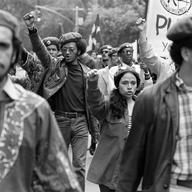
"Power to the People!" Young Lords Puerto Rican activist Julio Roldan chanted from his holding cell in Manhattan's infamous "Tombs" prison in 1970. A few hours later he was found dead, having hanged himself according to an official investigation, murdered by guards according to his supporters. In this press conference, civil rights attorney William vanden Heuvel answers questions and summarizes the findings of a committee appointed by Mayor Lindsay in the aftermath of Roldan's death and the subsequent riot that eventually resulted in the closing of the facility. Calling the events "sad and tragic," vanden Heuvel nevertheless maintains that evidence indicated Roldan did, in fact, commit suicide. He saves his wrath for the criminal justice system itself, which suffers from overcrowding and under-funding. The Manhattan House of Detention, as it is officially called, is operating at 151% capacity. Prisoners are doubled and tripled up. At Roldan's arraignment, during which he yelled, "This is not justice! I have not seen my lawyer! You are doing this to me because I am a Puerto Rican!", the judge, working straight through the day with no break, had less than two minutes to hear each case. The courtroom itself resembled "a crowded subway."
Vanden Heuvel's chief recommendation is the construction of a minimum security prison in Manhattan to both alleviate overcrowding and provide medical and psychiatric services for inmates who are either drug addicts or mentally ill. Indicating that the language of the report has been watered down, he urges that members of the City Planning Commission visit the Tombs or, if he had his way, be locked in a cell for a day. As an immediate fix, he presses for teams of lawyers and social workers to go from floor to floor in the jail, speaking directly to the prisoners, listening to their grievances, trying to give legal or humanitarian aid whenever possible. More Spanish-speaking personnel are also needed, considering the large Puerto Rican jail population. In addition, the prison guards are over-worked. Unless these conditions are addressed, he calls another riot "inevitable."
Vanden Heuvel's dire warnings proved all too true, though not perhaps in a way he could have foreseen. Mayor Lindsay had promised not to punish the leaders of the riot (they were holding five prison guards hostage) but after regaining control he had all the identified "troublemakers" shipped upstate…to the Attica Correctional Facility.
Julio Roldan's case is still a matter of controversy. After a second examination of the body, the pathologist called in by Roldan's family, Dr. David Spain, reversed his initial finding (reported in this press conference) of suicide, citing possible evidence of a beating. A grand jury empaneled to investigate charges of brutality against several guards after four other prisoners died in similar circumstances did not return an indictment. But, as the New York Times reported:
Mr. Vanden Heuvel…said the report of the grand jury was “neither complete nor useful in a public understanding of what happened” in the death of Mr. Moore. He said testimony presented to the jury was in conflict on several major points: on whether there had been “false official reports” and “the use of excessive force, including black jacks on prisoners."
Roldan is still regarded as a martyr by the Puerto Rican nationalist movement. In a 2009 interview on Democracy Now! Juan Gonzalez, at one time the Young Lords Minister of Education, recalls the group taking over the First Spanish Methodist Church:
…when one of our members who had been arrested on a minor charge, Julio Roldan, was found hanged in his cell in the Tombs, and mysteriously hanged, because supposedly he should have had his belt removed before he was put into this particular wing. And this had been after a period when about, I think it was fifteen or sixteen blacks and Latinos had been found hanged in their cells in a variety of jails in New York City. It was a rash that many suspected were actually guards actually hanging black and Latino inmates. So we then did a second takeover or occupation of the People’s Church. This time it was an armed takeover of the church, and it lasted for several days, and demanding justice in the case of Julio Roldan.
The fate of The Tombs itself was sealed by the negative publicity that came out after the riots. The New York City Legal Aid Society filed a suit on behalf of detained inmates. The trial revealed conditions which the judge found to be unconstitutional. The city closed the facility, although it is still argued if the treatment of inmates at their new address, Rikers Island, was any better.
This at times chaotic and refreshingly unscripted press conference, with Vanden Heuvel passionately calling for prison reform, complete with wailing police sirens in the background, provides a fascinating, if melancholy, portrait of New York City during one its most difficult times.
Audio courtesy of the NYC Municipal Archives WNYC Collection.
WNYC archives id: 151473
Municipal archives id: T7687

WNYC is funded by sponsors and member donations


