How a 'Whole Student' Approach Can Lift Graduation Rates
Click on the 'Listen' button above to hear this segment.
In the southeastern region of Washington State, you’ll come across the city of Spokane. It’s where hip-hop artist Macklemore led a parade of dancing people and rode a moose-covered two-wheeler in his music video “Downtown.” Music and mopeds aside, there’s another reason Spokane should catch your eye.
For many it is a tough place to grow up. Just under a fifth of children in Spokane county live below the federal poverty line. In 2006, the high school dropout rate in Spokane County was 25.6 percent. At the time, the whole of the The Evergreen State had a dropout rate of just 5.5 percent. Troubling statistics that inspired the community to take action, and a decade later, those actions have been award winning and more importantly, made a lasting impact in places like Central Valley High School.
Central Valley High School (CVHS) is a part of the Central Valley School District. Destiny DeHamer, 20, graduated from CVHS in 2014. By that time, the county dropout rate decreased drastically to just over 10 percent.
When DeHamer walks the hallways of her old high school, her eyes light up as she describes the feeling of returning to a place she spent four years of her life.
“It feels like I grew up here,” DeHamer says. “I don’t know how to describe that, really, but it definitely feels like a part of me is still here.”
Central Valley School District consists of 26 learning institutions, and McDonald Elementary is one of them. Melissa “Missy” Scott is a counselor there who captures the nature of the school.
“It’s a really caring environment, and I think that there is a focus on the whole child,” Scott says. “We’ve done a lot of research in regard to what things need to be in place to support students and families, so that they can be successful and just learn as much as they can.”
Studies show that increasing student success has positive impacts on both education and overall community health. In 2009, an organization run by local representatives of the county called Priority Spokane took steps to make education the main focus of the community.
Scott says some of those steps include creating a truancy board to help students stay in school, a proactive student intervention team, and other initiatives for students and families.
Data from the Spokane Regional Health District released in 2012 showed a correlation between parental education levels and child poverty levels. The higher the level of education a parent received, the lower the likelihood of their child’s poverty.
This better understanding of the link between education and health was recognized in 2014 by the Robert Wood Johnson Foundation and the correlation between these data points is something that Aaron Dahlgren, a third grade teacher at McDonald Elementary, has thought about a lot too.
“Since we have such a high level of students that come from low socioeconomic status, we’ve had book studies or professional development on working with children that come from backgrounds of poverty,” Dahlgren says.
His whole teaching career has been inside Title 1 schools, like McDonald Elementary, that aim to close gaps between students regardless of their socioeconomic status. Dahlgren says getting to understand who the students are is key in being able to help them.
“At the classroom level it starts with the relationship,” he says. “It starts on the very first day of school … So many teachers here at our school go to baseball games, dance recitals, or whatever the kids have going on outside of school just to build that relationship and find something that we can get in common with them.”
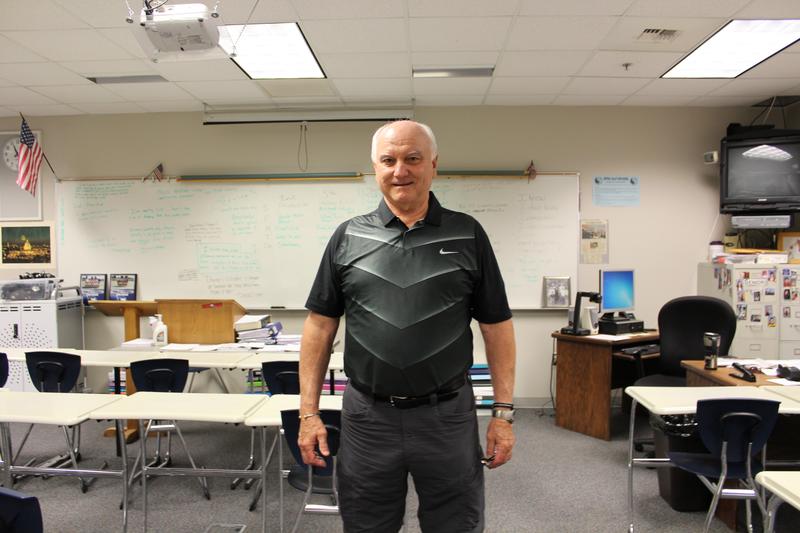
Back at Central Valley High School, Stanley Chalich has made a career of 48 years doing just that. He builds relationships with students through the sports he coaches and in the classroom where his main subject is civics.
DeHamer had him for psychology her sophomore year and civics for senior year. Chalich recalls his former student and describes DeHamer as a “very nice kid” and “a fantastic girl.” Not only does Mr. Chalich know the students, he even remembers things about their families, like how DeHamer’s grandpa was head custodian at the school.
Those details are what’s kept Mr. Chalich passionate about being in the classroom for so many years.
“That’s why I’m in education,” he says. “I say, ‘I love all of ya.’ And what I mean by ‘all of ya’ is I care about ya.”
“I think that the care and the time the teachers put in was most definitely one of the reasons that I excelled here,” DeHamer says. “Because if they didn’t care, then why should I care?”
DeHamer says the whole student approach helped her reach her goals. She’s now starting her third quarter at Spokane Community College for an associate’s degree and plans to transfer to a four-year university.
Want to learn more about Spokane's strategy? Click on the 'Listen' button above to hear Lyndia Wilson, division director at Spokane Regional Health District. She says that "the school system is the perfect setting to have impact and interventions."

WNYC is funded by sponsors and member donations