When Will Lego Art Grow Up?
Ai Weiwei’s newest show, @Large, recently opened inside the former prison on Alcatraz. The exhibition is anchored by Ai's portraits of political prisoners and exiles rendered in colorful Lego bricks. While the sheer number of faces impresses the viewer with a sense of massive injustice, the images themselves have a flat, paint-by-numbers look. Ai has done interesting things with unusual materials, like pottery and bicycles. So why are his Lego portraits so visually unimaginative? And more generally, why aren't artists using Lego in more interesting, provocative ways?

Ai Weiwei is certainly not the first artist to use the ubiquitous toy bricks as a medium. Probably the best known Lego-based artist is Nathan Sawaya, whose gee-whiz work has shown around the world — it even made it into a Lada Gaga video. In a positive yet slightly condescending review of Sawaya's exhibit at the Discovery Museum in Times Square, New York Times critic Edward Rothstein wrote, "One of the things we learn from play is the art of approximation, so why not relish here the approximation of art?" As popular as Sawaya's work is, it's unlikely that any of Sawaya's pieces will end up in the Metropolitan Museum of Art.
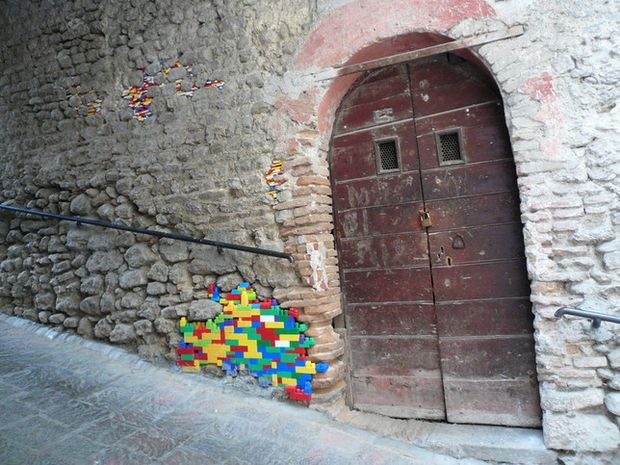
There are a few artists exploring the more conceptual possibilities of Lego as a medium: the German artist Jan Vormann used Lego to fill gaps in crumbling architecture around the world, drawing attention to things like shrapnel holes in Berlin buildings left over from World War II.

And Italian artist Valentino Fialdini makes Lego rooms that he photographs to look as if they're life-sized, some with colorful light effects that evoke Olafur Eliasson or James Turrell. Yet Lego art still has yet to find its Picasso, or even its Duchamp. Is it because Lego fans have been slow to shed their habits of numbered-instruction building?

WNYC is funded by sponsors and member donations