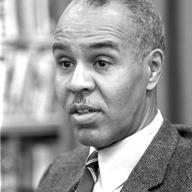
Roy Wilkins
Doug Cooper and George O'Brien were welcomed at the Washington D.C. offices of the long-tenured NAACP Executive Director, Roy Wilkins.
The Interview
Mr. Wilkins spent his entire career in pursuit of racial civil rights. He graduated from the University of Minnesota in 1923, and soon became editor of The Appeal, a Black newspaper. This coalesced his training in journalism with his early, formative years in advancing Black opportunities.
Initially, he dealt with physical threats like lynching. This gave way to policy practices such as the vote. W.E.B. DuBois turned over the NAACP's top spot to Wilkins, who expanded membership from 25,000 in 1955 to 400,000 by his retirement in 1977.
Wilkins played a central role in getting "Brown vs. Board" before the Supreme Court. Wilkins took over editorship of The Crisis, and gradually took the reigns of 100 disparate race-based organizations, and pursued legislation over militancy in the fifties and sixties, seeking to bridge the modes of moderates and activists for racial progress.
President Lyndon Johnson presented him, in 1965, with the Medal of Freedom, this country's highest civilian award. His autobiography was published posthumously in 1982.

WNYC is funded by sponsors and member donations