Review: The Whitney Biennial Cops Out
Let’s start with a few statistics. Of the 75 artists appearing in the Whitney Biennial, which opens today and remains the country’s leading survey of new art, more than half are women. Additionally, more than half belong to racial or ethnic minorities. This represents a welcome assault on the old hierarchies, and a sign of genuine social progress.
On the other hand, despite the divergent backgrounds of its participants, the Biennial feels surprisingly repetitive. Too much of the art looks like too much else in the show. Assemblage, figurative painting, and identity-based color photography dominate. Oddly, the show doesn’t include any abstract paintings, perhaps because an abstract painting is hard to summarize in words, and this is a show that favors sociology over poetry.
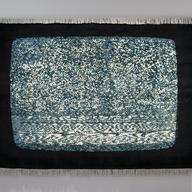
Moreover, the works that shine are not helped by the jargony wall labels. Consider, for instance, Nicholas Galanin’s “White Noise, American Prayer Rug,” a large-scale, black-rimmed tapestry depicting a blank television screen flickering with static. It’s a lovely object, mingling ancient prayers with the pop outlines of a ‘60s-era TV. But the wall label is a problem. The tapestry, it says, is intended as a “critique of white supremacy.” The piece is richly associative, but the curators of the show have stripped it of its visual integrity and reduced it to a tired academic slogan.
Still, there is plenty to admire here by new and newish artists. I love Janiva Ellis’s “Uh Oh, Look Who Got Wet,” a 20-foot-wide horizontal painting glowing with oranges and blues. It shows a rolling river landscape in which a woman, perhaps a slave, appears to be running to freedom. A second woman, lying on the ground with her body sharply angled toward the viewer, is reminiscent of Gauguin’s eroticized Tahitians, except that she is dead. This is a painting in which social critique is matched by first-rate artistry.
Generally speaking, the photography here is more engaging than the painting. Curran Hatleberg’s photographs of small-town America movingly update the social documentary tradition, while Paul Sepuya’s very meta efforts – people take pictures of people taking pictures – inspire deep thoughts. In the sculpture category, Nicole Eisenman, who is better-known for her paintings, contributes an audacious and comic “Procession” of larger-than-life classical figures in states of physical debasement, as if the Parthenon had been hit by a sh-t storm.
Another problem with the show lies in the unresolved administrative brouhaha surrounding the museum. More than 100 of the Whitney’s staff members, and 60 of the Biennial’s participants, have signed a petition requesting the removal of the museum’s vice-chair, Warren B. Kanders. He’s the CEO of Safariland, which might sound like a giraffe-laden theme park but refers to a company that sells weapons, including the tear-gas canisters that were recently used on migrants at the US-Mexican border. The controversy is acknowledged at the Biennial, in an informative video, “Triple Chaser,” by the collective Forensic Architecture. Running about 11 minutes and narrated by David Byrne, the video represents an important effort at institutional frankness, but, unfortunately, the reporting is extra-lame. It doesn’t include an interview with Kanders, and we never learn whether or not he was asked to appear.
The Biennial would have been stronger if the museum had tossed Kanders off its board on opening day. The show tries, to judge from the curators’ statements, to confront the injustices of the past and to imagine a better future. But how can we take that goal seriously when the Whitney refuses to stand up to acts of hypocrisy and ethical malfeasance within its own board room?
Note: An initial version of this story misspelled the name of an artist in the Whitney Biennial. It is Hatleberg, not Hattieberg.

WNYC is funded by sponsors and member donations