Review: Ai Weiwei Is Way, Way Ambitious
Ai Weiwei, the celebrated Chinese artist, likes to think big, and his new public-art project sprawls through all five boroughs of New York. It is comprised of 300 (!) one-of-a-kind sculptures that lavish welcome attention on the global refugee crisis. But good intentions are no guarantee of creative success, and it is not rude to ask: Is his project an artistic triumph?
Yes and no. “Good Fences Makes Good Neighbors,” as it is called, takes its title from a long-ago proverb favored by flinty new England farmers who thought it was wise to keep their cows from straying into neighbors’ yards. Robert Frost gently questioned that bit of wisdom in his now-classic poem, “Mending Wall,” a meditation on American-style loneliness. Now, Ai Weiwei recycles the line with heavy irony and global intimations. Fences and walls, he has said in interviews, separate people unnecessarily and negate the possibility of human connection.
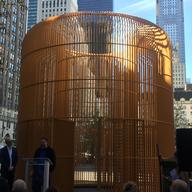
On the plus side, his project is timely and humane. The plight of global refugees is one of the abiding nightmares of the 21st century, and it is admirable that Ai wants to galvanize our social consciences. But his treatment of the theme varies in terms of formal inventiveness. I was disappointed by his “Gilded Cage,” a massive, nearly 25-foot-tall structure shaped like a Victorian bird cage and plunked down on 59th Street, at the crowded entrance to Central Park. The sculpture invites you to wander inside and peer out through orange bars. It is generic as far as three-dimensional structures go; you can have a similar experience looking through the bars of a jungle gym on a city playground. Unfortunately, the life-size turnstiles embedded in the piece, with their evocations of controlled human traffic, are inaccessible to visitors. This is a casualty of New York City fire regulations, and the piece does not get around them or transcend them.
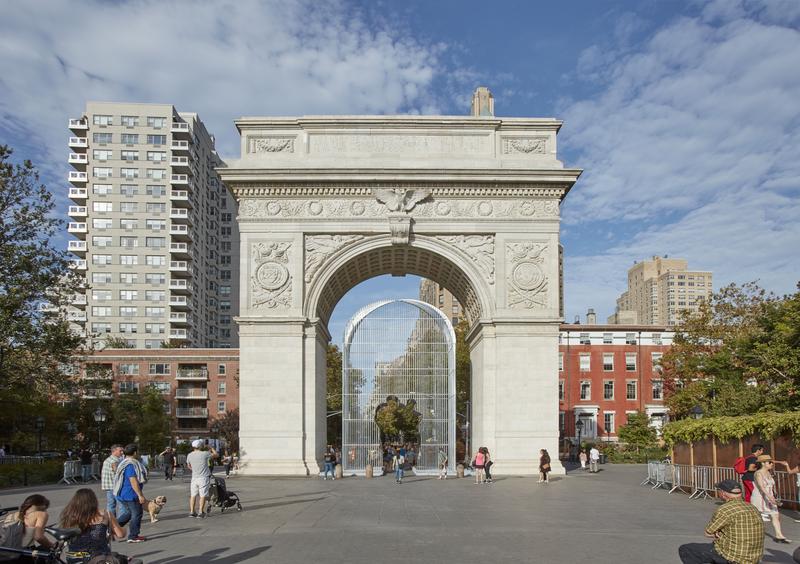
I far preferred Ai’s monumental sculpture at Washington Square Park, another bird-cage structure, this one standing 38 feet tall and enlivened by a cutout of what appears to be a purely abstract biomorphic shape. If you look at it long enough, it hardens into a nifty silhouette of a man and a woman who might be embracing. The shape, it turns out, was appropriated from a door designed in Paris in the 1930s, by Marcel Duchamp, one of Ai’s artist-heroes (and, relevantly, an émigré to New York). The bird cage, the arch, the embracing couple towering over the Washington Square Park – they form a lovely and memorable web of shifting images and views. The piece seems to be saying that those of us who cross borders are not just the poor and the unwashed, but figures of romance and even glamor.
The ways in which emigres can enrich a culture are evoked abundantly in Ai’s clever banners, some 200 of which are now suspended from light posts around New York. Each banner features a photograph of a different refugee, a mix of historical and anonymous figures floating above city streets. It’s a nice idea – commandeering the spaces of advertising for the display of bona fide art – but would have been more effective if the banners had been concentrated near the sculptures instead of being dispersed throughout the boroughs. As it is, “Good Fences Makes Good Neighbors” has no center, and lacks the overwhelming sculptural energy of such public-art predecessors as Christo’s “Gates,” or Richard Serra’s “Tilted Arc.”

WNYC is funded by sponsors and member donations