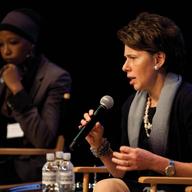
Tisch: Political Battle Over Teacher Evals Spurred Opt Out Movement
With reports that more students than ever are opting out of this week’s annual state tests in math and reading, Regents Chancellor Merryl Tisch acknowledged on Wednesday that the movement “gained momentum” after the legislature approved changing the teacher evaluation system as part of budget negotiations last month.
“The linkage of the budget process, the rhetoric about teachers, has all helped create a firestorm around the state testing system,” she told WNYC in a phone interview.
State officials said they won’t know how many students opted out until after the results from all 700 districts are scored this summer. Based on interviews with principals and superintendents from Buffalo to Long Island, news reports suggested many more kids declined the test.
Gov. Andrew Cuomo renewed the debate over teacher evaluations last year after 95 percent of teachers statewide received high ratings, while just 1 percent received the lowest rating of ineffective. His operations director called this “unacceptable” and asked the state Board of Regents to weigh in.
Tisch responded by suggesting that 40 percent of a teacher’s rating come from student growth on state assessments and “other comparable measures,” instead of 20 percent. She said this would still allow for classroom observations to count for 60 percent, but would do away with extra local assessments. Cuomo took it a step further, suggesting test scores count for 50 percent and minimizing the weight given to observations by a teacher's principal.
Tisch stopped short of criticizing the governor but called the testing debate a sideshow.
“Had we not linked the language of the evaluation to the testing system, had we not had such a heated debate across this state between the teachers union and the executive branch and the legislative branch, which has really kind of turned up — they’ve all turned up the rhetoric with each other — had we not had all of that, we would be talking about instruction, curriculum and professional development,” she said.
It’s not yet clear what will happen if many students opt out of the tests. The U.S. Department of Education requires states receiving federal Title I funds, which are for low-income students, to ensure that most pupils take annual tests. But there's some flexibility. State education department spokesman Jonathan Burman said sanctions are decided on a “case-by-case basis.”
The real impact of opting out, “is that we lose the chance – at both the state and the local level – to learn about the progress of our students and their schools,” he said.
Tisch has been making a similar argument, calling the tests “a tool” for districts to figure out what their students need and to provide better instruction.
Although Burman said he’s confident enough students will take the tests for them to be statistically valid, schools that don’t get enough participation will not be able to evaluate their teachers. Each teacher needs at least 16 students to take one test, or eight students taking both tests.
Meanwhile, it’s up to the Regents and the state education department to now develop guidelines based on the new teacher evaluation law by the end of June, which districts will have to implement by the middle of November, or risk losing state funds.
Tisch said she is confident this can be done.
“We are going to be sorting this out in public space,” she said, adding that “it is not going to be an easy task.”

WNYC is funded by sponsors and member donations