Ready or Not, Listeners Hear John Cage Composition Over WNYC in 1945
In 1945, America was still at war, and WNYC’s annual American Music Festival wasn’t just a celebration of American composers of all stripes; it also took on unavoidable and perhaps inadvertent patriotic overtones as well. This particular moment from that year’s February Festival is notable for several reasons: first, we have the performance of John Cage’s music by the piano duo for whom it was written. Second, we have all the information now that the radio audience had back in 1945, since the announcer’s introductory remarks are included.
For radio and history fans, this second element may be even more remarkable than the music: both before and after the performance, the announcer (anonymous, as was often the case back then) informs us that the music is being recorded by the Office Of War Information, for rebroadcast overseas. I know, I know – what troop of GIs dodging sniper fire on a Pacific Island was waiting breathlessly for the next transmission of avant-garde classical music from New York? But spare a thought for the totally unlikely combination of government war effort and contemporary music that allowed this recording (on a single-sided 33 1/3rpm disc) to come down to us all these years later.
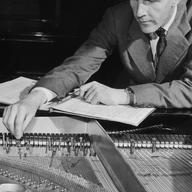
Of course, it’s music fans who will pay the most attention, and there’s plenty to pay attention to: John Cage’s Three Dances for Two Pianos, as the announcer puts it, is in fact a set of three pieces for two amplified prepared pianos. I can only imagine that in 1945, that missing information would have rendered the opening moments of the first dance a complete shock. Imagine a mid-century American family, gathered around the radio, being told that three dances would be played by two pianists, and then hearing the clangorous, metallic pounding of the opening work. In fairness, I suppose that even an attempt to explain what a prepared piano was would probably have left the audience mystified.
In terms of Cage’s works for prepared piano, the Three Dances are not unknown – a famous recording was made by Michael Tilson Thomas and company in the early 1970s on an album that also introduced a young Steve Reich to a wider audience (with his piece Four Organs). But this is one of his most intricate “preparations,” with metal screws and bolts, rubber erasers, and the like being affixed to a large number of strings inside the instrument. The play of “natural” and “prepared” sounds is especially striking in the third of the dances.
And finally, this is one of the earliest performances of the work, which was written specifically for the two pianists, Arthur Gold and Robert Fizdale, who performed it here; they premiered it only three weeks earlier. This must also be the first time the work was ever recorded. And the Gold/Fizdale reading of the piece, which we presumably consider authoritative, is surprisingly rockin’. They take the Three Dances at a brisk clip, and I only wish the recording included the audience’s reaction afterwards (stunned silence? Cheers and jeers? The telltale squish of rotten tomatoes being thrown?) instead of taking us back to the announcer in his studio.
___________________________________________________________
Special thanks to Jonathan Manton, Sound Archives Librarian, Archive of Recorded Sound, Braun Music Center, Stanford University for making this audio available to us.

WNYC is funded by sponsors and member donations