For The Stonewall Park Ranger, The Job Is Personal
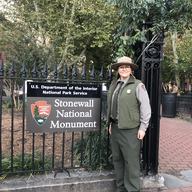
The Stonewall National Monument commemorates the gay bar's protest against a police raid nearly 50 years ago, an uprising widely credited with sparking the modern gay-rights movement. To the park ranger in charge of the site, Jamie Adams, the bar and small triangular park outside it on Christopher Street are “sacred space.”
Adams said she gets a lot of perplexed looks from people who she suspects wonder why “someone who looks like Smokey the Bear standing in such a tiny New York City pocket park.” Her job doesn't involve the typical ranger tasks of preventing forest fires and retrieving lost hikers. Adams said she doesn't protect the land so much as she protects the stories of LGBTQ people.
Much of her time is spent informing visitors of the Stonewall’s impact, as she did on a recent Tuesday when a group of students involved in their middle schools' Gender Sexuality Alliances visited. They were part of a new program is a partnership between the city's Department of Education and the National Parks Service meant to offer young people a connection to LGBTQ history and culture. The initiative comes at a time when the federal government considers rolling back their rights.
"Gay bars were some of our only safe spaces for generations,” she told the students, reminding them of how far the movement has come. “Now you all get to be a part of our recent progress."
It wasn’t that long ago, Adams said, that LGBTQ people like them were forced to live in the shadows. That was her experience when she served in the U.S. Coast Guard under the “Don’t Ask, Don’t Tell,” a policy enacted in the 1990s that barred LGBTQ military service people from being out. (It was repealed by the Obama administration in 2011.)
“I wasn’t allowed to be open and out as someone who identified as LGBTQ,” Adams said, choosing to stick with a job she loved over going public. “I suffered every day, so worried every day that someone would find out.”
Many of the students visiting the monument won't have to make that choice, having come out to their parents at an early age and living in a more tolerant era and city.
"Things have come crazy far even from a little bit ago,” said a student named Julia. “Two years ago people might not have understood at all what non-binary means or what that even is."
Ilay, a student who identifies as bi-gender, is grateful for broader social awareness, but said there are a lot of day-to-day challenges.
“When people use the wrong [gender] pronouns for me, like, say, today, 10 times at least just in one math class, I don't really feel comfortable correcting them,” Ilay said. Reminding people to use “they” instead of he or she can prompt a lot of awkward interactions or invasive questions.
And there are still social barriers for people like them. Ilay said they just went on a tour of the high school they’ve been hoping to attend for two years, only to find out that it doesn't have a gender neutral bathroom or an all-gender sports team.

WNYC is funded by sponsors and member donations