Columbus Statue to Remain in Place, But 'Context' To Be Added
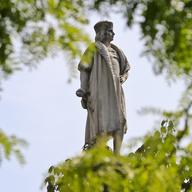
The city will leave the Christopher Columbus statue in its current location in Columbus Circle in Manhattan. Mayor Bill de Blasio made the announcement Thursday, while endorsing recommendations made by a special commission.
The report (embedded below) from the commission also recommended that two other controversial monuments — the Theodore Roosevelt sculpture outside the American Museum of Natural History and a marker for Nazi collaborator Marshal Phillippe Petain in the Canyon of Heroes — remain in place. However, the commission said additional context should be added to all three art works.
Additionally, members of the commission urged the city to install a large-scale monument that recognizes Indigenous people, plus take other steps to help the public understand the nuances of New York's history and address the lack of representation of non-white communities.
The commission said a fourth monument, a statue of gynecologist Dr. J. Marion Sims, should be moved from its location on Firth Avenue along the edge of Central Park to Green-Wood Cemetery in Brooklyn, where he is buried. Sims performed experiments on enslaved women without their informed consent.
The report acknowledged that commission members disagreed strongly among themselves about how to handle these works and could not reach consensus. Instead, decisions were made by majority rule.
De Blasio appointed the commission to study the city's public art after white supremacists rallied in Charlottesville, Va., to protest the imminent removal of a statue of Confederate General Robert E. Lee. But the city owns over 800 pieces of art and the commission, co-chaired by the the city's Cultural Affairs Commissioner Tom Finkelpearl and Ford Foundation President Darren Walker, was only given only 90 days to reach its recommendations.
So instead of making a judgment on each of those 800 works, the bulk of the report was devoted to laying out how the city should evaluate the art it has now and the art it will commission in the future. In general, the report urged the city to aim for inclusion, justice, complexity and historical context — with the understanding that art in public spaces is powerful and affects how people see themselves and the city they live in.
The commission recommended that the city adopt an "additive process" for its art. That is, instead of removing markers, works should be given complexity and historical background through additional artworks and plaques and through educational initiatives.
"For meaningful, positive and long-term change to take place in this complex situation," the report said, "solutions must be multi-pronged and inclusive of many points of view."
In a statement accompanying the release of the report, de Blasio agreed with the recommendations and instructed city agencies to implement them.
"Reckoning with our collective histories is a complicated undertaking with no easy solution," he said, "we’ll be taking a hard look at who has been left out and seeing where we can add new work to ensure our public spaces reflect the diversity and values of our great city."
Click the listen button to hear Jennifer Vanasco explain the nuances of the report to WNYC's Richard Hake.

WNYC is funded by sponsors and member donations