Nibbling Around the Edges of Bail in New York City
On an average night, almost 4,000 people in New York City's jails are there because they can't make bail. The urgency of the situation was brought into high relief in 2015, when a young man named Kalief Browder committed suicide after being held at Rikers for years because he couldn't pay bail before his trial.
In addition to the psychological toll, jailing those people costs upwards of $100 million annually. And that doesn't include the cost for those individuals when they miss work or need to find care for children and other family members. Posting bail is also a logistical nightmare.
To solve these problems, Gov. Andrew Cuomo is proposing to do away with cash bail for many offenses. But Senate Republicans said they don't want to include it in the budget package, due April 1, because it's not a pure fiscal matter. They plan to handle it later in the legislative session. In the meantime, New York City, judges and prosecutors have tried to whittle away at the number of people who go to jail before trial. Each effort has helped to reduce the city's jail populations, but is limited by what state law allows.
Beating the Clock
Whether it’s in the form of cash or a bond, bail must be posted quickly. New York City's busy courthouses don't have space to keep defendants waiting around all day, so Department of Correction buses arrive at court every four hours to bring defendants to jail if they can’t pay bail.
The Bail Expediting Program (BEX) run by New York City can slow down the clock and give defendants a better chance at posting bail right away. Pre-trial associates based in each courthouse call a defendant's family and friends to see if they can come and post bail.
"This is really time sensitive so the sooner we can reach someone the sooner we can take actions to try to help the person," said Ivette Hernandez, a pretrial associate with BEX in the Bronx. Defendants with bail up to $5000 are eligible for the nudging help.
Once a relative is contacted, they used to have only two hours to get to court before the defendant was put on a bus to jail. But they now have up to 12 hours. The city also added almost $500,000 to expand the program.
Several non-profits also will pay bail for low income defendants charged with misdemeanors, including the Liberty Fund, Brooklyn Community Bail Fund and the Bronx Freedom Fund.
Supervised Released
New York city also expanded a program that lets defendants check in with community programs — by phone and in person — before their trials. The city says about 7,000 people who otherwise would have had bail set have been released with supervision in the past two years. And statistics show they do come back to court.
But the program is still pretty small. A WNYC analysis found only 3 percent of those charged with petty theft get supervised release (see chart below), and the program will not take defendants charged with domestic violence. Each case also needs a prosecutor's approval.
Nonetheless, George Grasso, the supervising judge in Bronx Criminal Court, said prosecutors seem willing to try it.
"In the city of New York, there has never been a time where prosecutors have been more open and more flexible to the individual circumstances of defendants," he said.
Grasso also runs a program that steers people charged with opioid possession into a special court with treatment, for which he also credits the flexibility of prosecutors.
Bail for Misdemeanors
Recently, prosecutors in Manhattan and Brooklyn made headlines when they said they’d stop seeking bail for low-level offenses. But criminal justice reformers claim that's nothing new because bail is already rare in those cases. This is borne out in data The Marshall Project obtained from the state’s Office of Court Administration and WNYC analyzed.*
In 2017, bail was set in about 14 percent of all misdemeanor cases that continued after arraignment — meaning the defendants didn't plead and their cases weren't dismissed. But as this chart shows, bail is imposed at very different rates, depending on the type of misdemeanor.
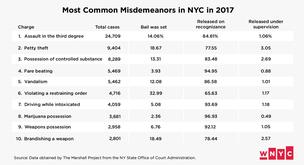
With pot possession, bail is set just a little more than 2 percent of the time citywide; with turnstile jumping it’s around 4 percent. With third degree assault — the most common misdemeanor — bail is set 14 percent of the time. And bail is set a third of the time when someone’s charged with violating a restraining order.
The View from Prosecutors
Brooklyn District Attorney Eric Gonzalez said there’s good reason for requesting bail on more serious charges.
"In Brooklyn, 44 percent of the cases we ask for bail on are domestic violence cases and sex crimes cases," he said. "We had a dozen homicides last year which were domestic violence cases and the majority of those cases had prior misdemeanor arrest involving intra-familial disputes and violence."
That's similar to the the position taken by Queens District Attorney Richard Brown.
"Our policy has always been, and will continue to be, to seek bail in those misdemeanor cases involving defendants with prior histories of failing to appear, lengthy criminal records which indicate a likeliness to flee, or other pending cases," said spokesperson Ikimulisa Livingston.
She noted an internal study last year that found Queens defendants stuck at Rikers because they couldn't pay bail had an average of 11 prior arrests, one felony conviction, six misdemeanor convictions and two prior failures to appear in court.
Judges — who make the final decision on bail — also consider the seriousness of a charge. "What level of consequence an individual may be facing, which is a factor that the law provides," said Grasso, in the Bronx. "You also look at the rap sheet. Is this the first offense?" Judges also see a risk assessment that's been conducted for each defendant by the city's Criminal Justice Agency, to determine whether they have community ties and are likely to come back to court.
Ending Bail
Public defenders say no matter how serious the charge, whether jumping a turnstile or violating a court order, everyone deserves the same presumption of innocence. But they say the data analyzed by WNYC show current bail practices don't allow for that.
"Both prosecutors and the courts are setting bail without regard for the individual financial circumstances or the ability to pay of most of our clients," said Joshua Norkin, who coordinates the Decarceration project for the Legal Aid Society.
New York is one of the few states that set bail according to a defendant's risk of flight instead of danger. Judges are also supposed to consider a defendant's finances when determining how big a payment is needed to ensure they come back to court. They could even set forms of bail that are less onerous to defendants, such as using one's own car as collateral. But in practice, they usually don't. Cash and insurance company bonds remain the preferred forms of bail. It's also commonly known that prosecutors use bail as leverage in plea agreements.
A state judge recently found a local judge in Dutchess county set the bail too high for a defendant charged with shoplifting, without inquiring about his means. New York City Councilman Rory Lancman has been pushing the city to require judges to look at a defendant's finances and the Vera Institute of Justice is now embarking on a pilot project.
With reporting from WNYC’s Fred Mogul. Data analysis from WNYC's Data News Team, including Rhyne Piggott, Jenny Ye and Lylla Younes. Additional data analysis from Anna Flagg of The Marshall Project.
*Methodology: WNYC filtered the data to A, B and Unclassified Misdemeanors. We excluded cases that would not have continued after arraignment, including those that were dismissed or where the defendant pled. WNYC consulted with the state's Office of Court Administration and also with the Mayor’s Office for Criminal Justice, which does its own tracking. The bail data covers 2017.

WNYC is funded by sponsors and member donations