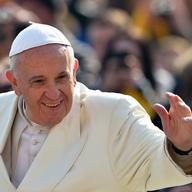
Latinos Drawn to Evangelicalism Seem Immune to 'Francis Effect'
On Tuesday, several thousand people packed Radio City Music Hall to hear Christian bands like Third Day. It was part of NY Cityfest, three days of Christian music and preaching. While Pope Francis is expected to pack Madison Square Garden this fall (capacity around 19,000), another Argentinean, so-called World Evangelist Luis Palau, spoke to a full house at Radio City and was expecting 60,000 to attend his sold-out preaching event in Central Park on Saturday.
At Radio City, the crowd was full of former Catholics, like Priscilla Nieves, 43, who is part of a growing number of Latinos who've converted to Pentecostalism. "At a Catholic church, all you do is just hear hymns, Santa Maria, like a regular boring monotone," she said, explaining why she left the faith. "But with Pentecostal it's on fire, you feel the holy spirit, you sing the songs and you dance and you use instruments to worship god."
Nieves' family is from Ecuador, but she was raised in Dyker Heights, Brooklyn. Would she go see the pope? "Maybe I'll watch on the news," she said.
Miriam Salam, 65, was born and raised Catholic in Colombia. After the Radio City concert she took photos with her girlfriends, uplifted by what she'd heard. She said she converted to Evangelicalism 15 years ago, in part because they encouraged her to read the Bible. "The priest read to us, yes, but we never read," she said."Now we know."
Salam said she's interested in hearing what the pope will say in New York, but she won't be returning to her old faith. "We believe in the same god, but in a different way."
Nearly 40 percent of the 78 million U.S. Catholics are Hispanic, according to a Boston College report. But their numbers are on the decline, with one in four U.S. Hispanics identifying as "former Catholics," according to a Pew survey. While all people identifying with religious affiliations are on the decline, the number of Evangelicals is rising, up to 62 million. That's two million more than in 2007; many of those are Hispanic.
At the Lamb's Church on the Lower East Side, Senior Pastor Gabriel Salguero began leading the Pentecostal church nine years ago when there were 12 members. Now it's grown to several hundred with services in Mandarin, Spanish and English. Many of his members are former Catholics. Salguero is also the president of the National Latino Evangelical Coalition, which includes 3,000 churches. Speaking from his office on the Lower East Side, he thinks the pope's popularity and his push to reinvigorate Catholicism parallels the global growth in Evangelicalism.
"Because of our charismatic worship, our empowerment of indigenous leadership, our ordination of women, which is a difference we have from the Catholic church, I think you'll see simultaneous growth of both Catholicism and Evangelicalism among Latinos in the U.S. and Latin America," he said.
But he insisted he's not trying to start a culture war, and there's no fight for numbers. "This is not the Hundred Years' War, this is not 18th century, this is not the church of England fighting the papacy," Salguero said. "We have solid theological difference and we're willing to talk about those."
He said his church and the Catholic church are in agreement on issues of the environment, poverty, abortion and capital punishment. In fact, Salguero hopes to meet the pope when he visits in September.
Still, many Latin Americans feel disenfranchised by the top down hierarchy of Catholicism. Jean Pierre Ruiz, an Associate Professor of Theology at St. John's University said the church began addressing this very issue in the 1960s.
"The church in Latin America has taken a decisive turn toward the poor, a decisive turn toward the marginalized, a decisive turn toward ordinary people and Pope Francis himself, prior to his election of Bishop of Rome, was part of that trajectory."
Ruiz thinks the Roman Catholic Church needs to not only to be figuring out why it is losing followers, "but in the spirit of ecumenical outreach and openness, recognizing the particular gifts that these other denominations are giving to the wider sense of those who believe in Jesus."
The church has its work cut out. According to the Pew Survey, the fastest growing group isn't the Catholics or Protestants. It's the "nones" — those with no religious affiliation at all.

WNYC is funded by sponsors and member donations