New York City's Failure To Recycle Is Also A Trash Problem
New York City produces massive amounts of trash, which is often exported to other towns and regions. The city has also failed to meet recycling goals in in the last decade. Politico New York City Hall bureau chief Sally Goldenberg spoke to WNYC's Richard Hake about a new series that investigates city trash policy and practices.
WNYC transcripts are created on a rush deadline and the text may be updated or revised in the future. Accuracy and availability may vary. The authoritative record is the audio record.
[RICHARD HAKE, host]: It's Morning Edition on WNYC. I'm Richard Hake.
In 2011, Mayor Bloomberg pledged to address New York's trash problem, and eight years later, Mayor de Blasio said he would take it on. Yet as New York enters a new decade, the amount of refuse the city produces continues to be massive.
Both mayors made addressing the climate crisis a major part of their bids to be the Democratic presidential nominee, yet neither was able to meet the goals of recycling and trash for the city.
Politico New York is launching a series this week on the city's trash and the policy decisions behind it. City Hall bureau chief at POLITICO New York Sally Goldenberg joins us in the studio now.
Sally, good morning.
[SALLY GOLDENBERG, guest]: Good morning. Thank you for having me.
[HAKE]: So first, paint a picture for us. How much trash are we talking about, and what happens to it currently?
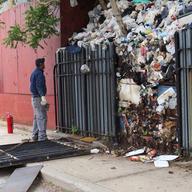
[GOLDENBERG]: So New York City produced last year at least 12 million tons of trash. That's about 3 million and change from schools and homes that are regulated by the city, another 3 million or more from commercial establishments -- you know, restaurants, stores -- and then another six and a half million from construction and demolition sites. You take down a building, you build a building, and all of that waste is very heavy, obviously, so that makes up a big chunk of it.
So it's at least 12 million tons. And because New York City doesn't have a landfill or an incinerator, it all gets shipped out. And some of it goes as far as South Carolina. Some goes to upstate New York to Newark, New Jersey, and oftentimes, not always, but oftentimes poor towns, towns of racial minorities, towns that, you know, don't really have a lot of other economic development going on. And they're sort of stuck with New York City's trash.
[HAKE]: Now in 2015, Mayor de Blasio wrote what he called a "climate change blueprint" where he wanted to reduce waste by 90%. So what is trash have to do with climate change?
[GOLDENBERG]: So trash, when it goes to a landfill, contributes to methane, which is a very toxic greenhouse gas. It's more potent than carbon dioxide in the short term. And when it goes to an incinerator or what is now called a "waste to energy facility," it's I think generally regarded as less harmful -- but it's still emitting toxins into the air, and again into areas that tend to be low income. You know, mercury and lead, and there are other things that people are breathing in if you live next to one of these facilities.
There's also the effect of just long haul trucks driving it all over the place. New York City uses barge and rail to try to mitigate that, but there's still long haul trucks that take our trash everywhere.
[HAKE]: Right, so like you've said, despite de Blasio's pledge to cut down on exporting our trash, we're still doing that. Can you describe what that's like for the communities receiving the refuse?
[GOLDENBERG]: So the one community we featured prominently in today's story, Rensselaer, is 150 miles north of New York City. It's kind of a working class town. They have a construction and demolition dump that the residents there say was sort of sprung on them.
So that trash is driven up by these long haul trucks every day. When we went there, we saw kind of a -- like a cavalcade of trucks driving past small homes into this huge dump, dumping their trash, and just a few hundred yards away is a school. It's the K to 12 complex for the town. And so these little kids or teenagers or whatever have you are breathing it in. I'm told there's dust that coats the teacher's cars every day. It smelled like sulfur, kind of like rotten eggs.
[HAKE]: Let's talk recycling. You write that if everyone in the city recycled all they could, about 60% of trash could be diverted from these landfills. But instead, residential recycling is only at around 18%. So what's holding the number down?
[GOLDENBERG]: The biggest factor is organics recycling. That's food scraps and yard waste, and the city collected in 2017 13,000 tons of it. It accounts for over a million tons... so it's like less than about 1%. And I think the reason for that is partly that it's challenging in a dense city with high rise buildings. And also there's no mandate, you know, you don't have to do it. It's not available in every part of the city. It's certainly available in some neighborhoods, but by and large, that's the main thing, that's 34% of the waste stream that just doesn't get recycled. In terms of metal, glass, plastic, and cardboard the rate is 18%, and it could be as high as 33 or 34%.
[HAKE]: Now, you mentioned that New York is far behind San Francisco in terms of recycling. You mentioned Seattle. Talk about other cities. How does New York compare?
[GOLDENBERG]: Well, those are the two cities we focused on. Los Angeles has a higher rate. Portland, Oregon has a higher rate. There are some cities that don't recycle well, but of the kind of major American cities, I think New York is one of the lower ones.
[HAKE]: All right, Sally Goldenberg is the City Hall bureau chief at Politico New York. Sally, thanks so much.
[GOLDENBERG]: Thank you.