Mr. Hylan in the Air
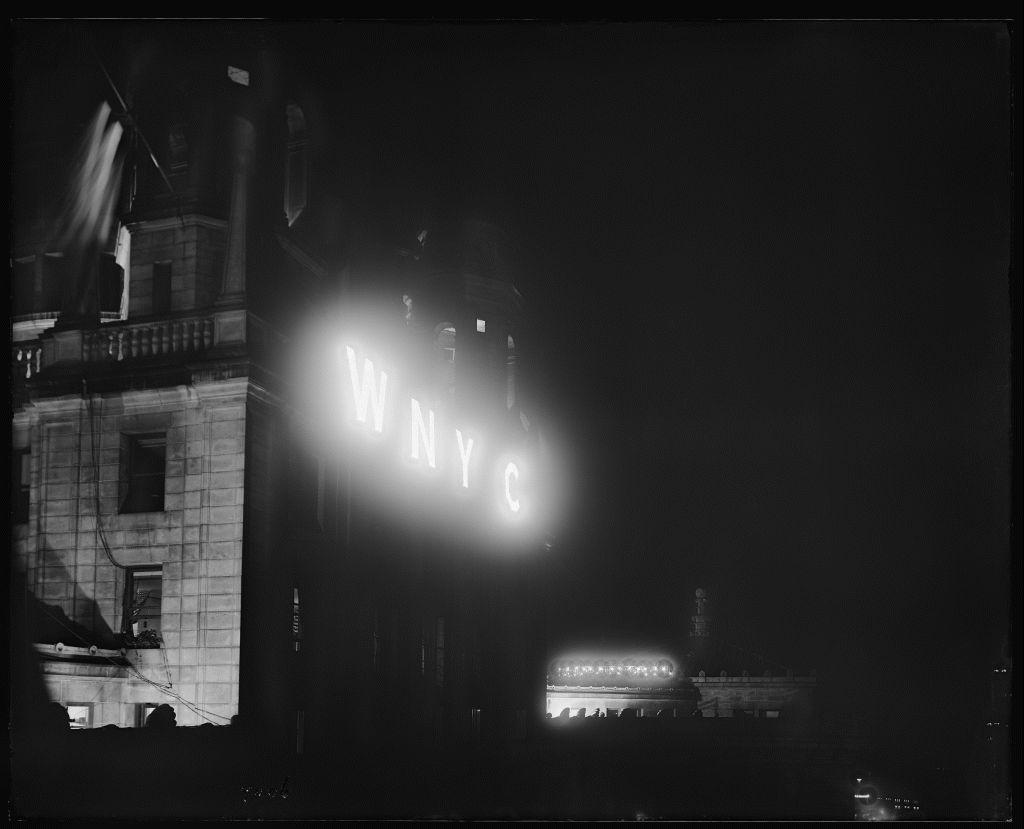
"CITY'S RADIO PLANT OPENED BY MAYOR," the New York Times headline read on July 10, 1924. “HYLAN PARTY IS DRENCHED.” The inauguration of “Station WNYC” by New York Mayor John F. Hylan had indeed taken place during a summer electrical storm, whose approach had been concealed by the dazzling new lights of the Municipal Building tower, where the gala opening was held. Even the Fireman’s Band, the newspaper noted with barely-suppressed amusement, had their pomp and circumstance extinguished by the sudden cloudburst: “the sheets of rain partially filled the large bass horns, which the musical but hurried firefighters accidentally inverted like brimming goblets upon many heads.”
This unintended immersion baptism did not douse the Mayor’s enthusiasm for the city’s new medium, however. In his opening broadcast, Mayor Hylan boasted that New York was now the first American city to offer a municipal radio station,* with “uninterrupted…recreational entertainment for all the people.” In fact, 1924 would be a year of many New York firsts: the first time the Yankees won the World Series (and their first season at the new Yankee Stadium); the first Macy’s Thanksgiving Day Parade; the first automatically controlled traffic lights (which only blazed red or green); the first time the black actor Paul Robeson performed at the Greenwich Village Theatre (in the controversial O’Neill play “All God’s Chillun Got Wings”). As the city was innovating and evolving, however, the nation was constricting. Hylan’s citizenry were fully aware of the local implications of Prohibition, or of the brand-new Johnson-Reed Act —a piece of legislation that used a national-origins quota to limit immigration to the United States and excluded all Asian immigrants, without exception.
Given this context, Mayor Hylan might have been expected to hit lofty themes in his inaugural radio address, perhaps contrasting his cosmopolitan constituency with the retrograde policies and fearfulness of the greater United States. Instead, brand-new WNYC listeners were treated to a monotonous lecture on the “operations of municipal machinery,” and the ways in which radio can furnish “facts —civic, social, commercial and industrial” for “public enlightenment” and general uplift. “We are prepared to tell you over your own radio,” Hylan went on, “just exactly what is being done to make your city a better place to work in and to live in …this will provide a fact basis upon which the people may found constructive criticism. That is what is needed and always welcome.”
These platitudes were a rehash of the remarks Mayor Hylan had delivered at his own inauguration six years earlier, when he was elected as the Tammany Hall candidate and was generally believed to be in thrall to William Randolph Hearst, the powerful publisher and isolationist politician. In an effort to separate himself from his backers, the brand-new Mayor denounced “favoritism” and spurned political “catering to any newspaper.” “Words do not mean anything unless there are facts behind them,” he insisted. “Just criticism will help us, false criticism will not greatly injure us, and the [involvement] of the people has nullified the value of puffing and systematic laudation, even to those who have a craving for it.” Hylan returned to this concept in his WNYC address as well, urging listeners to “send along your suggestions” for how to improve the city. “An enlightened citizen interest, militantly expressed, is now in keeping with the trend of the times.”
As it turns out, the “militant” expression of an enlightened citizenry was not at all what Hylan wanted WNYC to encourage —nor was the Mayor looking for “constructive criticism” from any quarter. For the next year, he used the municipal airwaves not to share municipal information, but as his personal bully pulpit, railing in speech after speech against the State Transit Commission, which managed the privately-operated subway systems in New York City and threatened Hylan’s hopes for a city-run system. Additionally, he censored the broadcast of rebuttals to these radio attacks from the Commission and the heads of the B.M.T and I.R.T., and circulated an anti-Transit Commission broadside entitled “Who’s To Blame?” at taxpayer expense. Nor was the Commissioner of Plant and Structures, whose job it was to oversee WNYC, exempt from participation in his crusade: Hylan enlisted him to read from his hagiographic memoir, Seven Years of Progress, on the air for fifteen minutes each night. By November of that year a New York Times editorial, “Mr. Hylan in the Air,” seemed to point out a new storm brewing around the Mayor with potentially far more destructive power than the one he faced on WNYC’s opening night. His peremptory lockdown of the airwaves, the editorial said, could not conceal a “serious defection going on behind Mr. Hylan’s battle line.” Indeed, by 1925 the fight was in the courts: Citizens Union brought an action against Hylan and his Commissioner, enjoining them from using taxpayer funds for propaganda purposes. It was the first in a series of legal challenges that would end in an injunction, and it also ended Hylan’s hopes for reelection. He was soundly defeated in the Democratic primary that year by a glamorous, Tammany-supported State Senator named Jimmy Walker.
In a rumination on the downfall of Mayor Hylan, one editorial suggested the public might look to the “sinister political figure” who stood behind him –William Randolph Hearst. “Of his devising,” the editors wrote, “is the scheme, if there is one, to use Mayor Hylan in order to disrupt and defeat the Democratic Party in this city.” It is, of course, not hard to draw historical parallels between Hylan’s erratic tenure and the current political situation in the United States: the exploitation of a new and under-regulated media platform, the insistence on loyalty and the silencing of critics —even the presence of a “sinister” influence in the shadows. But it is more interesting to contemplate the persistence of that new media platform, ninety-three years later, long after Mayor Hylan and his broadcast battles have been forgotten. WNYC endured thanks to the New Yorkers who sued for the station’s independence from partisanship and power struggles in its early days. May it continue to operate on a “fact basis” throughout many more mayoralties to come.
________________________
*Editor's Note: Actually, WRR in Dallas, Texas was the first municipal radio station in the United States. We can only guess that Mayor Hylan hadn't really looked into it.

WNYC is funded by sponsors and member donations