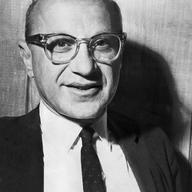
Milton Friedman
Milton Friedman
Milton Friedman, the pre-eminent economist of the second half of the twentieth century, earned a Nobel Prize for his Permanent Income Hypothesis to explain consumer spending. This revolutionary theory of economic science's consumption function, introduced the rational earner's propensity to consume, informed by average long-term income expectations, unaffected by transitory influences—i.e., bonuses, windfalls and tax shifts.
Since I was conducting an MBA thesis and not a 'career review' for radio in this 1981 telephone interview, my focus was particularly narrow, addressing a specific shortcoming of the PIH, which Modigliani later took account of in his life cycle hypothesis: the role of investments in the calculus of spending. As you will hear, Dr. Friedman wanted nothing to do with my assertion that stock market holdings (wealth) impact a propensity to consume.
_______________________________________________________________________________________________________________
The Douglas P. Cooper Distinguished Contemporaries Collection (1967-1974) contains rare interviews with influential writers, statesmen, artists, songwriters, journalists and others who have left their mark on our culture.

WNYC is funded by sponsors and member donations