Overcoming the Limitations of Time
From the January/February 1940 WNYC Masterwork Bulletin:
A MATTER OF RECORD: Mighty useful gadgets are WNYC's four new recording machines. They were used in a variety of interesting ways during the past year, so we decided that the how and the why of recording would be an appropriate subject for this, the third of our Behind the Microphone series dealing with the technical side of things at the Municipal Station.
One of the most valuable uses of the recording units is that they have partially enabled us to overcome the limitations of time -- have made it possible to make available to our listeners important evening programs which we could not broadcast directly because of our fluctuating time allotment.
For instance, we could not pick up the ASCAP Music Festival Concerts from Carnegie Hall last Fall because WNYC was not on the air after 8:30 P. M.[1] What to do? The recorders to the rescue! The concerts were "broadcast" over our regular Carnegie Hall lines to the Municipal Building where they were transcribed on our two standard studio-type recording machines. Each transcription[2] was put on the air on the afternoon following the original performance so that our listeners missed none of these splendid concerts.

Similarly, our two mobile recording units made possible an afternoon broadcast of the official opening of La Guardia Field which took place at midnight. Recording equipment is also used frequently to transcribe major programs "off the air" so that they may reach a larger audience through rebroadcast. There was the time, for example, when the Mayor's office was the scene of a final report on the new Police and Fireman's pension plan. Official reports on the balloting were recorded and rebroadcast at a time when the majority of the policemen and firemen affected could listen in.
We used to think recording an easy job: Just put the recording needle on the disk, turn a few buttons, and let 'er go. After watching one of our expert recording engineers at work, we realized that it's a delicate task, requiring special training and long practice.
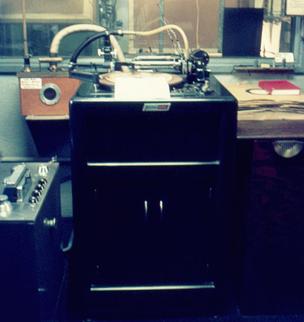
First, the recording man carefully polishes the black acetate recording blank to remove dust, oil from fingerprints, and other surface impurities, which if allowed to remain, would later result in surface noises. Then, a tentative adjustment to the sapphire recording needle is made. Next, the engineer turns on the juice, lets the blank spin around a few turns, and takes a "trial" cut.
As the needle bites into the acetate, a thin spiral of shavings unwinds. The shaving is measured with a micrometer. It must measure one and one-half thousandths of an inch! If not, the depth of the cutting needle and the pressure behind it must be regulated again.
Once the actual recording process has started, the engineer from time to time looks through the microscope, which is part of the standard equipment of each recording machine, and inspects the sound grooves as they are cut, checking to see that the grooves are of the proper depth and smoothness. But that's not all. It's a recording axiom (because of the mathematical laws of speed and diameter, etc.) that the outer portion of the record is always of better quality than the inner section. This means that the engineer must constantly make compensating adjustments of tone and volume controls as the recording proceeds, to make sure the entire surface of the completed transcription will be of uniform quality.
Yes, making a recording is a tough job. But the results are worth it: a record that listeners can't tell from a "live" broadcast.
_________________________________________________
[1] From June 5, 1933, to February 13, 1990, WNYC-AM was required by the Federal Communications Commission to go off the air at sundown to prevent its signal from interfering with WCCO in Minneapolis, a CBS clear-channel station that broadcast on the same frequency. Because of the nature of the ionospheric layers of the night sky, an AM signal’s broadcast range often increases by hundreds of miles after the sun sets, including the thousand miles between New York and Minnesota.
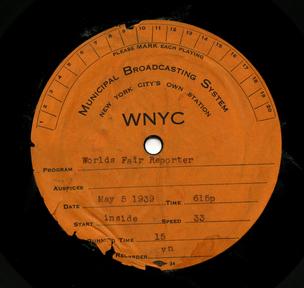
[2] The transcription referred to here is not the printed text of someone's speech, but a transcription sound recording disc, commonly referred to as an 'acetate.' These discs were 16-inches in diameter, aluminum-based (glass-based during WWII), and coated with nitrocellulose acetate. Record grooves were cut into the disc’s coating with a stylus as part of the recording process using the equipment described in the article.