City Offers New Teacher Tool to Improve High School Writing
By high school, students are supposed to go much deeper into their topics. They are asked to write longer essays and analytic reports. Ideally, they should write them well but there is a problem: many teachers don't know how to make their students better writers.
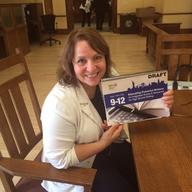
In response, the city's Department of Education has released its first "scope and sequence," or curriculum, for high school teachers focused on good writing. This 179-page draft booklet contains suggestions for lessons and activities teachers can assign each month of the year.
To learn more about this new document, WNYC caught up with Anna Commitante, senior executive director of curriculum, instruction and professional learning at the department. She's a former middle school principal. Below are edited excerpts from our conversation.
What's different about this document?
I think this is very much a writing curriculum. Most of the resources that currently exist in high schools today are reading resources. And while there's some opportunities for writing, it's basically opportunities to write about what they're reading and not with this intent to become better writers. And so this curriculum is very much about making sure we intentionally teach kids to be better writers.
Why high school?
Well, I think the chancellor in terms of her many visits to high schools pointed this out to us as a need, in terms of the kinds of writing and the quality of writing that she was seeing. And so we immediately thought about creating a resource. We're very cognizant of the fact that even though we have had a core curriculum for grades K-8, the opportunities for high schools to engage in that have been slim, and so this year we came out with this document as well as the ELA core curriculum.
Why do high school teachers need help with this? Do they presume students can write by high school or do they not have enough resources?
I think it's a resource issue. I think also - and I love our high school teachers, and I support them and I know they work hard - sometimes it's just not having an awareness that assigning an essay is not the same as teaching kids to write an essay well. And so we really wanted to model the kinds of teaching that should be happening in order for kids to write well.
You've said it's not just for English classes. Where can these suggestions also be used?
Argument, historical investigations, explanations in science, lab reports, you name it. And key parts of the social studies and science curriculum.
But I think when the Common Core came out and there was so much emphasis on English language arts and mathematics. When you look at all the kinds of writing that these students need to be adept at, it fell to the English teacher in many ways, the burden of making sure that students were able to do this. So we're saying here is, that's everyone's responsibility. So that while the English teacher may be introducing argument, the history teacher can be supporting that and teaching argument that's tightly connected to their coursework. And similarly the science teacher.
For example, what does the guide suggests for October?
The ninth graders are doing ancient civilization, we thought that would be a good opportunity for them to be examining some historical speeches.
We laid out the history by grade because we know that this is usually how it's taught. The sciences are laid out by course because it doesn't always happen that they're taking earth science in ninth and that could vary. But we thought the blogging across the year was an important thing to do so we put that in.
So if they're doing chemistry, you're saying they could be blogging about it?
We haven't fleshed out these particular units. Right now these are our suggestions.
So, will they have it later in the year, more suggestions?
That's the plan. This was intended for the E.L.A. teachers so we wanted to show how the work that was happening in the E.L.A. class around writing could be supported in the other content areas. But if we create those resources for history and science, it would just be in a different book for them.
I think high school teachers of the disciplines will be more inclined to teach writing if they understand how closely connected it is to their discipline. For example, the kinds of writing that you do in English class are not the same as the kinds of discipline-specific writing that you engage in when you're doing historical analysis, or when you're doing a lab report or research proposal. They're different. And so I guess the message is to ask those teachers to sort of own their discipline beyond the knowledge base.

WNYC is funded by sponsors and member donations