'Latinísimo' Features Recipes from 21 Latin American Countries
A new cookbook includes recipes from 21 different Latin American countries. Food writer and cookbook author Sandra A. Gutierrez joins us to discuss her new book, Latinísimo: Home Recipes from the Twenty-One Countries of Latin America.
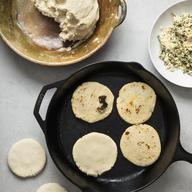
Pupusas de Queso y Loroco
Cheese and Loroco Bud Pupusas
El Salvador | Yield: Serves 4–6 | Difficulty Level: Intermediate | Total Cooking Time: 1 hour
Pupusas are the plump, stuffed, and griddled Salvadorian masa cakes beloved by multitudes
around the world. They can be filled with beans, cheese, pork, or a combination of the three,
called revueltas. But my preferred pupusas are stuffed with a mix of both creamy and melting
cheeses that serve as a canvas to the delicate flavor of loroco buds, from the vine that grows
in the wild throughout Central America. Loroco is easy to come by in Latin American stores,
where you’ll find it either frozen or packed in jars, but if you can’t find it, substitute your favorite
green (such as kale or collards) or chopped asparagus.
3 cups (400 grams) masa harina
3 1⁄4–3 1⁄2 cups (800–840 ml) warm
water (110°–120°F/40°–50°C)
1 1⁄2 cups (115 grams) shredded
queso blanco, Muenster,
or other melting cheese
1⁄2 cup (115 grams) soft goat cheese
1⁄2 cup (60 grams) chopped
loroco buds
1⁄2 cup (120 ml) vegetable oil
1 recipe Curtido de Repollo (page 227)
1 recipe Salsa de Tomate
Preparada (page 161) or
Salsa Santa Rosa (page 163)
In a large bowl, combine the masa harina with 3¼ cups (800 ml) of the water and knead with
your hands until you have a soft dough with the consistency of playdough or mashed potatoes
(add more water, one tablespoon at a time, if needed). Cover with plastic wrap or a kitchen towel
and let the dough rest for 10 minutes. To determine whether it is of the correct consistency,
shape a bit of masa into a ball and press it flat into a disc. If the edges of the masa crack when
shaped, add a bit more water, a few tablespoons at a time; if the dough is too soft, add a bit more
masa harina, a few tablespoons at a time. In the meantime, in a medium bowl, stir together
the cheeses and loroco buds until the mixture comes together into a ball. Line a baking pan
with a damp kitchen towel. Heat a nonstick griddle or skillet over medium-high heat (or heat
an electric griddle to 375°–400°F (190°C–200°C). Moisten your hands with a little bit of the
oil and divide the masa into 12 equal portions of about ⅓ cup (3 ounces/85 grams each); pat
each into a ½ inch (12 mm) thick disk. Keep them covered with a damp towel so they don’t
dry out. Working with one disk at a time, place 2 heaping tablespoons of the cheese filling in
the center; bring the outer edges of the dough up and together over the filling to enclose it.
With oiled hands, roll the pupusa into a ball and then pat it again into a ½ inch thick (12 mm)
disk between the palms of your hands (or press it down with a tortilla press lined with plastic),
making sure that the filling does not escape. Repeat with the remaining dough and filling.
Place the pupusas on the griddle and cook until they are golden, with brown flecks, about 4 to
5 minutes per side. (If the griddle is too hot, the exterior of the pupusas will burn before they’re
cooked through. If you see black rather than brown flecks forming as they cook, reduce the heat
of your griddle.) Transfer the finished pupusas to the prepared baking pan, covering them with
the damp towel (this allows them to steam and become tender). Serve the pupusas topped with
the slaw and a generous spoonful of the tomato sauce or salsa.
Variations
• To make pupusas de queso, replace the loroco buds with more melting cheese.
• To make pupusas de chicharrón, replace the cheese and loroco with 8 ounces (225 grams) of
cooked ground pork (or shredded carnitas).
• To make pupusas revueltas, mix cheese, loroco, and cooked pork in a food processor until it forms
a paste with the texture of thick mashed potatoes (it should hold its shape when pressed together),
then use it to stuff the pupusas