How to Make a "Culturally Responsive" Curriculum
The New York City Department of Education is calling on teachers to make coursework more inclusive. Last weekend, a group of educators met to talk about what that means.
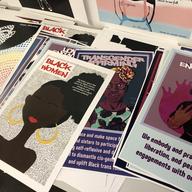
At a "culturally responsive" curriculum fair, teachers traded tips on how to make lessons more reflective of students' backgrounds and identities. They shared worksheets on using touch and sound to reach students with disabilities and how to make undocumented students feel safe. Workshops explored poetry through Hip Hop and indigenous perspectives on Christopher Columbus.
The Movement of Rank & File Educators (MORE), a social justice group within the United Federation of Teachers, organized the event.
"It's meeting your students where they are," said Javan Howard, a teaching artist who showed how he uses album covers from students' favorite artists as prompts for haiku and other poems. And he never finishes his lesson plan until he's met his students.
New data shows nearly 60 percent of city teachers are white; but over 80 percent of their students are not white. But teachers at the fair said being "culturally responsive" is more than adding black and brown authors to book lists. It's about allowing students to draw on their own experiences to generate ideas.
Fernando Alvarez said it's especially important given how few teachers actually live in the same neighborhoods as their students.
"When you're someone that's coming into the community I think it's really important you learn that culture," he said. "When you learn that culture and you see the value in it you start then you say let's work with to teach you and educate you...using the tools that were already in the community before you got there."
Students, parents, educators and activists have called for transforming schools' curricula to increase representation for years. Schools Chancellor Richard Carranza has said repeatedly it's a top priority. Last summer, officials adopted a common definition for Culturally Responsive-Sustaining Education, stating it's inclusive of students' race, ethnicity, gender, sexuality, class, religion, nationality and abilities.
This fall, Carranza announced plans to convene a group of teacher "fellows" who will be tasked with developing a list of best practices. Schools are also encouraged to use materials from the New York Times' 1619 Project to study the legacy of slavery and the "Hidden Voices" curriculum from The Museum of the City of New York, among others.
Natasha Capers with the New York City Coalition for Educational Justice said these are steps in the right direction, but too incremental. "We've identified the problem," she said. "Now is the time to get a new curriculum."

WNYC is funded by sponsors and member donations