Offering Salvation in a Bar: The Iceman Cometh
The Iceman Cometh, Eugene O’Neill’s 1946 play, has the trappings of gritty realism. It is set in a Hell’s Kitchen saloon that is home to down-and-out alcoholics, floozies, and grifters. But the play is a very formally constructed religious allegory.
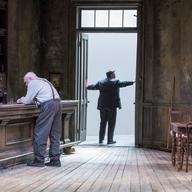
The current production at the Brooklyn Academy of Music's Harvey Theater, from the Goodman Theatre in Chicago, reinforces this. The play opens in Stygian gloom (superbly lit by Natasha Katz); its stupefied characters lie across tables and chairs like corpses. They awake, like spectres from Dante’s Inferno, to tell us their tales of woe.
Enter the Evangelist: a travelling salesman named Hickey played by Nathan Lane. He can usually be counted upon for a good time and a few laughs during his twice-yearly bender. But this is a new, disturbing Hickey. He’s had an epiphany: abandon self-delusion, kill your “pipe dreams,” and achieve happiness, salvation, resurrection. Instead, Hickey almost kills the spirit that keeps everyone alive.
The challenge of this play is to get the balance right between humanity and formality and to avoid turning O’Neill’s vivid losers into types. The Goodman’s strong ensemble cast (most from the show’s original 2012 Chicago production) also include Brian Dennehy as former anarchist Larry Slade, and Canadian actor Stephen Ouimette as the bar’s proprietor Harry Hope.
Lane, best known for his Broadway performances in musicals such as Guys and Dolls, The Producer, and The Addams Family, is unsettling and adept as the death-dealing savior of his erstwhile comrades in squalor; up to a point, Hickey is a song-and-dance man. But he fails to deliver in the transfiguring last act. He makes Hickey’s great confession a tragic set piece, and in performing it that way, Lane loses hold of his Hickey’s fundamental nature: a man who must make you like him, and must sell you something.
As Hickey’s keenest adversary, Dennehy (who played Hickey himself in a 1990 production) is a collapsed giant of a man whose slow conversion from detachment to anguished engagement can be felt in every shift of body and voice.
Still, the production, directed by Robert Falls with rigor and compassion, is a reminder of the power of a play that it took O’Neill his whole lifetime to write. And, as an allegory, a reminder that the last can be first, even in Harry Hope’s “no chance” saloon.

WNYC is funded by sponsors and member donations