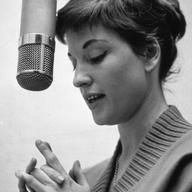
Girl Singer, Part II
Just “a bit of public appreciation” was, then, all that Beverly Kenney might ever have expected. Hers was not a gigantic Judy Garland of a voice; her range did not encompass, like Sarah Vaughan’s, the earth, the moon and the stars; her melodic trail had too many surprising angles for safety. Additionally, she disdained violins in an era when practically any singer would have died for them. And though obviously attractive and intensely feminine, Beverly shied from the camera.
“If she could have sung behind a screen,” Ivan Mogull, Beverly’s “personal management,” said not long ago, “she would have. She hated being photographed. She thought strings were hokey.”
And then quietly, perhaps even a touch conspiratorially—although it could have been the synthetic drama of a show-biz music publisher-personal manager named Mogull—he said: “She was always in some kind of pain.”
The veteran pianist Ellis Larkins, who made two albums with Beverly, spoke on the phone from retirement in Baltimore: “She was very deep. You could sense there was inner trouble. She was a loner, in a way of speaking.”
And hear this, from a young woman Beverly befriended, the actress Millie Perkins, who starred as Anne Frank in the film of the play: “Beverly was in pain all the time. Everyday life was difficult for her. You see, she knew things I didn’t know. She was the only person who knew who I was inside. She was somehow haunted, and at the same time so kind and so unselfish, with so much patience for other people. She had an amazing awareness of what the human condition really was.”
On the other hand, there’s evidence of a droll, gutsy smart ass buried in Beverly Kenney, with different kinds of determination. At the Village Vanguard (where she would headline three years later), in the audience for a Pee Wee Russell Dixieland gig, Beverly sent a note up to the drummer, Johnny Cresci. “Do you know ‘On Top of Old Smoky’?” she’d jotted down on a napkin. And admonishing the famous jockey Eddie Arcaro, who had come to hear her sing in the Black Magic Room in Miami: “Do I talk when you’re riding?”
And here’s Ivan Mogull again, nearing 70, New York City all over him, a sweet guy: “We went to the Copa to hear Nat. Nat ‘King’ Cole. Me and Beverly and William B. Williams and his date, Janet Mason. Then Beverly and I went back to my apartment. We’d never touched each other before. I was just knocked out by her singing. I had moved her off the little jazz label Roost over to Decca. We were strictly business.
“Jesus, I remember that apartment. Twenty-five Central Park West. Apartment 18H. It was a great bachelor pad. It had a dropped living room and parquet floors and a big round red rug in the center of the living room. And all black lacquer furniture.
“We listened to music. I remember exactly what we listened to. The guy was a Chilean singer, Lucho Gatica. He really turned us on. And Sinatra’s ‘Wee Small Hours.’ And Nat’s ‘Love Is the Thing.’ And we listened to Charles Aznavour.
“And we danced, and then Beverly took me by the hand. It was the greatest night of my life. She was just so natural and gifted. It wasn’t vulgar or anything. You know something? One of the things I remember the most is Beverly licking the rim of her glass. She did that all the time, and she did it that night.
“That was our only night.”
Far from apartment 18H and Ivan Mogull, so much farther than the fifty or so city blocks that separated them, lived the poet Milton Klonsky. A man of immense intelligence, an almost-holy figure in the Greenwich Village of the 1950s, revered by an impressively diversified group of men and women, Klonsky threw daring new conversational light on that which was already illuminated.
Seymour Krim, literary gadfly and provocateur, wrote:
To hear him speak of Auden, Yeats, Joyce, Kafka, Beckett, was to hear an equal… and the maturity of his comments swept away the champagne bubbles of romance that I sprayed on literature and revealed the steel soul of the cat I championed in all its mortal gravity.
Anatole Broyard, a book critic and essayist at The New York Times for many years, who considered Klonsky his closest friend, wrote of him: “His originality was such that from time to time I would suddenly perceive him as a stranger.”
In other words, one of those fellows trapped in potential, held captive by his own intellect, a giant mind of singular expression. How was he viewed, then, by Beverly Kenney, who found him, as had many before her, swirling through a Kerouac world, a lofty, lustful, agonized immortal; a failure in Mailer’s time; frequently reclusive in his sixth-floor walk-up at 245 West 4th street. That is where Beverly Kenney went to fall in love. By several accounts, Beverly and Milton were spiritually intertwined. That she held his attention there can be no doubt. That she found in him a crusading esoteric playing to a small house must have ratified both her fading self-esteem and her complicated wisdom. They stuck together for more than the ordinary six months; they held fast, up there behind Klonsky’s window.
One can only guess at the poetry read, the writers spoken of, the music listened to. One can only imagine Milton demanding to hear one of the six albums that Beverly would make, and then, whiskey in hand, holding forth, the singer literally at his feet, galvanized, her tongue caressing the rim of her glass.
There was no need in Milton’s pad for the silver flask that Beverly carried everywhere. The naked bottle was all they needed, starting up each night, perhaps ritualistically, maybe at the chime of the hour seven or at the first Lady Day song of the evening. The signal to begin, the gay trumpet that heralded the wash of alcohol, the reassuring deprivation of clarity. They could eat, if they wanted, at four in the morning. The could sing together the one song Beverly wrote, “I Hate Rock ‘n’ Roll.”
Or he could read to her. His own pages? In Gothic moods, he could turn to his dear William Blake, or Auden the Great.
Tentatively, it must be assumed, Beverly brought out her own poems. She had always written: Think of those hotel rooms in Toronto and Rochester. She wrote without literary aspirations. She wrote courageously, secretly. She shared with no one her handwritten pages, She only initialed those pages, never caving to the flourish of signature (she thought strings were hokey).
She had captured a guru in this Milton Klonsky, and held him to her on the sixth floor. Until he withdrew.
Beverly kept a room at the University Residence Club, on West 11th Street. In that room, one spring night in 1960, more than a year after Milton Klonsky, she wrote letters to both of her parents, who were divorced, and one to Ivan Mogull. The letters were conclusional, regretful, irrevocable.
She was 28.
On Cesarean Birth
I curled my body small
in hiding
to escape the view
of those who sought to start the flow
of waters long since overdue.
And watched in horror
Cautious Silver
part the roof of my Capri,
And heard the cry of anguished protest,
The first of many wrought from me.
-BK