Four Paths to the Future: IV. Alien Sonics
I was embarrassed at first, following a public reading of my book The Music of the Future in London a few months back, during which I had waxed enthusiastically about the extraterrestrial alter-egos of Sun Ra and Karlheinz Stockhausen. In the bar afterwards, a composer friend had put to me a theory that all the praise and attention lavished upon Stockhausen by the German state had simply driven the composer mad, and his so-called "Sirius" period in the early 70s was the result.
Stockhausen himself called them “crazy dreams,” those reveries circa 1971 in which he learnt, as he said in an interview at the time, “that not only did I come from Sirius itself, but that, in fact, I completed my musical education there.”
Karlheinz Stockhausen in 2000, speaking on his dreams, music and the planet Sirius.
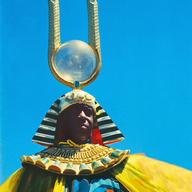
Sun Ra, too, dreamt of outer space. In his diaries of the 1930s, when the future Arkestra leader and free jazz pioneer was still known as Herman Blount and enrolled at teacher training college, he wrote of nocturnal visits from “space men.” Over the years, Blount’s personal mythology would evolve with his music. As he moved from the big-band sound of early heroes like Fletcher Henderson and Duke Ellington to something far stranger, forged of electronic whoops and blaring horns in free rhythmic counterpoint, Blount began to tell people that he was himself from Saturn, that his name was Sun Ra, that his musicians were “tone scientists.”
Sun Ra Interview (Helsinski, 1971)
Was this a kind of madness? Was my text exploiting, somehow, the unfortunate ravings of diseased minds? I don’t think so. I think it’s better to regard the personal mythologies of Sun Ra and Stockhausen alike as deliberate strategies. In his book Space is the Place: The Life and Times of Sun Ra, John Szwed quotes former Arkestra musicians who confirmed that the group’s outer space imagery would encourage them to play more experimentally. “You had to think space,” trumpeter Phil Cohran explains. “Had to expand beyond the earth plane.”
Compare the Russian formalist theorist Viktor Shklovsky, whose manifestos of the late 1910s advocated the adoption of a Martian perspective in order to defamiliarise the mundane reality of everyday life, or even Voltaire’s Micromégas. The French philosophe’s 1752 novella employs two extraterrestrial visitors from – coincidentally? – Sirius and Saturn in order to satirise the mores of the ancien régime.
Xenobiology: How We Are Creating Aliens
There have already been hefty books and international conferences dedicated to xenolinguistics and xenobiology, pondering the possibilities of hypothetica extraterrestrial physiognomy and language use. In an age of jaded eardrums, when everything has always already been done, it may yet be necessary to invent a speculative xenomusicology, to adopt a Martian perspective and make music weird again.
Robert Barry is the author of The Music of the Future, published by Repeater Books earlier this year, a history of speculative musics from the Enlightenment to the present day. In "Four Paths to the Future," a new four-part series for Q2 Music, he examines the past, present, and future of music through the lens of a set of topics normally reserved for science fiction or futurological think tanks. "Four Paths to the Future" will provide an imaginative glimpse of where we're at and where we might be heading, through the thoughts, sounds, inventions and ideas of the composers, thinkers and technologists who could be taking us there.

WNYC is funded by sponsors and member donations