The 'Founding Father' of Arab-American Literature
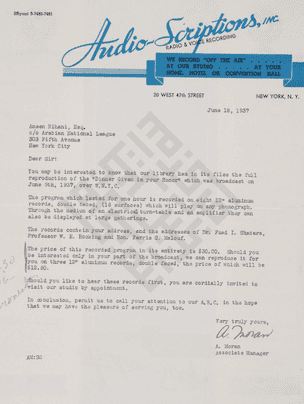
Ameen Rihani (1876 – 1940), was a Lebanese-American writer, intellectual and political activist. He was also a major figure in the mahjar (Arab diaspora) literary movement developed by Arab emigrants in North America, and an early theorist of Arab nationalism. He became a U.S. citizen in 1901. His June 5, 1937, talk at Town Hall on West 43rd Street where he was a guest of honor was broadcast by WNYC.
Known as the 'founding father of Arab-American literature' Rihani, spoke out against Zionism and said the only "possible and practical solution [in Palestine] would involve a decision that the Jewish National Home was now complete, and henceforth to be developed from within and not from without. Jewish immigration and land buying would be stopped at once, and a national representative government would take the place of the [British] Mandate."
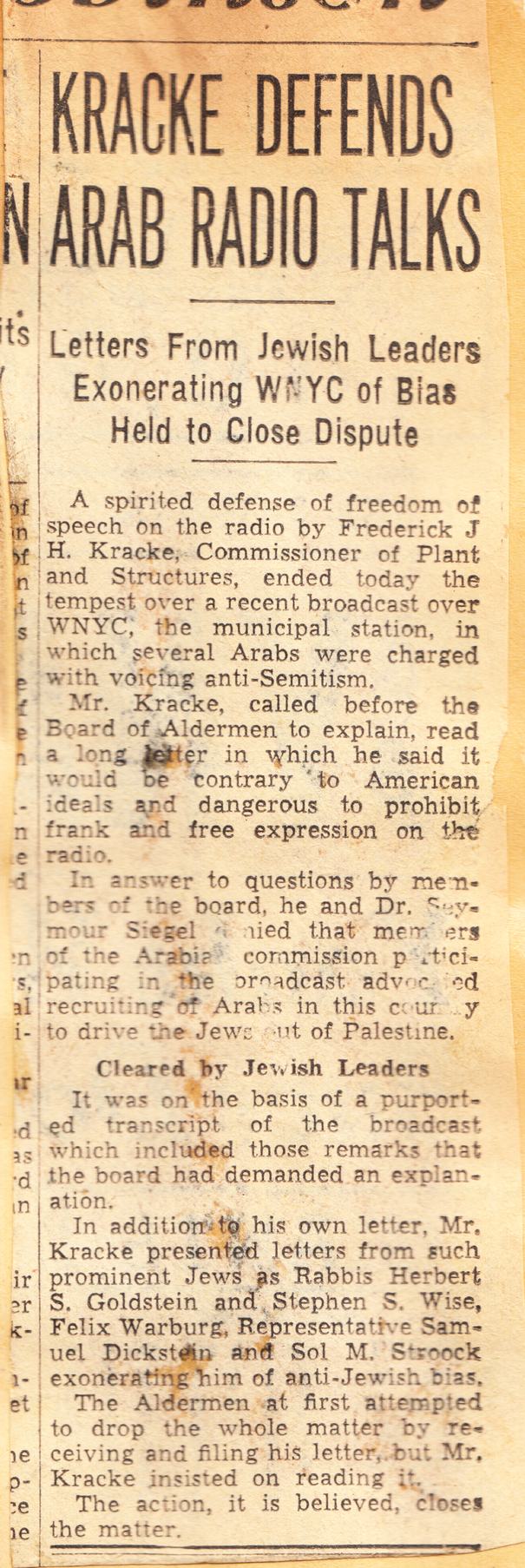
The broadcast prompted a charge of anti-Semitism against WNYC from City Alderman Samson Inselbuch. Three days after the broadcast, the Brooklyn representative was successful in getting the legislative body to approve a resolution condemning the station for spreading political propaganda and race hatred. The next day WNYC's program director Seymour N. Siegel was on the phone to Arthur Garfield Hayes at the ACLU. In a letter to the Alderman, Commissioner F. J. H. Kracke defended WNYC's broadcast.
It has often been pointed out that abroad, Government broadcasting monopolies have one or two policies regarding controversial subjects. They either broadcast only the Government viewpoint or they do not broadcast any viewpoint at all...It is contrary to American ideals to advocate regulation of radio by a Government agency whose authority would extend to the point of exercising a complete censorship over the program. The use of the air as a public forum is important to the maintenance of a democratic form of government.[1]
Kracke went on to point out the resolution's haste and inaccuracies (time and broadcast reach) and presented letters supporting WNYC's position from the National Council of Jewish Women, the President of the Rabbinical Council of America, and Congressional Committee on Un-American Activities. The Commissioner also noted that plans for airing 'the Jewish side' of the issue had been planned before the Rihani broadcast and they had indeed presented their views on Palestine in a broadcast round-table discussion. Rabbi Stephen S. Wise wrote that the charge against WNYC might be upheld only if the station had denied Jews the same right to speak. Jewish leaders were granted equal time. The American Civil Liberties Union weighed in favor of the station.
In the face of sharp criticism of WNYC, New York City's radio station, for the broadcast of the Arab position in Palestine, the New York Civil Liberties Committee commended the station's policy in presenting both sides of public questions. 'Such a policy is the essence of democracy. Without it, no radio station, least of all a publicly owned one, can justify its existence,' the Committee wrote Commissioner of Plant and Structures F. J. H. Kracke.[2]
It appears that the broadcast controversy also played a role in the period's simmering Middle-East politics. According to historian Rafael Medoff, Alderman Inselbuch was unaware that his local tempest had wider implications.
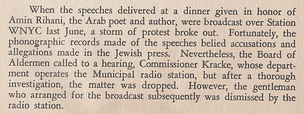
At that moment Arab representatives -- including one of those whose speeches were broadcast on WNYC -- were conducting secret negotiations with several prominent American Jews about the future of Palestine; the Arabs asked their Jewish interlocutors to help insure that the WNYC official who supervised the broadcast not be fired as a result of the affair.[3]
In January 1938 The Arab National League published a pamphlet appealing to "American justice and fair play" on behalf of Palestinian Arabs in which they expressed sympathy for the WNYC staffer arranging the broadcast, of whom we've yet to identify.

[1] Department of Plant and Structures news release, June 15, 1937, ACLU Papers, Library of Congress.
[2] "Approve of Free Speech Stand of N.Y. Radio Station," ACLU Bulletin 770, June 25, 1937, ACLU Papers, Library of Congress.
[3] Medoff, Rafael and Raymond A. Smith, Jewish Americans & Political Participation: A Reference Handbook, ABC-CLIO, Santa Barbara, CA, 2002, pg. 275.
[4] The Arab National League, "Appeal to American Justice and Fair Play on Behalf of Palestine Arabs," January 1938, pg. 3.

WNYC is funded by sponsors and member donations