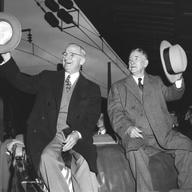
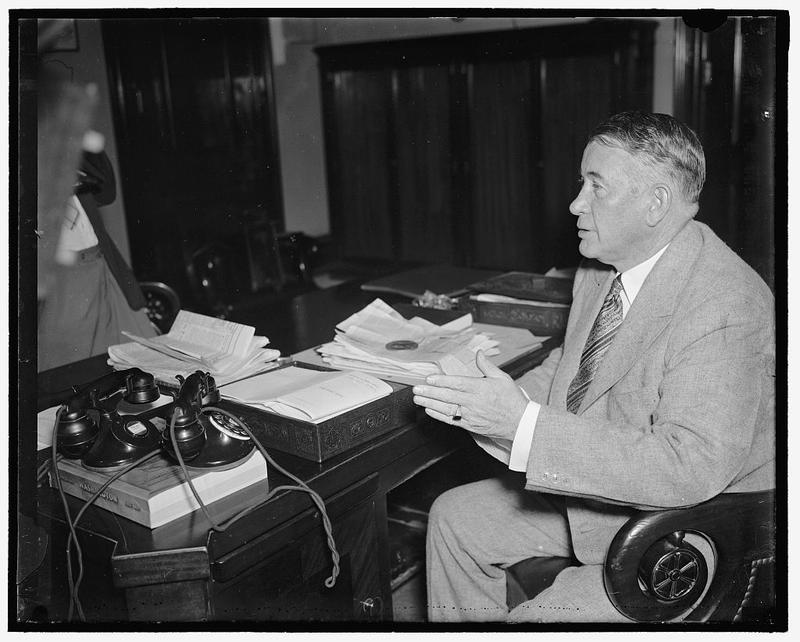
Former Veep Alben Barkley at the Book and Author Luncheon
The former vice president under Truman, now recently elected "junior" senator from Kentucky (he was seventy-seven), Barkley is ostensibly here to plug his memoir, That Reminds Me. However, his speech is mostly a mixture of (even then, one senses) antiquated campaign jokes and a paean to public service. Barkley was a professional politician and proud of it. Having served in various legislative bodies almost all his adult life, he professes contempt for "those citizens who wrap their spotless garment around them and withdraw from any public activity." He makes a plea for Senate and House members to receive a greater salary, so they can maintain two establishments (one in Washington DC and one at home.) Illustrating his points with anecdotes about Daniel Webster, Henry Clay, John Calhoun, and John Randolph (Barkley speaks so familiarly of these historical figures one almost believes he knew them personally), he makes a timely case for mutual respect and the spirit of compromise in governance. Legislators, he urges, should "reflect not the whimsical will of the people but their profound judgment and profound convictions."
This endorsement of collegiality and bipartisanship can be seen two ways: as a glimpse of a bygone era of more gentlemanly deal-making or as a hint that today's problems of ideological gridlock were just as pressing then as now. Perhaps of more interest, though, is Barkley's delivery. He indulges in a leisurely, orotund style and often rises to a kind of mellifluous bellow taking one back to the fairgrounds and outdoor meetings of the early 20'th century, when a "stump speech" was indeed delivered on a stump.
Alben Barkley was born in 1877. He represented his native Kentucky in the House of Representatives in 1912 and in the Senate from 1926. Barkley became majority leader in 1937, succeeding "Scrappy Joe" Robinson, a combative and dictatorial ruler. As the Dictionary of American Biography recounts, Barkley's style was different.
Barkley's performance as majority leader drew mixed evaluations. Robinson had been one of the strongest leaders in the history of the Senate, and Barkley succeeded him just as the conservative coalition was beginning its twenty-five year dominance of the Congress. He not only faced difficulty with the Republicans but also suffered frequent obstruction from powerful members of his own party. He appears to have seen his job as one of conciliation between the conservatives on Capitol Hill and the militant New Dealers who formulated the White House legislative program. Barkley's own policy positions were predominantly liberal, even to the extent of supporting civil rights legislation, but he usually counseled acceptance of whatever compromises could be put through the legislative process. Frequently criticized as weak and ineffective, he was nonetheless capable of ordering the Senate sergeant at arms to "arrest" absent members in November 1942, in an effort to compel their attendance to break a filibuster.
Although backing most of FDR's New Deal legislation, Barkley's relations with the White House could be tense, most notably during Roosevelt's veto of the 1944 Revenue Bill. Later that year, he vied unsuccessfully for the vice-presidential nomination. His relationship with the eventual nominee, Truman, was civil but cool. He is perhaps best-remembered as having inadvertently coined the campaign slogan, "Give 'em hell, Harry!" Despite being elected vice president in Truman's upset victory of 1948, his heart remained in Senate. As the website senate.gov relates:
Barkley was the last of the old-time vice presidents, the last to preside regularly over the Senate, the last not to have an office in or near the White House, the last to identify more with the legislative than the executive branch. He was an old warhorse, the veteran of many political battles, the perpetual keynote speaker of his party who could rouse delegates from their lethargy to shout and cheer for the party's leaders and platform. … He was partisan to the marrow, but with a sense of humor and a gift of storytelling that defused partisan and personal animosities.
Barkley's death seems entirely in keeping with the devotion to public service he speaks of here. In 1956, after regaining his place in the Senate, he declined an offer to switch seats with a more senior senator so as to be able to sit in the front row of the chamber. Giving a speech at Washington and Lee University, he alludes to Psalms 84:10, proclaiming:
“I am glad to sit on the back row, for I would rather be a servant in the House of the Lord than to sit in the seats of the mighty.”
Then, as can be heard on youtube.com, there is a crash. The announcer explains that the senator has collapsed. A call is made for a doctor. Barkley had died, on the podium, addressing the crowd.
Audio courtesy of the NYC Municipal Archives WNYC Collection.
WNYC archives id: 150152
Municipal archives id: LT2987

WNYC is funded by sponsors and member donations