Electric Eels Bunking with Tigers: The Itinerant New York Aquarium
On October 1st, 1941 Castle Garden in Battery Park shut its doors as the New York Aquarium. It would take sixteen years for the aquarium to find a new home at Coney Island.
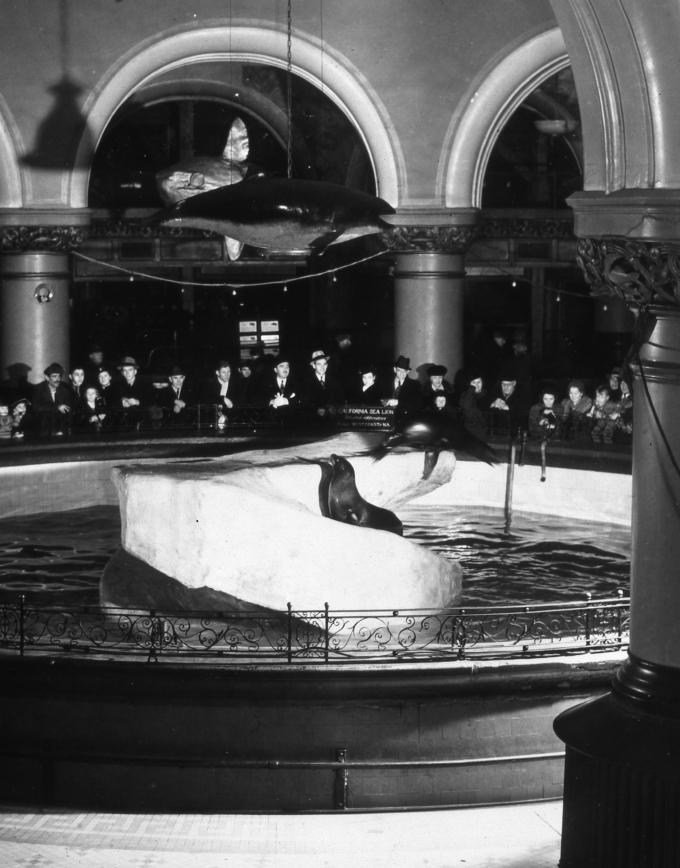
Operating under the aliases West Battery, Castle Garden and Castle Clinton over its 208 year life span, the building has served as a fort, grand ballroom, spa, gateway for millions of immigrants and, today, a national monument. Images of the Aquarium at Castle Garden show finely dressed patrons staring down into pools of water. The aquatic life quite literally jumps out of unusually small enclosures backed with white tile and little natural vegetation, contrary to modern aquatic exhibitions.
According to William Bridges in A Gathering of Animals: An unconventional history of the New York Zoological Society:
[A Humboldt penguin]…lived in one of the floor pools by day (when it was not hopping out and following its keepers around the building), and at night it was kept in an open pen on the gravel roof. It was the first of what was in later years to be a succession of sea birds—pelicans, cormorants, gulls and the like—that [Director] Dr. Townsend insisted on keeping in the floor pools even though they were (to put it mildly) untidy in their habits, given to making noisome messes, and generally unsuitable for exhibition in a closed and not too well-ventilated building.[1]
Tour of the New York Aquarium at Battery Park
In this tour of the aquarium at Battery Park, you can hear Peter and Wendy, two noisy Sea Lions at feeding time.[2] A pair of waggish WNYC reporters interview Curator Dr. Christopher W. Coates as he describes the building and its inhabitants such as a seven foot long giant grouper, an African Lungfish and the Octopus, "villain of all underwater moving pictures."
However, the real villain of the Aquarium at Battery Park—at least in the eyes of sentimental New Yorkers—was Parks Commissioner Robert Moses who fought to have the building demolished to facilitate the construction of the Brooklyn-Battery Tunnel. The New York Zoological Society had been managing the aquarium since 1902 and lobbying for assistance from the city to construct a new building since 1911. Thus, the doors to the aquarium were closed with the promise of an entirely new building, and one that was, most importantly, not circular![3]
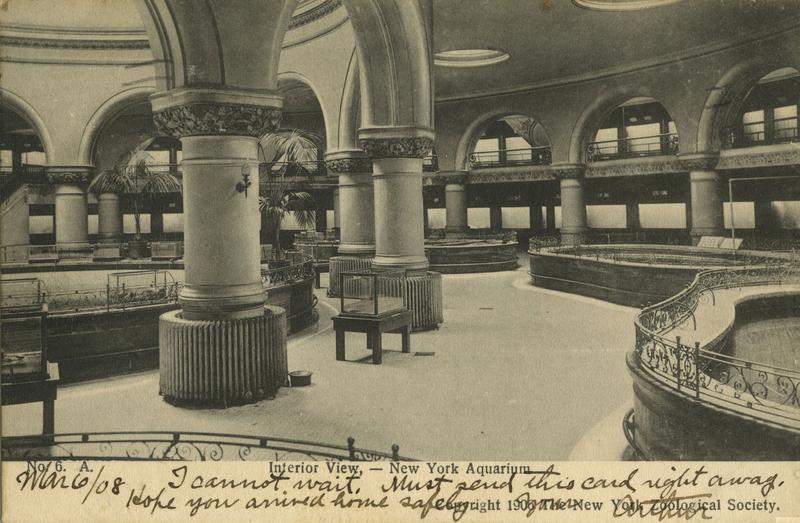
In a 1941 letter to the New York Times Robert Moses wrote, “…the Aquarium is an ugly wart on the main axis leading straight to the Statue of Liberty—a vista of which future New Yorkers someday will justly be proud."[4] However, uproar from the public, historic societies, and civic leaders saved the building from demolition and “Castle Clinton” officially became a national monument in 1950.
Stymied by the financial effects of the Great Depression and foreign wars, the New York Aquarium did not re-open until 1957. So what happened to the roughly 10,000 residents at Castle Clinton?
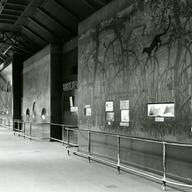
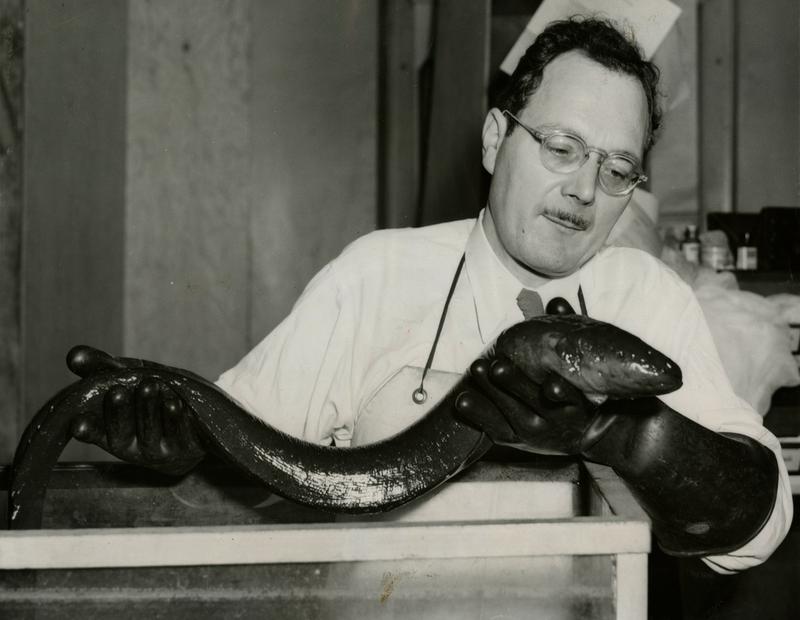
With funding from the city, specimens captured locally were returned to the sea while others were sent to nearby aquariums. A collection of specimens that were rare, valuable and popular were sent to live at the lion house in the Bronx Zoo. A 1942 article in the New York Times describes, “The present collection includes some 2,500 specimens of 104 species. Brilliantly colored tropical fishes were retained from the former collection and are in ‘jewel box’ settings with more elaborate underwater planting and decoration than at the old Aquarium."[5] This included an Electric Eel exhibition where:
…at intervals during the day a rubber gloved tankman stroked the eel until it discharged its five hundred volts thereby causing a series of neon pips to spell out ELECTRIC EEL, a loudspeaker to crackle with static, and wavy blue lines to flicker across the face of an oscilloscope.
...the exhibition electric eel was not quite so popular with the Lion House keepers. Its tank happened to be directly opposite the compartment occupied by Dacca, the Zoo’s prolific tiger mother. (She had thirty-two cubs between 1948 and 1959.) During several of her pregnancies she took a fierce dislike to the eel, watching it intently and clawing at the wire front of her cage when it rose to the surface to take a gulp of air. For the sake of Dacca’s peace of mind, the eel tank was kept covered during the critical weeks.[6]
Coney Island was long considered the ideal site for the new aquarium, even before the doors were shut to the public at Castle Clinton. Mayor La Guardia saw an opportunity to spread cultural institutions to other boroughs and the site was adjacent to ocean water, yet also accessible to most New Yorkers and tourists. After a decade of planning and fundraising, the cornerstone was laid at Coney Island in 1954. By this time Coney Island had passed its halcyon days as the "Playground of the World" and was planned for residential rezoning.
New York Aquarium Cornerstone Laying Ceremonies
In this recording, Robert Moses posits the New York Aquarium as the symbol of a new family and tourist friendly Coney Island with an amusement section shrunk "to proper limits," destined to overcome its sordid past:
Coney was town land owned by the people, given away to crooks for a song, and in a small part recaptured for the public at large expense. It had become, when we took it over under the new charter in 1937, a honky-tonk catch-penny waterfront. That only some 50 acres of receding over-crowded beach. It had a board walk with access underneath it from dubious, miscellaneous structures. Often at high tide there was no beach at all. Coney with its seasonal gaiety, in spite of its accessibility, under the auspices of absentee landlords, was on the way out.
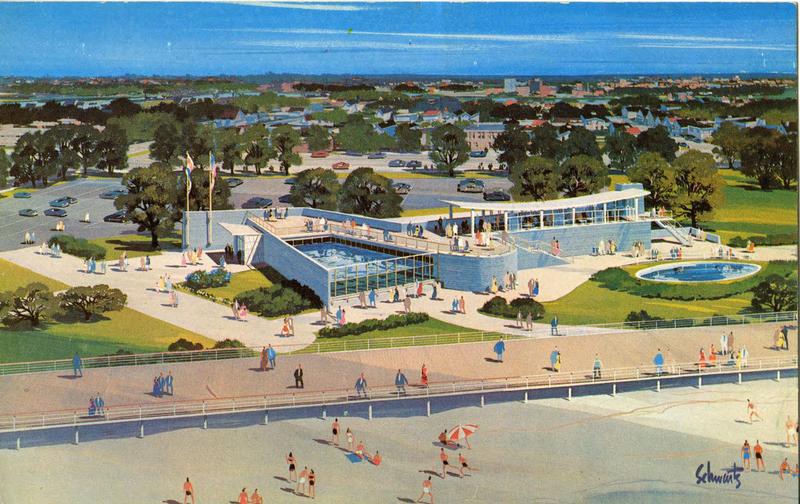
The first stage of a grandiose 6.5 million dollar plan was completed by 1956. At the ribbon cutting ceremony, Fairfield Osborn, president of the New York Zoological Society predicted, "It is the beginning of an institution, which, if we can get the support, which we pray for, hope for and must have, will grow into the most incomparable institution of its kind anywhere in this country, or for that matter, anywhere in the world." (Listen to the audio at the top of the article.)
The doors were officially opened when Annie, a black footed penguin, served as the ribbon cutter by biting at a wrapped smelt fish. A WNYC reporter described the melee as Annie performed her official duty and children poured past to explore the brand new, permanent home of the New York Aquarium.
____
Additional recordings:
1965 interview with Dr. Carl Ray, Curator at the New York Aquarium
He discusses the practicality of evolving man to live underwater as a solution to human over-population, "Now the physiological strain on man to do this is going to be solved, we are going to be able to go, there but how many people are going to be even willing to go there?"
Robert Moses speaking to the New York Zoological Society Annual Meeting in 1957
"One thing however we can agree on, that if once more, the long night descends upon the earth, setting us back thousands of years, when the luckiest reincarnationist will inhabit a pterodactyl immune to radioactive fallout, the most priceless evidences of the heroic ascent from clod to man, the hardest to duplicate and replace, will be those which are now exhibited in our great museums here in New York."
____
[1] Bridges, William, Gathering of animals: An unconventional history of the New York Zoological Society, 1974, pg. 199
[2] This recording is incomplete and unidentified, but most likely an episode of All Around the Town. The audio has been edited for continuity.
[3] After taking over as Director of the Aquarium in 1902, Charles H. Townsend drew up several plans to improve Castle Garden for aquatic display and research, however the circular shape of the building proved too prohibitive, in his opinion, and he began lobbying for a new building.
Bridges, William, Gathering of animals: An unconventional history of the New York Zoological Society, 1974, pg. 192
[4] Moses, Robert, "Mr. Moses and the Aquarium: Tracing Somewhat Tarnish Past, He Insists It Be Banished From Battery", Letters to The Times, New York Times, February 25th, 1941
[5] "Aquarium Will Open In New Home Today: Fish to Be Shown Among Murals in Lion House of Zoo," New York Times, February 12th, 1942
[6] Bridges, William, Gathering of animals: An unconventional history of the New York Zoological Society, 1974, pg. 472-473
My special thanks to Madeleine Thompson, Archivist and Digital Resources Manager at the Wildlife Conservation Society. Check out Wild View: An Eye on Wildlife for more history on the Bronx Zoo and the New York Aquarium.
Audio courtesy of the NYC Municipal Archives WNYC Collection.
WNYC archives id: 150510
Municipal archives id: LT7646

WNYC is funded by sponsors and member donations