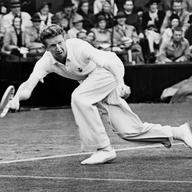
Don Budge
Commentary
Around the world, fifty million tennis enthusiasts in 36 countries were waiting in front of their televisions, with 30,472 in attendance at the Houston Astrodome, the largest audience in its history.
Dubbed "The Battle of the Sexes” by promoters, the matchup of Billie Jean King and Bobby Riggs in a best-of-five showdown was either the apotheosis of King's career or, in her words, "a set back of fifty years."
It was to be the physical manifestation of the so-called Second Wave of Feminism, which encompassed equality in sports. In 1973, the Senate passed the Equal Rights Amendment, the Supreme Court adjudicated Roe vs Wade, Legislators passed Title IX, Gloria Steinem published Ms. Magazine, and the U.S. Open became the first major tournament to offer equal pay to men and women.
Don Budge was my friend. And he was part of the old guard, where women did not reside. He was the first ever to win the Grand Slam, and was the world's #1 player for five years. He introduced the power game which still rules the day.
So in turning to Budge for a forecast on the outcome of this historic battle, there was tennis history and gender equality on the line. Riggs provoked, and the press ate up, his chauvinistic and misogynistic comments as to female inferiority in sports, place in society and gender pay disparities.
The Interview
I asked Budge about his tennis camp in Maryland. It was going well and enrollment was up. His wife ran the office.
I congratulated him on his win in the Wimbledon senior men's doubles. I noted that it was the 35th anniversary of his "Slam."
O'Brien asked if the men took it easy on female players. Not at all said Budge. We hit every serve and overhead just as hard. Otherwise they could get an edge.
I asked about the huge event on September 20. He didn't beat around the bush, saying Riggs was in great training, running 3.5 miles and playing 8 to 10 sets a day.
I noted that Riggs takes 300 vitamins a day. Budge said it wouldn't hurt him. He plays defense and relies on strategy.
How do you see the match, I prodded. I think if they go best of three, it'll be Riggs 6-3, 6-3. But they're probably going best of five, so I'll say 3,3 and 3.
And here's how I see it: On serve, Billie Jean's got a good serve, Riggs' is better; forehand, Billie Jean is good, Bobby is great; on backhand, Billie Jean is good, Riggs is great, and on overhead, they're about even.
O'Brien asks how Budge would do.
He said, I have no problem with Bobby, so I'm fine there. And I think if she played Gardner Mulloy, he'd win easily. Doug, I'd say there are currently 2 to 3,000 veteran or club players who can beat Billie Jean.
George asks if this match will lead to more men challenging women. Yes, he says, I've already been asked to go on tour with Margaret Court and Billie Jean. There's a mixed gender 50 yard dash. Snead has challenged any of the women in golf.
O'Brien asks if there aren't a lot of fields where women excel. I don't think so says Budge...men are better doctors, better chefs...
The Big Event
King was behind early in the first set. A serve and volley player, she made a conscious effort to keep Bobby running and worn down with baseline rallies. King struck a number of winners late in the set and secured the final point on a Riggs double fault, 6-4.
Though Riggs broke King's serve in the first game of the second set, he lost, 6-3.
Visibly tiring, Riggs hit a high backhand volley into the net on match point, 6-3.
Several hypotheses were used to explain the loss: it was a deal to help him pay off the Mafia; this was really a youth (King-29) vs. age (Riggs-55) match. Budge was cynical, claiming Riggs tanked the match.
On the evidence of the past 4+ decades, the Battle will be remembered for its effect on society and contribution to the women's movement.
_______________________________________________________________________________________________________________
The Douglas P. Cooper Distinguished Contemporaries Collection (1967-1974) contains rare interviews with influential writers, statesmen, artists, songwriters, journalists and others who have left their mark on our culture.
The Origins of The Cooper Collection
WNYC archives id: 92237

WNYC is funded by sponsors and member donations