Dispatches From the Bang on a Can Summer Festival 2024: Part 8
The Bang On A Can collective, which has championed new music since 1987, decamps every summer to MASS MoCA, the vast complex of former industrial buildings in North Adams, Massachusetts that now houses one of the country's largest contemporary art museums. Since 2002, Bang On A Can has hosted Fellowship programs for emerging composers and musicians - a way of allowing a younger generation of creators and performers to essentially grow up together. This year, they have once again included a Fellowship program for aspiring music writers, and invited me and the radio host/music scholar/pianist Terrance McKnight to serve as the faculty.
This week, we are reporting back from the Berkshires with a new batch of writing fellows. You’ll get their impressions of the concerts, rehearsals, and unusual concert settings they're experiencing. It all leads up to the big event this weekend - Bang On A Can Summer Festival's LOUD Weekend at Mass MoCA -a "fully loaded eclectic super-mix of minimal, experimental and electronic music," (massmoca.org). Follow our writers, Elizabeth Derner, Jurgis Kubilius, Leona Oliveros, Maddy Briggs, and Stephanie Manning as they follow the musicians and composers who may be the next generation to change the sound of contemporary music. -John Schaefer
More radical than John Cage: Julius Eastman and Gay Guerilla
By Maddy Briggs
It’s a short list of composers who would be able to mark themselves as being more radical than John Cage, but composer Julius Eastman would surely make the cut.
At a 1975 performance by the SEM Ensemble, Eastman performed Cage's Song Books in front of the composer himself. Song Books, a collection of short works, sometimes presents as a list of rather free instructions, and Eastman took full advantage of the fact. Here, he was ‘Professor Padu’, and described an outrageous, provocative ‘new system of love’, as he asked a performer to undress on stage. Cage left fuming.
The usually mild-mannered American avant-gardist was incensed, believing that Eastman had violated the limits of freedom the works allow for. Eastman had injected politics into a work that Cage saw as free from the political.
This story isn’t one often told about 20th century musical history, but it’s an incredibly powerful one. Here is a composer that defies Cage - the political is the personal, he boldly declares.
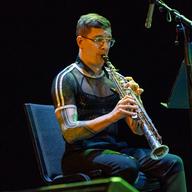
A slice of Eastman’s spirit hit North Adams, Massachusetts last weekend. His work Gay Guerilla was one of the featured works at this year’s Bang on a Can’s LOUD Weekend, performed by a mix of this year’s young performance Fellows and Bang on a Can faculty musicians. Though Eastman originally performed and recorded the work with four pianos, the work’s instrumentation is left unspecified. Bang on a Can’s fellows took full advantage of the fact, performing as a nonet – concert and alto flute, clarinet and bass clarinet, bassoon, saxophone, bass clarinet, piano, keyboard, harp and guitar.
For Montreal saxophonist and performance fellow Thomas Gauthier-Lang, Gay Guerilla begins long before the first note sounds. Instead, it begins with the thoughts and preconceptions that begin to bubble up once the title’s read on a program.
“There’s something so empowering in the title for me,” he says. “It influences how I’m breathing, how I’m moving on the stage, how I’m looking at the other performers.”
The reason for the title, as Eastman explained before the work’s 1980 premiere performance, is entirely about this empowerment. He aimed to lend the strength of the word ‘guerilla’ to the word ‘gay’. “These names: either I glorify them, or they glorify me.” Eastman said in an introduction to the performance.
Fluidity, says Gauthier-Lang, is really at the heart of Gay Guerilla. Each section of the work is dictated by time codes rather than bar lines; tempo, along with instrumentation, is another element left open to performers’ choice.
“The piece is 29 minutes long. There’s something very athletic behind it, and you have to be ready to get into it. Otherwise, you’ve already been defeated before you start playing,” explains Gauthier-Lang.
“I’m used to playing [long works], it’s an interest of mine. It makes me just feel so alive, because my body’s reacting to what I asked of it. Julius’s music is doing that to me.”
Clarinetist Vashawn Arora is another of Bang on a Can’s young Fellows, who played bass clarinet in the performance at the Summer Festival. He concurs with Gauthier-Lang.
“To go through a piece that long with the ensemble was really beautiful,” he says. “There’s a lot of trust that has to happen across the ensemble; there’s not just one person that makes the piece work, it’s everybody.”
Born in New York City in 1940, Julius Eastman was an openly gay, Black composer, pianist, vocalist and performance artist. Trained in composition from the Curtis Institute of Music, his practice spanned solo chamber, orchestral, experimental and electroacoustic music.
His performance credits carry significant weight – he was the first male vocalist in Meredith Monk’s Vocal Ensemble, and his voice featured in the 1973 Nonesuch recording of Peter Maxwell Davies’ Eight Songs for a Mad King (he also performed the work live under Pierre Boulez at Lincoln Center in 1976).
There’s a fierceness to Eastman’s work as a composer. The naming of several other of his titles show the same brazen sensibility as Gay Guerilla – Eastman’s Nigger series prompts a complex set of questions in regards to its presentation (in fact, the audio of him introducing both Gay Guerilla and Evil Nigger on YouTube as linked to Wise Music Classical has been removed for violating the site’s hate speech policy).
It’s not certain whether Eastman knew his performance of Cage’s Song Books would be as provocative as it was, but it showcases an incredibly important part of his musical philosophy – one’s political identity is inextricable from all else.
These ideas are powerfully distilled within Eastman’s minimalist stylings. Gauthier-Lang explains that what Eastman was making was what he calls ‘organic’ music, where each musical phrase borrows from the preceding one. This creates a cohesive through line throughout the work.
“There’s moments of control in the piece, but there’s also moments of letting go,” Gauthier-Lang says. “Sometimes, we have to align on the same rhythm at one point, and then we’ll all dissociate.”
The emerging sound is an amorphous beast. In the spirit of Eastman, Bang on A Can’s Fellows chose to swap lines throughout the piece, never following a single part. This means that the texture of a chord was always shimmering, ever-changing.
Hypnotically, relentlessly, Gay Guerilla hammers in each chord - in this performance, the consistent percussive strum of Mark Stewart’s guitar was what gave the piece its driving power.
When the harmony begins to grow too familiar, the ear begins to be drawn towards strange, incidental artifacts of sound that float to the top. In Bang on a Can’s rehearsal, this was the brash ringing of a high harp note that bounced around the performance space; the overtones of the bass clarinet that emerged as most of its note was buried within the ensemble.
This performance of the work was Gauthier-Lang’s second time playing Gay Guerilla, but for him, it was all new again.
“It felt different because of the instrumentation, but I think it mostly felt different because of where people are coming from in their musical journey, and the way they individually share themselves during the performance.”
Later in his life, Eastman fell into drug addiction. Evicted from his New York apartment in the 80s, Eastman left behind all of his possessions, including the scores of his works. His death in relative obscurity at the age of 49 came as a shock to those who knew him, many of whom hadn’t heard from him in years.
Though some of his works exist in fragments or incomplete scores, a push in recent years has seen his music rise in popularity across the US and the UK – in fact, the first-ever Australian performances of Gay Guerilla took place on 3 August, the same day it was performed at MASS MoCA.
Vashawn Arora points to one of the work’s movements, “A Mighty Fortress is our God.” Eastman borrows the title and melody from the Martin Luther hymn, which is passed around the ensemble – Using the freedom that the piece affords them, the ensemble chose to perform in three groups of three. It’s intense, but it’s an intensity that draws the creative best out of its performers, Arora notes.
“What I am trying to achieve is to be who I am to the fullest,” said Eastman in a 1976 interview. “Black to the fullest, a musician to the fullest, a homosexual to the fullest.”
And at the Summer Festival, Gay Guerilla was performed to its fullest.
Maddy Briggs is an electroacoustic composer and writer. She joined Limelight as Staff Writer in 2022. Her work has been featured in VIVID Sydney, the International Electroacoustic Music Festival and on BBC Music 6.