Dispatches From the Bang on a Can Summer Festival 2022: Part 7
Music in a post-industrial landscape
By Alice Koeninger
MASS MoCA has always been home to live music. A huge part of this is thanks to its founding director, Joseph Thompson, but another part is the physical space that the factory-turned-museum has to offer.
Founding member Julia Wolfe tells the story of how the Bang On A Can (BOAC) organization found a home at MASS MoCA— like a tale of destiny or fate. BOAC was searching for a place to hold a summer workshop when Thompson invited another founding member, David Lang, who was nearby at the Windstone Theater Festival, to tour the factory space with him. By the end, Thompson turned and asked if BOAC would like to do some music there. It was perfect. “It seemed incredible to us,” said Wolfe in an interview. “It was like synergy.” The first Bang On A Can marathon concert took place in a contemporary art gallery in New York City, so it felt right that the summer festival found its home at a contemporary art museum.
With its exposed-brick walls, high ceilings, and huge rooms interrupted by bare wooden support columns, the museum’s past life as a factory is beautifully obvious. Its post-industrial aesthetic suits the contemporary music festivals it hosts. “The heart and soul of Bang On A Can certainly has an edge [to it] that’s kind of crusty. [MASS MoCA] matches us,” Wolfe said. “There’s something fascinating about these raw spaces that take you… outside of the paradigm [of classical music].”
Wolfe and the other BOAC founders Lang and Michael Gordon liked that the museum was tucked into the Berkshires, a couple hours drive from any large city. The city of North Adams can feel like an artist’s retreat, and that became important to the summer workshop. “It's a whole different feeling, I think, kind of all coming here and leaving New York City behind and just sort of being about this community,” she said.
While Wolfe can write music anywhere, she began writing Steel Hammer (2009), inspired by the convoluted history of the ballad of John Henry, at MASS MoCA. “I think some of the [Berkshire] mountains ended up in this piece,” she said when introducing it at the start of this year’s LOUD Weekend (the BOAC All Stars performed the piece Thursday evening). Steel Hammer was the first of a trilogy of pieces about labor that Wolfe would write over the years. Anthracite Fields (2014) is about Pennsylvania coal miners, and Fire in my mouth (2019) is about the Triangle Shirtwaist Factory Fire in New York City. It’s easy to see how the looming industrial history of North Adams, could inspire such an interest in the stories of America’s laborers.
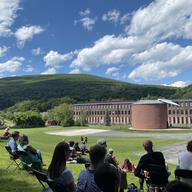
The biggest difference between New York City and North Adams is the availability of space. At MASS MoCA, this space isn’t limited to the (expansive) galleries, but includes the outdoor courtyard spaces as well, and a sprawling green field with a small hill.
Most of the concerts that made up the Bang On A Can LOUD Weekend Festival took place inside MASS MoCA, which has space for a larger auditorium as well as a smaller club-like setting called Club B-10, and a window-lined alcove-like space past a sculpture gallery, called “the prow.” There were two exceptions: composers Phil Kline and Michael Gordon took advantage of the museum’s large outdoor spaces as settings for their experiential pieces.
Kline’s "last words before vanishing from the face of the earth" consists of 24 boomboxes installed in various locations outside in a field or wood. The piece was originally written for a rural music festival in Vermont, but it fit well into the Berkshire landscape. The boomboxes emitted long tones, some electronic, some more natural and reminiscent of insects, that wove together slowly to form eerie, shifting, and sometimes dissonant harmonies. Listeners sat on the hill in front of the boomboxes to absorb the sounds, or walked around the perimeter to get different perspectives. The sky was a bright blue and the clouds made shadows on the green mountaintops. The industrial bulk of the museum seemed to fit the landscape, as if it was part of the hills.
Gordon’s “Field of Vision” took place in one of the museum’s large courtyards, on asphalt surrounded by brick. The site-specific ritual/spectacle featured 36 percussionists from the University of Michigan Percussion Ensemble & Sō Percussion Summer Institute, directed by Doug Perkins. The percussionists surrounded the listeners and played gongs, drums, wood blocks, and more to create a sort of immersive cloud of noise for people to move around in. Earplugs were readily available, and listeners were able to stand right next to percussionists as they moved from one instrument to the other, soaking up as much sound as possible.
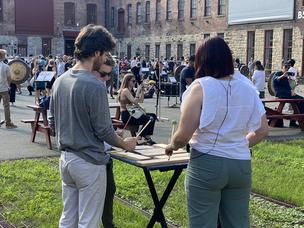
Though neither Kline’s installation nor Gordon’s were originally written for the MASS MoCA space, they fit well. Both created a completely immersive experience and combined new technologies with old or natural spaces. They were representative of what BOAC is all about-- dedicated to “making music new,” whether that’s the music itself, how it is experienced, or both.
Another special thing about the BOAC summer festival is that young composers are invited to write and premiere new works. These works, as Wolfe pointed out, are specifically written in the MASS MoCA space for the instrumentalist Fellows and BOAC Faculty to play. Many of the composers were inspired by the art that surrounded them for their three weeks in North Adams. For example, Udi Perlman’s piece “Compliments,” written during his time at BOAC, was inspired by the complementary colors of artist Sol Lewitt’s wall drawings. Yaz Lancaster’s piece “Prime” was partly inspired by Jenny Holzer’s Truisms posters in the Lady Pink x Jenny Holzer exhibit. These are works tied to a moment and place in time, and though they will go on to be performed again elsewhere, they were conceived here, shaped by the art and the brick and the mountains.
Stop, hey, what’s that sound?: The noisy world of Gunnar Schonbeck
By Alice Koeninger
People don’t often associate the word “noise” with the concept of music. In fact, some might consider the two words to be opposites-- music is something you want to listen to, something composed and lovingly created, while noise is just that: noise. Chaotic and incomprehensible.
Musician, college professor, and inventor of instruments Gunnar Schonbeck chose instead to revel in this chaos. In the MASS MoCA exhibit of Schonbeck’s instruments titled No Experience Required, a quote on the wall reads, “Everything makes a sound. You just have to find what it is.”
The gallery is filled with Schonbeck’s musical inventions, instruments made from rebar and old wood and metal tubing and wire. Some instruments look familiar, resembling marimbas or conga drums. Others, including a chandelier-shaped object with five groups of dangling windchimes, are more mysterious. Mallets made of PVC pipe and triangular, plastic picks are provided to visitors at the entrance to Schonbeck’s collection of sound-emitting contraptions. The message is clear: anyone can be a musician.
This democratization of music and its creation is something that Mark Stewart, one of the curators of the Schonbeck exhibit, has made his personal mission in life. Stewart is Paul Simon’s music director and a member of the Bang On A Can All Stars, but he is also an instrument designer who focuses on creating musical devices that everyone can play. Part of this approach allows for a broader definition of the word “music.”
“Adults didn’t invent music,” Stewart said in an interview. “It sprang from children or our childlike spirit. Adults organized music.” He views sound-making as a human birthright that people don’t always know how to claim.
“The word ‘musician’ is too often used to discourage people from participating as sound-makers. When people discover that they are in fact potent sound makers, they often discover then that they’re musicians.”
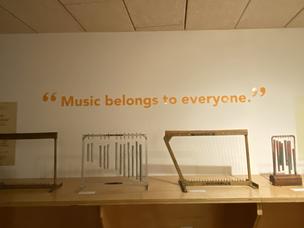
This desire to help others enjoy their “birthright” extends to professional musicians as well. Those who are conservatory-trained are so proficient at playing their instruments that making a strange noise or playing a wrong note is an embarrassing idea, to say the least. As part of the Bang On A Can summer festival, Stewart leads a workshop he calls the “Orchestra of Original Instruments,” where he invites the Fellows to “leave their mastery behind” and rediscover some of that childish joy in making sound.
When asked why he continues to invent instruments, Stewart declined to claim the title of “inventor,” but preferred to compare himself to a scientist capturing and naming each species of sound. “I’m not as interested in populating the sound world as cataloging [sounds],” he said.
It’s clear from the Schonbeck gallery, which feels more like an exhibit at a children’s science museum than an exhibit at a contemporary art museum, that there are many sounds out there to be discovered and cataloged. One of the standouts, and Mark Stewart’s favorite, is the nine foot tall banjo. “It sounds incredible. You can play it about 100 different ways. It turns everybody back into a toddler--think of how big a normal banjo would be to a human-- it dwarfs you. It’s not just about embracing the child in your spirit, you are a child in size, next to that,” Stewart said.
Anyone who has spent an extended period of time with small children can tell you that they are phenomenal noise-makers. They have not yet learned to be self-conscious about the sounds they produce, and if you ask Stewart, he thinks they are more closely connected to the music in all of us.
The Schonbeck gallery’s collection of new but approachable instruments makes it easier for people of all ages to get in touch with their musical side, their aforementioned birthright. Like some more avant-garde classical pieces, the sound of Schonbeck’s inventions might not be what people think of when they think of music, but it is music nonetheless.
“The minimum daily adult requirement [of musical consumption] has not been established,” said Stewart, “but it is an absolutely nourishing thing that is vital to humanity.” Stewart doesn’t just mean listening to music, but playing it as well. “Don't neglect the homemade variety. It doesn’t have to be public.”