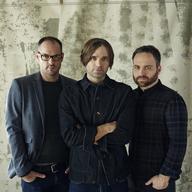
Death Cab For Cutie Finds Art In Repairing Something Broken
The last few months have been bittersweet ones for fans of Bellingham, Washington's Death Cab For Cutie. In January, the band announced that it would be releasing its eighth record, Kintsugi (out March 31). But in late 2014, founding guitarist and producer Chris Walla formalized his plan to part ways with the band following the recording sessions.
Since it's Death Cab for Cutie we're talking about, however, bittersweet finds the band firmly in its zone. Kintsugi is a classic Death Cab record, if such a thing exists. Over 11 tracks, lead singer and songwriter Ben Gibbard examines heartache, loss, absence -- and dresses these themes in driving, occasionally soaring pop garb with impeccable sheen. That latter quality owes much to a new set of ears: the band worked for the first time with an outside producer, Rich Costey, who helped add some perspective to a band that has traditionally done things as a closed ecosystem. Bassist Nick Harmer and drummer Jason McGerr create the recognizably pulsing heart for the ultraviolet-tinted set.
Gibbard and Harmer sat down with Soundcheck's John Schaefer in advance of Kintsugi's release, to talk about the departure of their friend, the subliminally suggestive powers of the Pacific Northwest, and the possibility that the band owes more to Tears for Fears and Blue Oyster Cult than may first meet the ear.
John Schaefer: The new album is called Kintsugi. What does that title mean?
Nick Harmer: It’s actually a Japanese word to describe a technique of repairing broken ceramics. I think literally in English translates to “golden joinery.” Which basically is a technique of using 24-karat gold -- or any gold, really -- infused into the resin or glue to piece together back broken ceramics, porcelain; basically anything that you want to repair.
JS: It’s making an art out of repairing something broken.
NH: Exactly. It comes out of a philosophy of making a repair to an object part of the new history of the object.
JS: Considering this is Chris Walla’s last salvo with the band, did you see this album as a repair of some sort?
Ben Gibbard: People have been jumping to that conclusion that the title is meant to refer to that. I don’t see it that way at all. For me, what really resonates about the title is that technique is something I’ve been trying to do with music my whole life. When things are broken in my life, and the lives of those around me, you want to be create something out of that struggle, of that strife. What one is doing as a songwriter is ostensibly highlighting those broken pieces and trying to make something beautiful out of them.
I don’t see the title as referring to Chris’ departure at all. I see it more as a reflection of not only the songs on this record, but a really nice encapsulation of what I been trying to do for the last 20 years as a songwriter.
JS: Now it’s important to say that Chris is all over the new album, doing his usual thing.
BG: Absolutely, yeah.
JS: He’s just not producing it. Instead, you have Rich Costey, who produced The Decemberists, Interpol...
BG: He did Muse, yeah.
JS: So how big a difference does a change in producer make for you guys -- and perhaps the more interesting question, for us, the audience, the listeners?
BG: For us, it was something -- and I mean this as no slight to Chris and his talents -- I wish we all would maybe have done earlier. Our world in this band is so unique in the sense we've had somebody in the band producing the records over the years. And for the most part that has had positive results. I don't say that because I'd want to go back and change anything. But for me, it was an eye-opener as to what a producer really does. Because I always seen Chris is my bandmate first and producer second.
When Chris was producing records, these were songs he was then have to go into the world and perform ad nauseam. But an outside producer, their only job is creating the best record out of the songs that exist in that time and place. There’s no antiquity with the band; there’s no “I gotta play this guitar part for the next two years.” There’s none of that.
So Rich's perspective really changed the direction of the album. We started working on this record in 2013 with Chris producing it, and after a couple of weeks he came to us and ostensibly fired himself, and said “I don’t think I’m the right person for this record.” I think that was the right decision for all of us. Hearing what Rich brought to the songs that we had attempted to record the previous year, was a real eye-opener to me: this is what somebody who’s not in the band can bring to these songs.
To re-iterate it, that’s not a slight to Chris, it’s just that when somebody is outside of it, they can see things that somebody inside of it can’t. And I think we desperately needed that.
JS: Well you know, I think of when David Bowie took up with Nile Rodgers. And everyone was like, “Wow, what a different sound!” And it was. But then, he worked with Brian Eno, he worked with Tony Visconti, he worked with Nile Rodgers. As the years go by and you have the benefit of hindsight, it’s like, it’s all Bowie.
I get the sense that this new record is still a Death Cab record. Do you guys feel that way?
NH: I do. Definitely. Obviously that was one of the things Rich was very concerned about along the process. He would constantly check in with us and himself -- he wanted to push us and challenge us in ways we haven’t been pushed and challenged in years. But I think he was really good about stopping and asking us, “Is this still Death Cab? Are you guys comfortable in this? Are we making choices that you guys are excited about?” It wasn’t even a conversation that we were having actively.
BG: He would stop and say things like "Yeah, sounds great. sounds like you guys."
NH: He didn’t want to rehash history, but I think that it speaks to his strength as a producer; he knows what we’re good at. And he can zero in our comfort zones and in our wheelhouse and pull us into areas that maybe we were not seeing or were reluctant to go to.
JS: I don’t want to go too deeply into the weeds here on what a producer does on every record. But when it comes to sequencing the record, whose decision is to say, “‘No Room In Frame’ is first, 'Ingenue' towards the end.” Who makes those decisions?
BG: It’s kind of a committee decision, but Rich kind of brought some interesting perspectives into album sequencing that I had not really thought of before. And one thing he had said, and I now believe this to be true: The way a lot people are listening to this record, they’re listening to this on streaming sites, they’re listening to it on the Internet; people don’t have the attention span for like, “Let’s put the 12-minute challenging track first, and then go into the acoustic thing, and later have the hits track eight, nine, and ten.”
Front-load the album. Put all the quote-unquote hits at the front of the record.
JS: That’s “Rock 101.” People have been doing that forever.
BG: It is. But it’s strangely different as to how we always worked. As I go through our records, we always tend to have a song opening that’s kind of like a statement, a slow build. And then there’s something soft and quiet at the end. There’s a piece in the middle that’s a larger, meaty piece.
Like I said before, these things have worked for us in the past. So I don’t mean to kind of throw ourselves under the bus in how we sequenced albums. But Rich brought a perspective -- a "Rock 101" perspective -- that maybe we had kind of lost sight of because we always think of people listen to the albums start to finish rather than the way they do it now which is sort of cherry pick stuff.
JS: The album does have a reflective closer. But the opening seconds of the record, on “No Room In Frame,” begins with this kind of spacey, looped electronic sound. And you think, “Oh, what is this going to be?” But very quickly, the guitars come in. Were there a little bit of misdirection there just in those opening few seconds?
BG: I don’t think consciously. Chris had been working on this damaged sequence in the other room in the studio. And I think sometimes we end up throwing a lot of things at a song and then peeling things back and determining what actually needs to be there. I think that little piece in the beginning was something that was very Death Cab-y to have something like that in the front. But as the song opens up and we get into kind of the role of the song which is kind of a swing feel.
We learned in the process of recording that song, that’s an incredibly difficult tempo and feel to pull off without having it sound like, “Everybody Wants To Rule The World” by Tears For Fears. Which is one of my favorite songs. But as we were going through different arrangements of that song we were like, “We can either make this sound exactly like ‘Everybody Wants To Rule The World’ -- which is not necessarily a bad thing but not in our wheelhouse. How do we pull this back and make it a little more Death Cab For Cutie?”
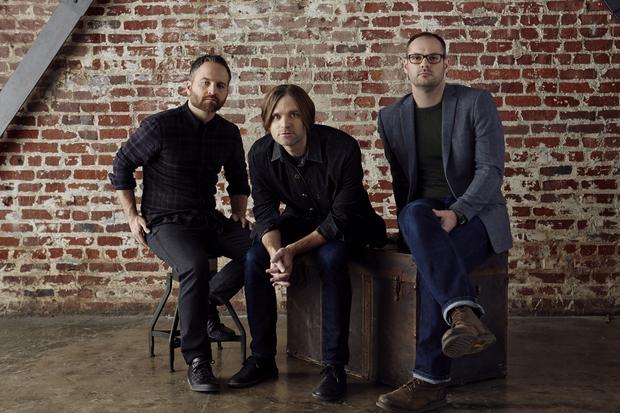
JS: So with Chris now off doing his own thing, how is this going to work when you play live?
BG: Well, we’ve added two new members to the touring band. What their future in the studio will be will be determined in time. But we added a gentleman named Dave Depper, who’s from Portland: He’s played with Menomena and Fruit Bats most recently, he was a touring member of Ray Lamontagne’s band, he’s been a long time friend of the band. He’s playing guitar, a little of bit of keyboard, singing. And then we have a gentleman from Los Angeles named Zac Rae -- who is a phenomenal keyboard player, and turns out, a phenomenal guitar player.
So, as far as the immediate future of the band going out and playing these songs: adding a fifth person was something that I’d always wanted to do, we were just never able to make it work. Having an extra set of hands has proved invaluable in presenting these songs and everything in our back catalog. And on top of that, having a third guitar player added another level weight and sound to the live experience that has got me really excited.
JS: Is Nick excited about this?
NH: Absolutely.
JS: You don't ever think "Hey, what about the bottom end here? Do we really need another guitar?" [laughs]
BG: We already have one of the greatest bass players in rock, we don’t need a second one of those. [laughs]
NH: Honestly, Ben and I keep looking at each other and flash each other looks in the rehearsal space [like] “I cannot believe how full things sound.” I mean, the addition to a fifth person, clearly, they’re an extra set of hands, but two new musical minds really reinvigorated everything that we’re accomplishing right now. So I can’t wait to get on the road. I feel like we’re right on the edge of a great adventure and I can’t wait to get started.
JS: This record has this breadth of sonic palette -- from you on a guitar to the big, lush sounds that we get on some of the other tracks that Death Cab is known for. Maybe it’s too soon to ask this question, but given that Chris was on the record, did his departure change the songwriting process for you.
BG: No. I’ve always kind of written in my own little vacuum. And when I feel I have enough songs, also when the other guys kind of chime in and it looks like we have enough material that we can go in the studio and start making a record, that’s typically when I tended to do that. I always thought that my expression as a songwriter has always been the initial expression and how those songs are arranged and recorded and presented, that’s been the band’s primary job.
So for me, this band will never be the same without Chris -- but this band has not been the same from album to album. The constant through all this is Nick and Jason and the songs I’ve been writing for 17 years. I say that only to kind of reassure fans: Chris’ departure will change the sound of the band, there’s no doubt about that. But I’ve been the songwriter for all these years. The band can only change but so much, the sound can only change if I’m still the primary writer.
JS: Is it hard for you as a writer based in the Pacific Northwest to write a song and then give it the title, “Black Sun?” With that “hole” in the middle of the title?
BG: It’s interesting. There is a lot of strange iconography that gets tied to “Black Sun.” Some of it is not so pleasant. I just found myself when I was writing that song of really locking into this image, only to find out later in a park that I run through all the time in Seattle there’s a [Isamu] Noguchi sculpture called Black Sun -- which turns out is also allegedly the inspiration for Soundgarden’s song, “Black Hole Sun,” which I did not find out until after we recorded this song.
Maybe there’s a subconscious Northwest thread tying all this together. But when I wrote “Black Sun,” in my mind, I kind of thought this is purely my invention -- I was the first one to ever put these words together. “God, I’m so brilliant.” And then I find out after the fact there’s all this occult stuff happening with “Black Sun” and there’s the statue in the park that I run by every single day and I look at it and go like, “That’s a great looking statue.”
JS: And now that you mention it, this reminds me there was a record label called Black Sun -- a jazz label.
BG: I’m so late to this party.
JS: The band now has a 17 year history. There are people you reached out to early on and they sort of grown with the band. These are people who will hear every difference in every record: Every change of direction, every change of producer now. But there’s a larger group who are just tasters that may only know a few songs. So when you’re making an album, when you’re writing songs, do you have to think along those lines? Are you super serving the base -- to use political terms -- or do you wanna have something to reach out to those people who are just tasting here and there?
BG: I never consciously think about it in those terms. When I’m writing songs, I’m solely in the moment of writing whatever the thing I’m sitting in front of currently. And after, I often thought that it’s the band‘s job to sift through all of these demo’s in different stages of completion -- and now the producer -- to forge an album out of all that.
There are certainly songs that we have recorded over the years that while we’re in the studio listening to them back -- we would never say anything as gauche as “I think we have a hit here!” But there are songs, “Black Sun” being one of them; it was one of the first songs we recorded with Rich, and hearing it come back off the speakers, it just sounded so good to us. We thought, “Man, people who are fans of the band are really going to like this. I think people who are really fans of the band dig this song.” You get excited sharing something like that with them.
But I think also I learned over the years -- not just as a music fan but as a member of this band -- that not everybody has the same intense relationship with music that I do. Not everybody knows which studio David Bowie’s Low is recorded at. Not everybody knows which guitar on that guitar on that one record. Not everybody knows that I’m Ben Gibbard, I’m the singer for Death Cab For Cutie. A lot of people don’t know these things. They hear a song on the radio, they like it, they download it, or they stream it, maybe they buy the record, maybe they come see the band live.
I feel very fortunate that anything we’ve made has resonated with anybody on a casual scale. I don’t get too caught up with like, “Oh, I really hope we can pull in some more tasters.” I like that term, by the way. I think over the years, we’re compiling set lists now. It’s interesting to look back, and go “Wow, we have a fair amount of songs that not everybody knows, but we have a fair amount of music that somebody who listens to this music would recognize.” That’s a cool thing.
JS: One thing that seems missing from the album are the epic, eight-minute long songs, like “I Will Possess Your Heart”-type things. Everything is three to five minutes.
BG: We’re waiting for Nick to bring another killer bassline. If he can bring another “I Will Possess Your Heart” then we can do another 8-minute song.
NH: I’m working on it. Day and night. I don’t think it was a conscious decision to not to include songs like that. It really is demo dependent. These songs seem to address and come from a place of specific moments and there's sort of a brevity in that that we kinda reflected into the music. I know Rich wasn’t opposed to anything like that. Sometimes we stumbled across a change or there’s a moment in the song where it absolutely makes sense to extend indefinitely.
BG: But they happen really organically. “I Will Possess Your Heart” or “Transatlanticism” were songs that when we were rehearsing them, we just didn’t want to stop playing the progression. It felt so good to continue playing it. While writing songs for this record, there was a song by this band La Düsseldorf -- a German kind of-Krautrock rock band -- called “Time” that I tried desperately to rip off because I wanted a really long, crowdy kind of song on this record. I tried and tried and tried to like figure out how to kind of steal the essence of that song and make it into a Death Cab song and it became apparent that unless that happens organically, we cannot write long songs to make long songs. They have to just turn out that way.
JS: Which of the songs were you trying to do this Krautrock thing with?
BG: It was just other demos that I'd written. Other songs that will never see the light of day and I turn them to the guys, like "Here it is!" And they’ll be like, "Yeah, I don’t know about that one. This is two chords for ten minutes." "Yeah! But it’s like La Düsseldorf and that’s cool, right guys?" [laughs]
JS: When you first brought to the band, the song, “El Dorado” did it have that opening guitar riff?
BG: It did. Yes.
JS: Did you guys say, "Isn’t that 'Don’t Fear The Reaper'?"
BG: Is that “Don’t Fear The Reaper?” It very well could be.
JS: It’s so close though.
NH: That never occurred to us. This is the first time.
BG: I gotta go check “Don’t Fear The Reaper” now. I gotta go figure that out.