
Middle School: A 'Hot Mess' of Distractions
Seasoned middle school teachers and principals know what they're up against. Their students are bombarded by physical and psychological changes. The same child can show up dedicated and hard-working one day, silly and difficult the next.
But if you grab their attention, educators told WNYC, there's a chance to make a difference with long-term benefits.
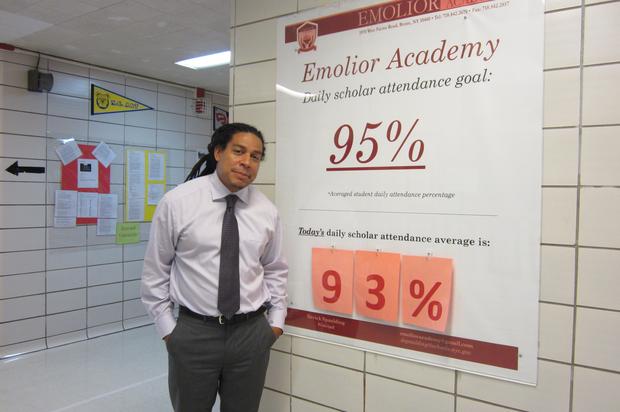
“In the spectrum of adolescent development, 12 is really when you start to have the changeover,” said Derick Spaulding, the principal of Emolior Academy in the South Bronx. “They come in with a set of ideas, but a set of ideas that are amendable and moldable to a degree.”
The key is to cut through all the distractions. On a recent morning in a social studies class, 12-year-old Elijah Harper couldn't focus. Why?
“She’s just on my mind, the girl right here,” he said, sharing a photo on his phone.
"Seventh grade is a hot mess,” said Jason Borsella, Elijah’s social studies teacher. “You’ve got kids that are six-feet-tall and squeaking and then you’ve got boys and girls that are barely 4 ½ feet. You’ve got hormones galore with the girls and the boys. It’s like potpourri on 'Jeopardy' night. You never know what you’re going to get with a seventh grade.”
The key to teaching middle school, he said, is learning to “be like water.” Let things flow. Be flexible.
Researchers have found attendance, grades and behavior in middle school are key indicators when it comes to predicting who will drop out of high school. This is why educators say there’s a big opportunity in the middle grades. It’s a moment to reach kids before they harden their assumptions about who is and who isn’t a good student.
Emolior has earned a good reputation as a small middle school that’s on the right track, despite having a difficult population and low test scores. Its 250 students are mostly poor and include many pupils with special needs and immigrants who don’t speak English. But their attendance rate is over 92 percent, and suspensions are low. One reason: attention.
Staff members often stop to talk with students in the lunchroom and hallways. And, as part of the city’s Middle School Quality Initiative, the school offers extra support. For example, all sixth and seventh graders have four extra periods a week to work on their reading skills. Coaches from Generation Ready pinpoint where students are weak and coach them directly, using tablets loaded with texts catered to their individual reading levels.
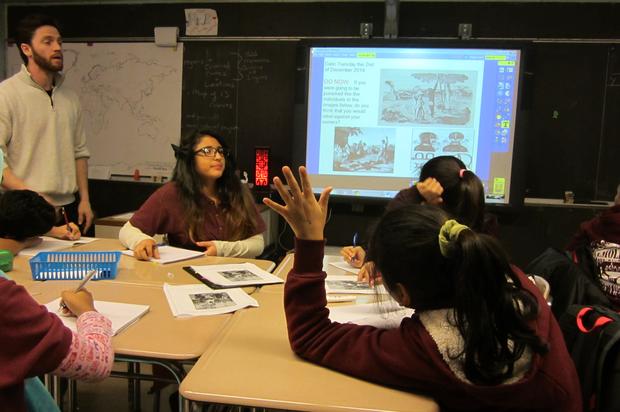
Seventh grader Sheiquel Kabba said the close attention of English teacher Peter Scaramuzzo helped her improve: “He tells us to keep on working, like he makes it encouraging. He don’t put us down.”
Various foundations, including Carnegie, have poured a lot of money into studying what’s wrong with middle schools. New York City has gone through two iterations of middle school reform in the past decade alone. The current thinking is middle schools need to hone in on the academic deficits many students bring with them from elementary school.
“We call them pushables,” Spaulding said. “Those are the kids that with very strategic intervention can get to that proficient level.”
With a little push and a lot of hand holding, he said, even the most distracted or struggling students can make it through middle school.

WNYC is funded by sponsors and member donations