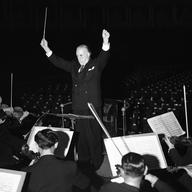
Conductor Sir Thomas Beecham on his 70th Birthday
"I don't feel seventy and I never shall," Sir Thomas Beecham declares in this 1948 birthday tribute. The famous British conductor is interviewed by British poet, memoirist, and travel writer Sir Osbert Sitwell. Beecham, known for his blunt speech, does not disappoint. Asked about the future of the large orchestra, he says it "depends upon the production of good music," which is sadly lacking in this age. Without more masterpieces, "players will gradually lose much of their interest." Grand opera is in similar straits, although here the danger lies less in not having enough material as in the quality of today's singers. They have been lured away by "radio, gramophone, and musical comedy," all of which offer an "easier means of livelihood." Sitwell then takes him through his recent recordings and concerts. Beecham gives short descriptions of works by Gounod, Mozart, Dvorak, and others. Liszt's tone poem Orpheus "has the further merit of being comparatively brief." Excerpts from The Bartered Bride have the advantage of being "tolerably unfamiliar." The talk takes a political turn, with Beecham being asked about state support of the arts. While allowing that such patronage is "admirable," he notes how all arts institutions controlled by government end up with "the wrong people in charge, with devastatingly unsatisfactory results." In conclusion he makes a plea for organizations "devoted to the pursuit and achievement of excellence."
This is a scripted talk. Half the fun is hearing these two aristocrats trot out their carefully cultivated upper class opinions and elocutions. While the emphasis is on music, there is a sense of Beecham as, if not a "character," certainly a British institution. One might even venture to detect a note of self-parody.
Sir Thomas Beecham (1879-1961) did not climb the ranks of the music world through arduous apprenticeships. Rather, when the heir to the Beecham's Pills fortune wished to conduct he simply used his wealth to form an orchestra and installed himself on the podium. A musical prodigy, he quickly became the face of British classical music. As the website allmusic.com relates, this collection of players, the London Philharmonic,
…quickly became a top-rank ensemble and successfully toured the Continent. He became artistic director at Covent Garden in 1932, and ruled there in his customary autocratic manner. When the war began, Beecham toured the United States and Australia. He was appointed music director and conductor of the Seattle Symphony Orchestra (1941-1943) and was a frequent guest conductor at the Metropolitan Opera Company until he returned to England in 1944. Upon his arrival in England, Beecham discovered that the orchestras there weren't overly enthusiastic at the prospect of working permanently in proximity to his withering tongue and dictatorial manner. Even the London Philharmonic Orchestra, with a new charter that permitted it to make some of its own decisions, showed little interest in having him at the helm full-time. So, typically, Beecham founded a new orchestra in 1946 -- the Royal Philharmonic Orchestra -- and maintained his relationship with this group for the remainder of his career.
Reading about Beecham now takes one back to a different time, the "great man," male-dominated, somewhat juvenile world of Brahms as opposed to the present-day emphasis on orchestral teamwork and collaboration. It is difficult to imagine a conductor today being applauded for such dubious remarks as these, reported by the Guardian:
During a rehearsal, conductor Sir Thomas…thought that his female soloist was playing less than adequately on her fine Italian cello. He stopped the orchestra and declared: "Madam, you have between your legs an instrument capable of giving pleasure to thousands, and all you can do is scratch it!" Once he described the sound of the harpsichord as "two skeletons copulating on a tin roof"; on another occasion he declared that "the British may not like music, but they absolutely love the noise it makes". His pointed goatee beard, his proud and portly stature and, most of all, that dry, acerbic wit have passed into musical mythology. No other conductor could possibly have got away with saying: "There are two golden rules for an orchestra: start together and finish together. The public doesn't give a damn what goes on in between."
But to dismiss Beecham as an amusing relic is to deny his true musical gift. Beneath all the showmanship (which was really no different, for its time, than Leonard Bernstein's well-documented public persona several generations later) was a dedicated promoter and interpreter of the arts. As the critic Charles Spencer writes in the Telegraph:
What I admire most about Beecham, and I have been collecting his recordings for many years now, is the palpable sense of style and enjoyment he and his orchestras almost always communicate. There may be more searching interpreters of classical music but for sheer pleasure Beecham often strikes me as unbeatable.
Audio courtesy of the NYC Municipal Archives WNYC Collection.
WNYC archives id: 150201
Municipal archives id: LT5525

WNYC is funded by sponsors and member donations