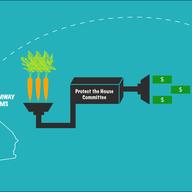
How California Baby Carrots Turned Into a Cash Crop for New York Republicans
Republicans desperate to keep control of the House of Representatives are using a recent Supreme Court ruling to raise millions for vulnerable colleagues, including New Yorkers John Faso, John Katko and Claudia Tenney.
The fundraising effort is being led by House Majority Leader Kevin McCarthy and is known as Protect the House. It’s one of myriad ways for campaigns and activists to raise and spend money following years of Supreme Court decisions loosening the rules.
Protect the House is what’s known as a joint fundraising committee, which is pretty much exactly as it sounds: Political groups join together to share the time and expense of fundraising — and share the money they raise. Donors can write one big check to Protect the House, and the money is distributed to dozens of candidates.
It’s a way for a high-profile politician like McCarthy, who wants to be the next speaker if Republicans keep their majority in the House, to earn the loyalty of freshman colleagues like Faso and Tenney.
But critics say the growing use of joint accounts are another example of runaway modern fundraising in the age of Citizens United. The set up can create a convoluted web of political IOUs: Members are indebted to leadership raising the money; leadership is indebted to deep-pocketed donors; and donors expect a return on investment from everyone involved.
“The favor factory is an apt description,” said Sheila Krumholz, director of the Center for Responsive Politics. “There is going to be a favor associated with that money by the donor and by the recipient.”
McCarthy wants to follow in Paul Ryan's footsteps one Ryan retires, but he’ll have to overcome precedent.
“History is against us,” McCarthy said last month as a Public Policy Institute of California event. “I actually gave a presentation to the president at Camp David earlier this earlier this year. Normally the party in power loses roughly 32 seats. Twenty-three seats is our majority.”
Republicans have to get their message out, he told the audience, and to do that they need money. McCarthy spent the August recess crisscrossing the country; he — with some help from Vice President Mike Pence — has raised $13.8 million for Protect the House so far.
“I will leave here, get on a plane,” McCarthy told the Public Policy Institute of California recently. “I’ll go to Indianapolis. I’ll go to Iowa. I’ll go to Minneapolis. I’ll go to Omaha, Nebraska. And I’ll be back in California on Sunday and then I’ll be back on the road again.”
McCarthy has turned to donors like Barbara Grimm Marshall, who co-founded the world’s largest carrot grower, Grimmway Farms. She’s given to 29 candidates around the nation and more than $500,000 in this election cycle, according to Center for Responsive Politics data.
The biggest chunk of that is a $371,500 donation to Protect the House in March. Las Vegas casino owner Sheldon Adelson and Houston Texans owner Robert McNair and his wife have also given as much.
Unlike super PACs and other outside groups to which those same donors have given millions, federal campaign limits apply — a maximum of $5,400 from any individual donor. But — also unlike super PACs and the other groups — the money goes directly into a candidate’s account. And that’s a big advantage, Krumholz said.
“Any candidate would rather have money in the bank, money that they have the possibility to tap whenever they need it,” she said.
There are lots of ways for candidates to return the favor if they win. Faso, for instance, sits on the agriculture committee. And he’s already on record supporting McCarthy for Speaker.
His campaign declined to comment for this story. So did Barbara Grimm Marshall of Grimmway Farms.
But Protect the House has meant easy money, turning California baby carrots into a cash crop for New York Republicans.
Federal records show Protect the House has raised $169,000 for Faso so far, doled out every few weeks like an open faucet. Katko and Tenney have received about as much.
And the multiplier effect is only limited by how many partners there are in the joint committee.
Until recently, the donors could only give $123,000 per cycle, total, to candidates and parties. But the Supreme Court struck down that cap in 2014, in a case known as McCutcheon v. the Federal Election Commission.
Brendan Fischer tracks campaign finance issues for the Campaign Legal Center. He scanned Protect the House documents and started adding up the numbers to figure out how much one person could give.
“My rough math, there’s 24 candidates, there are two PACs… the PACs would be $5,000, each,” he said, taking notes. ”Twenty-four candidates, that would be, if it’s both for primary and general, $5,400.”
There’s also several accounts at the National Republican Congressional Committee, the GOP’s campaign arm for the House. It adds up fast.
“So that means a donor could write a check exceeding five hundred thousand dollars to Protect the House,” Fischer concludes.
Grimm Marshall mostly gives directly to candidates and state parties. The McCutcheon decision had a dramatic effect on her donations.
Records show she donated about $100,400 back in the 2014 cycle. In the next cycle — the first full cycle following the McCutcheon decision — her donations more than doubled. And already this cycle, they’ve more than doubled again to $517,000.
“The Supreme Court’s decision in McCutcheon supercharged joint fundraising committees,” Fischer said.
In the four decades before McCutcheon, there were 2,000 joint fundraising committees. In the four years since the decision, eleven hundred have been added.
And campaigns have found loopholes around the remaining restrictions. A big one: State parties can send as much as they want to national parties — and the national party might then spend it on candidates. Just as lawyers said they would when they argued McCutcheon in 2013
Supreme Court Justice Samuel Alito was skeptical.
“How realistic is it that all of the state party committees, for example, are going to get money and they’re all going to transfer it to one candidate?” Alito asked the Department of Justice attorney defending the limits.
But that’s exactly what the Democrats did during the 2016 presidential campaign, according an FEC complaint filed by a super PAC supporting President Trump.
Both Hillary Clinton and Trump set up joint fundraising committees.
Records show that Clinton raised money for state parties, who then transferred it back to the Democratic National Committee. The DNC then spent the money on Clinton’s campaign. The complaint alleges the DNC spent $84 million more on Clinton’s campaign than the law allowed.
It could take years for the FEC to rule on the complaint. In the meantime, the practice can continue. Fischer says the transfers are a way to circumvent limits on hard money.
“Laundered is about accurate,” Fischer said. “In a variety of different areas we’ve seen candidates and political operatives feeling comfortable pushing the legal envelope because they have little fear of the FEC actually taking legal action against them.”
A Protect the House spokesman did not respond to requests for an interview.
Records show they haven’t copied the practice yet. But they do show that Protect the House added 14 state parties to the account last month, including the Republican parties of New York and New Jersey.
So the maximum individual contribution to Protect the House is now up to $527,700.

WNYC is funded by sponsors and member donations