'Born To Drum' Presents A Wide World Of Dudes, And One Chapter For The Ladies
Not sure if I’ve outed myself before, but when I’m not helping to prop up the New Sounds Empire, I’m a drummer -- playing metal, rock, and pop. As a teacher of drums -- a lot of my students identify as female -- I also care a great deal about the visibility of female drummers. And I cheer and fist-pump when I see players who are women and non-binary genders getting good press -- be it inclusion in books and magazines, online interviews, serving on panels, giving master classes, getting sponsorships, being part of the answers to drum quizzes, or top drummer lists -- moving audiences, and inspiring young and older people. I just do.
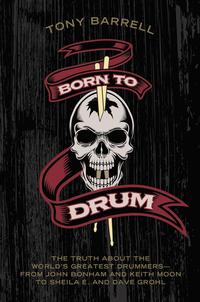
In all of my free time, as one might expect, I devour books and magazines showcasing drummers to learn a few things about my favorites (like jazzer Terri Lyne Carrington, Sheila E., or Stella Mozgawa from Warpaint), and discover new ones (Jess Bowen of The Summer Set, & Emily Dolan Davies, formerly of the Darkness.) Every now and again, people pass me reviewers’ copies of books involving drums and drummers. Which is how I came across a copy of Born To Drum: The Truth About The World’s Greatest Drummers, From John Bonham And Keith Moon To Sheila E. And Dave Grohl.
Sweet! A heavyweight like Sheila E. included in the subtitle!?! At least I wasn’t going to be consuming another boring list of drummer-dudes to whom everyone always gives props. (Re: “The Greats.”) But as I dove in, I realized this was a collection of bizarre, yet somewhat predictable conclusions author Tony Barrell has drawn about drummers: drummers are flashy, working class (because they have many tattoos?), and, by and large, many are lunatics.
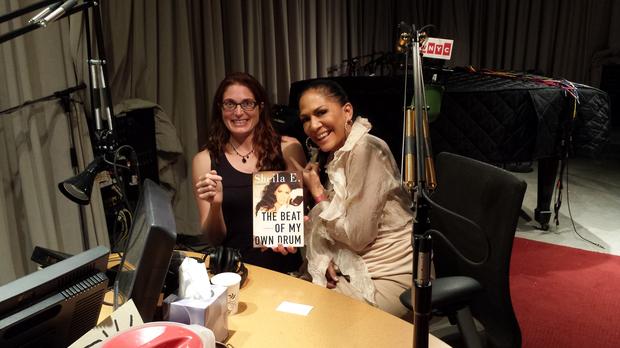
As the chapters wore on, there was nary a mention of a female player, and my frustration began to mount. Was this another one of those collections of old boys club stories and perhaps some words from a token female player, Sheila E., lifted from her very excellent recent autobiography, The Beat Of My Own Drum: A Memoir? (WHICH SHEILA E. SIGNED FOR MEEEEE!)
Well, yes and no. After 104 pages of waiting to finally read something about a drummer who was not a man, there was an entire isolated chapter, simply titled “She Plays The Drums.”
In this chapter, Barrell quickly acknowledges that women have been drummers -- since the beginning of civilization. (For much better detail on that history, check out Layne Redmond's When The Drummers Were Women.) Barrell also briefly cites jazzer Viola Smith and her contemporaries, and mentions Honey Lantree from the 1960s. There were no mentions of trail-blazing female drummers like Alice de Buhr (Fanny), Palmolive (The Slits) -- save Moe Tucker (Velvet Underground), Sandy West (The Runaways) and Karen Carpenter. There's a long line of names that were left out -- something Angela P. Smith tackles in her book, Women Drummers: A History from Rock and Jazz to Blues and Country, which catalogues and presents encyclopedic entries on a whole range players over the years.
That said, Barrell goes on to devote the chapter to introducing female drummers, mainly rock & pop players, from the 1980s through 2010s -- some better known than others -- and sharing how and why they became musicians or educators, and the odds stacked against them. He also provides quotes from them about their lack of representation in music or the media, and the stereotypically (but not unexpectedly) awful assumptions leveled at these players. There was also a hefty page or two devoted to Sheila E:
I fist-pumped and might have cheered aloud to read that Barrell had attended a Tom Tom Magazine event in London and even spoken to Tom Tom’s creator, Mindy Abovitz (Full disclosure: I am an occasional contributor to Tom Tom Magazine.)
In all, it felt like the book's “She Plays the Drums” chapter was included only at an editor’s insistence, as if an organizational afterthought. And especially so, with a later chapter called “Do You Think I’m Sexy?” devoted to all of the women who have crushes on more famous male drummers. There was an awkward segue at that point, which highlighted the objectification and sexualization of female drummers and somehow made the fact that people might find us sexy into a bad thing -- which, just as quickly took a left turn and went into speaking about drummers who are married, such as Cindy Blackman Santana.
To be fair, there was also a worthwhile chapter on “secret drummers,” about musicians who are much better-known for their other talents, like Madonna, James Brown, Suzy Quatro, Donovan, or Belinda Carlisle. Folks like Debbi Petersen (of The Bangles), and Patty Schemel (Hole) are metioned, but there’s not one drummer among these who is a woman who then cites her favorite drummer, banishing any kind of proud lineage that might be claimed. And the author does carefully throw out one crumb from a famous female drummer of note on studio techniques, or mention others in the chapters on pain and substance abuse, and the section on drummers as diplomats and peacemakers. It’s not as if I sat there and made hash marks for every time a player who wasn’t a man was mentioned throughout the 300 or so pages. But the inclusion of the experience of these “token” players felt less natural and interspersed throughout than I would have liked.
(Patty Schemel at the Hit So Hard premiere):
So, in a book constructed from loosely collected anecdotes such as this, why is there such a pronounced separation of female drummers from just drummers, and why mostly relegate them to only one chapter?
In the current July 2015 issue of DRUM! Magazine, there's this quote from Daniel Glass, which was really nice to read, even if a little hard to believe, at least in the world of heavy metal: “These days, we are accustomed to seeing fantastic female drummers laying it down at every level of our industry, from local clubs to arena stages.” Why this isn’t reflected in a book about drummers and drumming is bewildering, maddening, and perhaps a little insulting. It's pretty much the same as in many mainstream magazines. Also, it feels like Tony Barrell's Born To Drum could serve as an open invitation for someone to better balance the scales by mentioning drummer-dudes in passing, and devoting more pages (in print and online) to introducing a wide world of players that deserve more attention.
And now please enjoy this drum solo by Kim Thompson:

WNYC is funded by sponsors and member donations