Girl Singer, Part I
Pop arranger Billy May once said that there are three kinds of human beings: men, women and girl singers. By that, he meant that girl singers were especially idiosyncratic: flighty-moody, always running late, a bit daffy, leaking jealousy of other girl singers, occasionally hilarious, often bawdy, sometimes squeaky-whiny, erotic on the phone with husky morning blues.
In the Fifties, my record albums consumed first my father’s apartment and eventually my own. The “A” shelf, then: Sinatra, the early Miles Davis, Beethoven string quartets, anything for the cello, the Verve Billie Holiday, the original-cast recording of Carousel and the albums of a woman named Beverly Kenny.
Tricky covers on those albums. You couldn’t get a feel for what she really looked like. Was she blonde or dark-haired or what? Was she pretty, or kind of not pretty—who could tell? She was a chameleon on those covers, elusive, hiding.
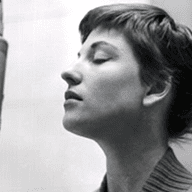
But then, in the music trade Cash Box, there was a photo of Beverly Kenney that seemed accurate. She was standing with the blind pianist George Shearing. That photo revealed a quite beautiful woman, voluptuous, dignified. She appeared ethnically mum. Her dark hair was short. She was smiling and not smiling at the same moment.
Beverly Kenney left Harrison, New Jersey, as fast as she could. She came from a huge Catholic family in a blue-collar town, which she fled, not with malice but, it might be assumed, with a certain kind of panic built on claustrophobia, and a secret knowledge far too threatening for her to examine: she was rich in overview. She was wise. She was significantly empathic.
She might have realized this gradually, or understood it in one grand moment, an epiphanic fraction of a second in which truth came flooding into the teenage girl she had so recently been. It’s possible she felt helpless, falling through dreams, drifting above her sleeping family and away into the night, passing through the darkness into the territory of the Outsider while maintaining a credible radiance during the day-to-day of it. She hid out inside herself, swamped in the guilt of her elevation. All Beverly Kenney could do was run.
Run anywhere. First to the Newark YWHA. Then to Miami. Soon to New York City, to Greenwich Village, where the music was, where the writers wandered. Beverly loved the music, the songs, the Billie Holliday in the walls. She loved jazz and musicians and the smoky little rooms where the tunes got played. And she could sing. She got up occasionally to do so, and the people applauded.
What exactly were they clapping their hands for? Clearly, for a marvelous-looking girl with the guts to stand before them. And, surely, for the twists and turns this natural musician revealed. Her jazz melodies, within the standard songs she presented, were something new. They dipped and rose and dug deeply into the song at hand, supplying semicolons, parentheses and italics that invited the audience into the soul of the lyric, into Beverly Kenney herself.
There was just a little bit of gum-chewing in Beverly’s sound, girl-singer common, a kind of scat without scatting, vibrato-less, gee-whizzy, Fifties-cool. Beverly, born in 1932, was still something of a kid by the time she’d found her way downtown. Her secret, glowing like gold in a stream, was her wisdom. And so she hid out, deep down under the chewing-gum cool.
She sought out pianists and drummers. She moved in with them, or they with her. She ingested their drugs and their drink, she called at four in the morning. She was Beverly Kenney, girl singer, who slept till mid-afternoon.
The Tommy and Jimmy Dorsey Orchestra invited her on board. There began the trail of Beverly Kenney albums. What was going on was something of a career. But, not surprisingly, Beverly left the Dorsey band after only three or four months; she was far too much of an original, her mind happily cluttered with improvisation.
In the world on her own as a jazz singer, she began the nomadic life of a free-lancer: Toronto, Rochester, Cleveland, Philadelphia, Chicago. “I’m opening one of the top jazz rooms,” she wrote to her family from Chicago. “It’s known as Mr. Kelley’s.” Ah, Mr. Kelley’s the legendary Mr. Kelley’s: Saragh Vaughan, Anita O’Day, Nancy Wilson, Carmen McRae.
From Philadelphia, she wrote: “Toronto was a ball and I have a return engagement April 9th. To date it is the best town for jazz crusaders, and naturally that’s my speed.”
“Jazz crusader.” Let me look up “crusade”: “Vigorous concerted action for some cause or against some abuse.” The cause: the presentation of American song through fresh and unyielding eyes. The abuse: mediocrity of spirit and intention. But then there’s this from Miami Beach:
I’m a mite disappointed in my trip here because I, as usual, built it up so much. According to those who know, this is Florida’s worst season. The clubs are all dying and therefore so are the artists. All except the name talent. There are about 150 female vocalists like myself and about 50 are working. I am not one of the fifty. So far I’ve done one week’s engagement, and my money dwindled long ago. I have much time to read and came across an interesting thing on “karma,” entitled Green Mansions, by Gino Carminera, my introduction to the reincarnation theory and probably not my last. Also read Wiley’s latest, Tomorrow, a little gory but still Wileyish.
This from a girl singer camped out in Miami Beach, probably with a piano player named Johnny Eckner (“B. Kenney c/o Eckner, 6959 Harding Ave.”)
But the albums reached the right people. There appeared a New Yorker review, enthusiasm from William B. Williams on New York’s influential WNEW, an invitation from The Steve Allen Show.
“I’m enjoying a bit of public appreciation,” Beverly wrote home. “As usual, I have complaints about the backup music, but my loyal esoteric fans are with me anyway.”
“Crusade.” “Esoteric.” Again to the dictionary, for “esoteric”: “Meant for or understood by only a chosen few.”