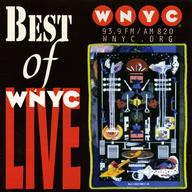
The Best of WNYC Live - Volume One
Originally published in 1999.
When I was a kid, I assumed that the music I heard coming from the radio in the kitchen was somehow being played by real musicians, right there in that little box. Admit it - you thought the same thing. But then we grew older, and wiser in the ways of the world. That's when we realized that the musicians weren't really in that little box. They were obviously playing this music in the radio station's studio, where the announcer was. If it seemed odd that the announcer never actually referred to the musicians or acknowledged their presence in any way, well, that was just another example of adults being odd.
Most people don't remember the exact moment when they learned that all the music on the radio was actually coming from records. I do remember feeling cheated, somehow. What made it even more unfair is learning, later on, that for many years people really did hear live music on the radio. Then it seemed to stop. Why? Well, from experience, I can now tell you why. It's expensive. It's time-consuming and labor-intensive. It's hard to do and really hard to do well. But it's also worth doing. Because there is an excitement and intensity to live performance that is rarely heard on recordings. And having musicians in the studio gives all of us an opportunity to meet the real people who make and play the music. These segments provide a friendly, informative entrance to the music we play on WNYC.
What is the music we play on WNYC? We are the world's oldest classical music station, but we've always taken a broad view of what "classical" means. So while this CD features such classical mainstays as Mozart and Brahms, it also includes musical curios like the Modern Mandolin Quartet's performance of a Haydn piece, and an on-the-spot composition for vocal ensemble by Bobby McFerrin.
A few of these performances were recorded for WNYC-FM's nightly new music program, New Sounds. Started in 1982, New Sounds first presented live music in the studio in the fall of 1983, and began the ongoing New Sounds Live concert broadcast series in 1986. Others are from Around New York, which was a grand experiment in daily live performance, begun in September 1991 and running until the end of 1996. During that period, when the City of New York was divesting itself of the licenses to WNYC and harsh fiscal realities set in, Around New York was scaled back to the slightly more manageable series of weekly performances we call simply WNYC Live. This segment airs each Thursday afternoon at 2; and occasional other segments often appear elsewhere during the week.
At the same time, WNYC has begun producing more live music outside the studio than ever before. Our director, Eileen Delahunty, and our tech crew, directed by Edward Haber, maintain a grueling schedule. Fortunately, our crew is first rate, and it's worth mentioning their names here: Michael DeMark, George Wellington, Irene Trudel, Wayne Schulmister and Paul Ruest. Live broadcasts from the Chamber Music Society of Lincoln Center, Brooklyn's Bargemusic, the Frick Collection, the Kosciuszko Foundation, New Sounds Live at various venues, and occasional special events do more than just keep the concert crew off the streets and out of trouble. They help to recapture, I hope, some of the magic, and sense of event that surrounded music performances during the "Golden Age of Radio."
Richard Cobo
Brouwer: One Day in November
A hauntingly beautiful piece of musical impressionism from Cuban composer Leo Brouwer, still unpublished. Played by a talented Columbian guitarist now residing here in NY. Recorded: April 8, 1998. Mix Engineer: Michael DeMark.
David Golub
Brahms: Intermezzo in A, Op. 118 #2
David Golub is one of America's premiere pianists - a renowned soloist, member of the Golub/Kaplan/Carr trio, and now a conductor as well. He performed this lovely late piece by Brahms on WNYC's Steinway B, a vintage 1959 instrument that was rebuilt (by the same fellow, we're told, who originally built it!) in 1995. Recorded: January 15, 1998. Mix Engineer: Michael DeMark.
Marianne Faithfull
Weill: Bilbao Song
Wonderfully decadent, world-weary singing from the rock legend whose voice once inspired the Rolling Stones and now inspires visions of a... well, decadent, world-weary cabaret singer. One of our most memorable in-studio performances. Recorded: January 23, 1997. Mix Engineer: Edward Haber. Marianne Faithfull appears courtesy of BMG Entertainment.
Continuum
Pärt: Ein Wallfahrtslied (A Song of Pilgrimage)
One of the classical world's most popular composers, the Estonian-born, German-based Arvo Pärt often evokes the music and spirit of medieval Europe. The liturgical text and hushed accompaniment of this performance are typical of his style; the vocal part, sung by James Martin, is extraordinary in its simplicity - it uses only three notes! Easy to sing, but hard to sing well. The performance is by one of New York's leading contemporary music groups, based at the famed Juilliard School, Recorded: October 10, 1998. Mix Engineer: Edward Haber.
Philip Glass
Glass: Etude #2
The classical music world's most recognized contemporary composer is a longtime friend of WNYC. This Etude is part of a set of piano etudes, one of which was written by Glass for WNYC-FM's 50th birthday in 1994. Recorded: July 25, 1995. Mix Engineer: Michael DeMark. Philip Glass appears courtesy of Dunvagen Music Publishing.
Jocelyn Montgomery, David Lynch
Hildegard von Bingen: O viridissima
Yes, that David Lynch. The famed film maker created the sound environment into which early music specialist Jocelyn Montgomery sings the timeless music of the 12th century abbess and composer Hildegard. Montgomery is a former member of the fine English early music group Sinfonye. This performance, from New Sounds Live at the World Financial Center, was broadcast on the Internet as well. Recorded: January 22, 1999. Mix Engineer: George Wellington with Irene Trudel. Jocelyn Montgomery appears courtesy of Mammoth Records.
James and Jeannie Galway
J.C. Schultze: Sonata for 2 Flutes
Don't worry, we've never heard of him either. Schultze, that is. Everyone knows James Galway, the "man with the golden flute." His wife Jeannie is a fine flutist as well, and part of the trio Zephyr. The two of them introduced us to this brief but charming work by an otherwise totally obscure German Baroque composer. Recorded: November 4, 1998. Mix Engineer: Edward Haber. James Galway appears courtesy of BMG Classics.
Modern Mandolin Quartet
Haydn: Minuet and Trio from "The Lark" Quartet
Two mandolins (played by Mike Marshall and Dana Rath), mandola (Paul Binkley), and mandocello (John Imholz) play music from the classical string quartet repertoire. An engaging but somewhat different approach to a classical favorite. Recorded: October 26, 1995. Mix Engineer: Michael DeMark.
Bobby McFerrin's Circlesongs
McFerrin: improvisation #3
The singer, hit songwriter, conductor, and opera composer leads an all-star group of vocalists in a live improvisation, conducted by McFerrin in the studio. This genial, elegant assortment of conventional and unusual vocal sounds is typical of McFerrin's work; the fact that they're making it up as they go along may surprise you when you hear how "composed" the piece sounds. Recorded: April 22, 1997. Mix Engineer: Michael DeMark.
Anonymous 4
Hildegard von Bingen/Anonymous: O rubor sanguinis/magnificat animomea.
A medley of one of Heldegard's typically ecstatic 12th century melodies with a traditional liturgical chant of the time, by one of classical music's most popular groups. Anonymous 4 was first heard on WNYC-FM shortly after they formed in late 1986, and were WNYC favorites well before the rest of the world caught on. Recorded: May 9, 1995. Mix Engineer: Michael DeMark.
Manuel Barrueco
Sor: Variations on a Theme by Mozart
Barrueco is probably best-known for the TV commercial for Lexus, where he recorded an actual CD track in the back seat of the car. Off screen, he is one of the most popular classical guitarists in the world, and has had a recent series of crossover hit records as well. Recorded: February 25, 1998. Mix Engineer: George Wellington.
Ruth Laredo
Mozart: Piano Concert #14, 2nd movement
The Manhattan School of Music Chamber Sinfonia, Glen Cortese, Conductor
From WNYC's 1998 New Year's Eve broadcast, a mammoth, nationally-syndicated show that involved crews at Bargemusic in Brooklyn, the 92nd Street Y on the Upper East Side, and the majestic Cathedral of St. John the Divine, where this recording was made. It features one of America's pre-eminent pianists, and a gifted group of MSM students, who performed with professional aplomb despite the cold (you can hear the heating fans if you listen closely) under the able direction of Glen Cortese, one of New York's busiest conductors. This performance courtesy of the Manhattan School of Music, in support of WNYC Radio. Recorded: December 31, 1998 at the Cathedral of St. John the Divine. Mix Engineer: George Wellington with Wayne Shulmister.
Jerry Hadley
Carlisle Floyd: "It's About the Way People Is Made," from Susannah
Susannah, spotted by some of the townsfolk while bathing in the river, has become the target of lies and false accusations. She asks her brother how people can turn so cruelly on one of their own, and he answers her with this song. Simply beautiful music from an opera only now coming into its own. Jerry Hadley is one of the Met's brightest stars, and has become one of American's most successful operatic tenors. Recorded: February 25, 1999. Mix Engineer: George Wellington.
Producer: John Schaefer
Mastering Engineer: Edward Haber
Project Coordinators: Ken Dinitz, Fred Child and Ted Manekin
Special thanks to Ralph Graves and Digital Chips, Inc.
Thanks to: Sara Fishko; Francois Ravard; Susan Jacobs; Glen Cortese; George Martynuk; Jim Keller; Dunvagen Music Publishing; Nancy Wellman; Jennifer Plantz; George Nicholas; Linda Goldstein; Sony Classical; Angel/EMI Records; And YOU, for supporting WNYC Radio!

WNYC is funded by sponsors and member donations