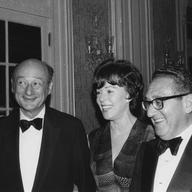
Bess Myerson Starts Her Career in Government
"This is the greatest city in the United States," Bess Myerson Grant (as she is then called) declares at her swearing-in as New York's first Commissioner of the Department of Consumer Affairs, "but it can also be the most difficult. Right, Mr. Lindsay?" …a sentiment to which Mayor John Lindsay can be heard echoing an emphatic agreement.
"This is the greatest city in the United States," Bess Myerson Grant (as she is then called) declares at her swearing-in as New York's first Commissioner of the Department of Consumer Affairs, "but it can also be the most difficult. Right, Mr. Lindsay?" …a sentiment to which Mayor John Lindsay can be heard echoing an emphatic agreement.
This 1969 press conference captures the city government at its most condescendingly genteel, with Lindsay praising her "eleemosynary" work while at the same time paying tribute to her "beauty" and "winning smile." Myerson, in contrast, sounds determined to lay her glamorous past to rest, reading a prepared statement promising to "exorcize from this city the persistent cancer created by greed and advantage-seeking…" She points out that consumer fraud has a particularly devastating effect on the poor who are often the victims of illegal installment contracts, are unable or unwilling to take law-breaking merchants to court, and have no lobbying power. On the other hand, she seems aware that the Consumer Affairs Department must compensate for its relatively weak enforcement tools by functioning forcefully in the area public relations, by pointing out unscrupulous business practices and shaming those who rely on such deception. The office's aim, she concludes, will be warning consumers "not so much what to look for as what to look out for."
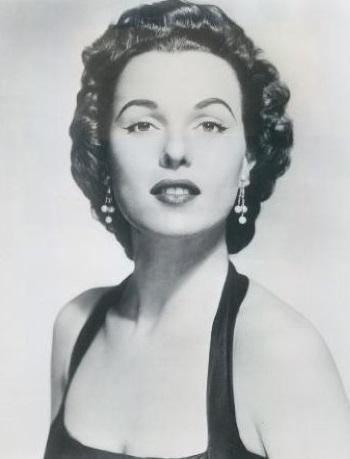
In 1945, at the age of 21, Bess Myerson (1924-2015) became the first Jew to be crowned Miss America. For the next forty years she was rarely out of the public spotlight. As a beauty queen, television personality, fund-raiser for various charities, public servant, politician, and finally the focus of a bizarre scandal, Myerson had an extraordinarily eventful ride on the roller-coaster of American celebrity.
Although it might seem a minor milestone now, Myerson's being crowned Miss America was a major news story, and not all of it positive. As Susan Dworkin, who wrote about the event and its aftermath, reminisced:
…when Bess won, she went on this tour and expected to be loved and applauded. Instead, everywhere she went, she was met with terrible bigotry. People didn’t want her at their country clubs. People didn’t want her at their hotels. There was a horrible incident with the parent of a World War II veteran at a hospital who screamed at Bess that it was because of the Jews that her son was dead. After a couple of months, she had to go home. She had nothing left to do.”
Myerson was more than a pretty face. Driven, articulate, musically talented, and ambitious, she was faced with the dilemma of how to parlay her dubious fame into something more significant and long-lasting. Television provided an initial career. She was a longtime panelist on I've Got a Secret and regularly substituted on The Today Show. Her 1969 appointment to the Department of Consumer Affairs was a surprise. But it turned out that an agency whose clout depended a great deal on publicity was a good fit for Myerson, who had developed a professional's command of the media. Though derided within the Lindsay administration as something of a loose cannon, she was one its most recognizable and, as the financial crisis tainted almost every other branch of government, most beloved representatives. The New York Times, in its obituary, noted how:
Some Lindsay critics initially called her appointment “window dressing.” But she became highly visible in the job, issuing the first city regulation in the nation requiring retailers to post unit prices on a wide variety of products to make comparison shopping easier. She pushed through consumer-protection laws against deceptive trade practices, chastised restaurants selling hamburgers that were less than 100 percent beef — she called them “shamburgers"— and criticized manufacturers for putting too many peanuts in jars labeled “mixed nuts.”
Myerson's political journey then took a wildly unpredictable turn when she was enlisted by Ed Koch's mayoral campaign to appear with him as a kind of surrogate wife to counteract rumors of his homosexuality. This led to her own unsuccessful campaign for Senate in 1980 and to her appointment as Commissioner of the Department of Cultural Affairs in 1983. However, her involvement with Carl Capasso, a sewer contractor involved in a contentious divorce proceeding being overseen by a judge whose troubled daughter Myerson appeared to have hired with an eye towards influencing the judge's rulings, led to widespread unflattering news coverage and a corruption inquiry. Myerson's imperious behavior was gleefully reported and shortly before she was to stand trial she was convicted of shoplifting. Although she was eventually acquitted of bribery, the "Bess Mess," as it was known, effectively ended her public career. She was forced to resign her position and went from being one of the city's most prominent figures to near-invisibility, the self-imposed obscurity providing a strange coda to such a public life.
This press conference captures Myerson at what must have seemed like the beginning of yet another triumphal chapter: the poor girl growing up in the Sholem Aleichem Houses in the South Bronx rising to a high-profile job in city government. A few years later, New York Magazine captured her at her zenith, the way she would probably most likely want to be remembered:
A tall, elegant brunet steps out of the car. She’s attired in a classic Jerry Silverman blazer, skirt, and turtleneck sweater, low-heeled black boots, and green sunglasses. She is nearly six feet tall; she looks men in the eye and towers above women. The congressman puts his arm around her so that it appears that he is guiding her, but it is the other way around.
Over seventy years later, Myerson remains the only Jewish woman ever to be crowned Miss America.
Audio courtesy of the NYC Municipal Archives WNYC Collection.
WNYC archives id: 151726
Municipal archives id: T4118-T4119

WNYC is funded by sponsors and member donations