Atop Vessel, You'll See Old New York Disappearing
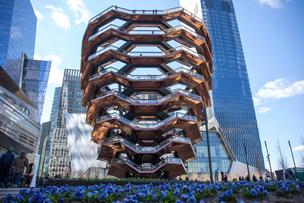
A vase, a basket, a 3-D Escher drawing sprung to life, endlessly looping. There's something about the immensity of Vessel, the 15-story-high public sculpture at Hudson Yards, that makes you want to describe it with an analogy on a more humanly relatable scale.
"A giant hockey mask," offered Rasmia Kirmani, a housing development specialist who until recently worked for the city. "An exoskeletal beetle."
A beetle that, according to The New York Times, is "sheathed in a gaudy copper-cladded steel." The critical reception for Vessel, and for Hudson Yards as a whole, has been poor. The gripes have ranged from how the development and its high-end mall turns it back on the rest of Manhattan to the shadows thrown by Vessel onto the outdoor public space.
And yet, those concerns seem to fade after you present your free timed ticket and begin to climb the sculpture's two thousand five hundred steps. There are people above and below you, silhouetted, on ramps like ants in a colony where there's no real work to do. (Taking selfies doesn't count as work, although visitors who post images of the site on social media are technically engaged in making content for Vessel.)
But turn your back on the mall and face west and you'll find a somewhat surprising sight: a lingering remnant of a waterfront that once used muscle and machines to move people and goods, and that made things. There, where the deck that holds the towers has yet to reach, you'll see row upon row of Long Island Railroad trains, round-backed and gleaming in the silver-white sun. Behind them flows the unruffled Hudson River.
"It's like the end game of post-industrialization," said architectural historian Gabrielle Esperdy as she looked on the scene and across the river to New Jersey. "The waterfront here and in Hoboken and Jersey City — it has all transformed into something else and now we're just seeing the end of it."
Part of the confusion about and pre-contempt for Vessel, I'd suggest, is that it looks like it's supposed to be doing something — holding parked cars, maybe? In fact, it's an architectural folly, a decorative structure that misleadingly appears to serve a purpose. The simplest purpose of Vessel is to present visitors with a mounting series of views of what once was Manhattan's gritty West Side and is now home to the wealthy and the brands to which they obsessively pledge allegiance: Fendi, Neiman Marcus, Dior, and more.
The city as we know it is always disappearing. If you decide to visit Vessel, you might honor that notion by approaching on foot along the High Line, an exquisitely designed urban parkscape that for most of its life was a freight line.

WNYC is funded by sponsors and member donations