Ambassador J. M. Baroody
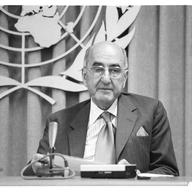
The Overseas Press Club presents James Pinkney, sitting in for Seymour N. Siegel, moderating a panel of journalists who interview Ambassador Jamil M. Baroody, Deputy Permanent Representative from Saudi Arabia to the United Nations. The panel includes:
Spyridon Granitsas, Cyprus Broadcasting Corporation
Mary Hornaday, formerly of the _Christian Science Monitor_
Ed Edwin, political writer
Ambassador Baroody has been the Saudi Arabia representative for more than 20 years, going back to the League of Nations. He does not see the fact that he is not originally from that country as problematic since he is a self-proclaimed "pan-Arab." Mr. Baroody believes that the Middle East will be a source of conflict for many years since Arabs see the Zionists (like others before them) as invaders; he emphasizes that this is not a religious question but rather a cultural question, or rather a way to preserve their original way of life. He goes through a history of the region, saying that after WWI the Allies "gerrymandered" the area in exchange for the liberation of Arabs from the Turks.
On the question of whether the 1960s will truly be known as the "decade of development," Mr. Baroody finds the matter academic. He contends there will be no substantial progress int he world until there is a change of heart in the big world powers and more resources are shifted towards development instead of armament.
Ambassador Baroody gives a historical perspective on young people's worldwide unrest. He thinks the industrial revolution made people achieve maturity much later, and the Soviet revolution made people more aware of their economic position. Meanwhile, the world's great three monotheistic religions, which originally sprung from tribal societies, have failed to keep up with the times and have been somewhat hypocritical.
On the question of why Syria and the United Arab Republic have not condemned Russia's invasion of Czechoslovakia, Mr. Baroody demurs, saying it is a decision of each country, and that the matter is simply a question of balance of power in Europe.
Ambassador Baroody then tackles the question of mass media, which he believes to be very powerful. U.S. media seem mostly hostile to the Arab cause, which is why there are so few press representatives in the U.S. Until the Palestine question is taken off the U.S. domestic agenda, he believes there is little reason even to try to shape public opinion in America. "All media is controlled," he says, by someone or other; there is more "Freedom of license" than "Freedom of information."
Mr. Baroody thinks that ocean floor exploitation should be regulated by international treaties that benefit all of mankind. He is concerned that worldwide population growth will bring about famine which can only be tempered through additional protein resources outside of agricultural methods. These resources include the world's oceans.
Produced by Sylvia [Sirota] Taylor
Directed by John Baird
Audio courtesy of the NYC Municipal Archives WNYC Collection
WNYC archives id: 151848
Municipal archives id: T5989