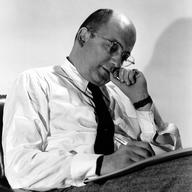
Abe Burrows Seminar
Abe Burrows discusses the function and activities of the librettist in the musical theater in this seminar for the American Society of Composers, Authors, and Publishers.
Burrows begins by bemoaning the lower reputation of authors of musical comedies in America, comparing their work with famous opera composers.
He reminds us that Cole Porter only wrote one song that was not part of a show. He preferred to work within the idiom.
Burrows discusses his main role, which is writing the libretto, which is "not the most important part of a show, but it is."
The librettist must place songs within the structure of the play. He argues that there must be a close-grained interaction between songwriters and librettists because of this. Songs should say something that spoken words do not. Music expresses emotions that words cannot.
He discusses the opera "The Ring of the Nibelung" and the emotional import of the music.
He discusses working with Bob Fosse and the use of dance and music. Fosse suggested a soft-shoe routine during an office setting in a play, which worked well. Burrows wrote the script after this was established. The song precedes the full writing of the scene for Burrows. He talks about writing this way with Oscar Hammerstein.
The librettist should always defer to the songwriter/composer. He describes a librettist who stubbornly refused to collaborate with a composer she was working with and describes his process in Guys and Dolls - he shared a bit of dialogue for a song.
He talks about writing to a libretto for 14 of the songs from Guys and Dolls after they had been written. He talks about the word integration in the context of musical theater; to him it means "unity of feeling (idea, purpose)."
A song must be a single emotional statement. It does not just further the plot. Scenes should build to a song (for the most part).
There must be respect between librettists and songwriters, etc. when talking about integration.
Burrows opens the floor to questions:
Don't you continue with your scene after the song is done? Not if the song is right. If it is you should not be able to go on with the scene.
He is asked about plot songs and character songs.
He talks about structural elements of musical theater and what plot songs and character songs are to him. At one point he notes that such questions would not be asked of an opera.
How did you arrive at the rapid-fire opening to Guys and Dolls?
Michael Kidd came up with it in a brainstorming session. The ballet section had come in after the book had been finished.
A question is asked about the order of writing between the song and the libretto.
Burrows clarifies his earlier response, arguing for the necessity of ideas and communication.
Would discourage the librettist from writing words and then seeking a composer? He thinks it chancy - 20 to 1 odds. He talks about famous songwriting partners' processes. Most of them worked closely though differently in each case.
The less libretto the better?
he answers by clarifying his dislike of the word libretto, by which he means the spoken word and the ideas of the songs. He proposes the word "gunk," the whole thing. He compares the "libretto" to gravity - is it gravity's purpose to hold us to Earth, or are we on Earth because gravity holds us there? The libretto/gunk is like the latter, there is no "purpose" to it.
Are there advantages to doing an adaptation over creating original works? He discusses the nature of creativity and adapting previously unknown material. He discusses Pygmalion/My Fair Lady, Shakespeare, and his failure adapting Jane Austen.
Burrows is asked what he means by music that is not really a song. Once ideas are expressed musically they become songs. He discusses an example from Pygmalion.
[gap]
Burrows is discussing hit songs; in this case from Guys and Dolls.
Ideas should develop in a song (as opposed to a musical idea). Opera is different because it is all sung, but even in opera and symphony there are full ideas expressed.
How much time does it take to do a show as a librettist? It takes at least two years (counting the time spent watching the World Series). He jokes about the realities of working with casts (especially demanding stars).
Is there a standard rate paid? Yes, talk to the guild.
Could you discuss the types of comedy songs? Funny and unfunny. High comedy and satire equal no laughs.
[abrupt end]
Audio courtesy of the NYC Municipal Archives WNYC Collection
WNYC archives id: 150275
Municipal archives id: LT9483