A dance to change Denmark’s minds about refugees
Watch Video | Listen to the Audio
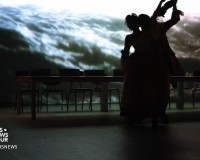
COPENHAGEN, Denmark — Six asylum seekers are the stars of a contemporary ballet that began a month-long run here tonight.
The production, called “Europa,” aims to demonstrate that refugees and migrants, are not parasites, as they are sometimes perceived.
The refugees’ personal stories form the backbone of the production, led by Christian Lollike, a director of the experimental Corpus Company, part of Denmark’s Royal Opera.
Lollike previously attracted international attention with a spectacular anti-war ballet called “Contact,” that featured former Danish soldiers who had lost limbs to Taliban bombs in Afghanistan.
“Europa” originally started off with ten asylum seekers, but one was deported to France, two have had their applications rejected and another has gone into hiding.
Two of the participants left the Syrian city of Homs in August last year, and during one of the dress rehearsals they learned that Denmark, a nation regarded as hostile to refugees, had granted them asylum.
Music Professor Salam Susu from Homs University was overwhelmed at her selection, praising the “very high professional people who really make me feel like I’m home. And I really restart being a real human being, feeling with everything.”
One of her fellow dancers, Muhammad Ali Ishaq, who left Lahore in Pakistan because he faced death threats over his homosexuality, is still waiting to hear whether his application for asylum will succeed.
The ballet is, he said, “very self-therapeutic for me. Speaking about my life, it gives me a feeling that when I tell people my story, people respond in a way that is not confrontation or condemnation. I’m not scared that they’re going to punish me.”
Read the full transcript of this segment below:
HARI SREENIVASAN: This week, the government of Denmark approved a law that enables the authorities to seize valuables from asylum seekers in order to pay towards their shelter and living expenses.
It’s an effort to make one of Europe’s top destinations less attractive to refugees and migrants. But one of Denmark’s leading dance troupes is taking to the stage to expand understanding of the hardships many of those same refugees have faced. They’re doing it by incorporating a number of asylum seekers into a new ballet.
It opens this evening in Copenhagen’s Old Opera House.
Special correspondent Malcolm Brabant was at the rehearsals, and sent us this reflection from the director and cast, in their own words.
SALAM SUSU, Refugee: You cannot explain it in words. Like, people dying all around you, friends, relatives, children, bombs, explosions, cars. You don’t know when you’re going to be dead.
My name is Salam Susu. And I’m from Syria. I lived in Homs. I work as a university professor in music. I came here. I play music. And I work with a very high professional people who really make me feel like I’m home. And I really restart being a real human being, feeling with everything.
CHRISTIAN LOLLIKE, Director: My name is Christian Lollike. I’m the director of this piece called “Europa.” It’s called asylum ballet. It’s a mix of asylum seekers and royal ballet dancers.
I’m trying to sort of explode the idea of what is a refugee, because,, very often in Europe, refugees are considered as parasites who come to take things from us and as a problem. And I want to show that they are much more.
MOHAMMED AL-ISHAQ, Refugee: It was necessary for me to leave Pakistan because of my sexuality. My name is Mohammed al-Ishaq from Lahore, Punjab.
It was becoming hard for me to survive and it was becoming extremely hard for my parents to survive because of me also, because they also started getting threats from the religious authorities who gave me threats also that, either I become non-gay, like non-homosexual, and get married normally to a woman, or I find my own ways, or be ready to be killed.
ELIAN YAAKOB DAWOOD, Refugee: When the bombs came, we were hoping they would hit our neighbor, not us.
My name is Elian Yaakob Dawood. I came from Syria. And now I’m here in Denmark. I need to send a message. We all send a message. We are good. We love the life, not everybody a religious fanatic.
CHRISTIAN LOLLIKE: I think it’s actually scary and wrong that the Danish government is trying to scare people away, instead of being constructive and work together in the European Union and to create a solution on this problem.
It’s very important, especially in Denmark, where a lot of people are afraid of asylum seekers and refugees. I think it’s very important to see that they are human beings and they have all kind of skills and qualifications.
SALAM SUSU: They are not all similar. There are a lot of really high-educated people who run away from death to rebuild their life, and to integrate into the society, to live the life that they really wanted, and to explain that we are good enough to be in your society.
MOHAMMED AL-ISHAQ: This will help people in thinking differently for refugees. They look at us as normal human beings, the way we are, not just the parasite.
As far as I’m concerned, it’s very self-therapeutic for me. Speaking about my own life, it gives me a feeling that, when I tell people my story, people respond in a way that is not confrontation or condemnation.
I’m not scared that they’re going to punish me. It’s not about the people who come from war-trodden countries only. It’s not just the war that people are dying of. There are other reasons also. And I do not come from a place where there is war going on. But there is a war going on at a society level for me, for my sake.
So, I’m sure there are people who have other reasons, other than war or even sexuality, that they do not find a place to survive where they are.
SALAM SUSU: We got asylum today. The papers and the commune, and — yes, I can’t explain too much, because it’s so good. Like, you had a paper, you are not nobody anymore. You became a human being.
My dream? To have a life again. To live. To experience my humanity. It’s really incredible. I really start to experience my skills on a real world, among the real people, who really start to know who I am. I’m like stepping on stairs to dream.
The post A dance to change Denmark’s minds about refugees appeared first on PBS NewsHour.