Getting NYC Teens Into Science
Educators have long complained that U.S. students are falling behind other countries in science. There’s also a shortage of blacks, Hispanics and Native Americans in the sciences. An organization in New York City has been devoted to increasing those numbers for the past 10 years through summer internships in prestigious science and medical labs.
At City College's chemical engineering lab, students and undergrads dressed in white lab coats lean against 1970s-era blue cabinets surrounded by microscopes, and a nitrogen tank used for polishing glass slides.
Dr. Ilona Kretzschmar, associate professor of chemical engineering, says the researchers are separating tiny particles about a tenth as wide as a strand of human hair.
“The particles are polymer particles and so we put a metal patch on the surface then we try to put molecules on these patches to then anchor different particles together,” she says, explaining how they’ll eventually be coated with a metal vapor.
It’s a lot to absorb. But 14-year old Elijah Akinbamidele is following along.
“Like, what she’s trying to say is, like, we’re trying to add onto a singular particle by adding patches from other particles to create something larger and something that can be more useful,” he says.
Elijah hasn’t even taken chemistry or physics yet. He’s just entering 10th grade at Bronx Health Sciences High School. Dr. Kretzschmar gives him lots of reading materials and already has him building models of the particle research with marbles and lights.
“I was like ‘Wow.’ Like, I thought I wouldn’t be able to catch on,” he says of his first day in the lab this month. “But if you set your mind to it you’re actually able to follow and understand.”
Expanding the minds of teenagers, and their career options, is the goal of the Harlem Children Society. The non-profit places low-income high school students in real working labs all over the city and gives them stipends. It was founded 10 years ago by Dr. Sat Bhattacharya, a molecular geneticist and cancer researcher who works at Sloan Kettering and Rockefeller University. He was concerned about what he was noticing.
“I could hardly see a lot of African American, Hispanic, Native American students in the sciences and medicine, hospital floors and university settings, very few higher ups,” the 41-year-old Indian-born doctor recalls.
Doctor Sat, as he’s called, is trying to recruit low-income students of all races who show an interest in science but don’t get enough exposure. He looks for promising students at local high schools by calling science teachers. Sheveen Greene of the Frederick Douglass Academy in Harlem was his first city high school intern. She recalls working alongside Dr. Sat in a cancer lab 10 years ago.
“He was very patient and by the end it was very inspiring,” says the Bronx native. “It really built my confidence in, you know, my ability to potentially pursue science research or study the sciences once I did get to college.”
Greene went to Swarthmore and is now enrolled in a nurse practitioner’s program at Columbia.
About half of this year’s 300 interns are from New York City. There are also low-income kids from Washington D.C., New Orleans, Detroit and even the Hopi Reservation in Arizona. They have weekly seminars and writing assignments, and are paid a stipend at the end of the summer. Last year's students made up to $1,500. Dr. Sat says the annual budget is about $600,000 and that he raises money from the National Science Foundation and other organizations.
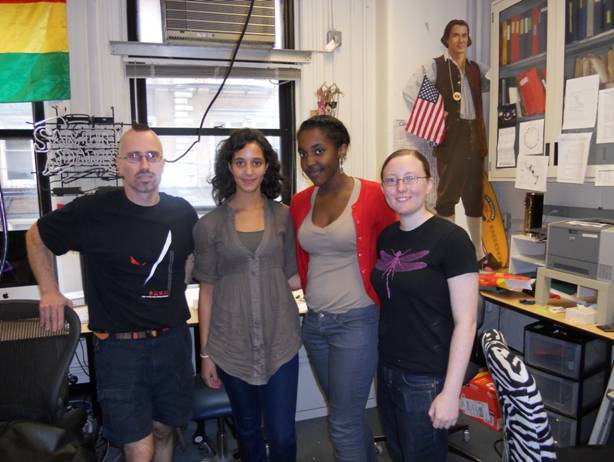
At New York University, anthropologist Todd Disotell’s office is filled with toy monkeys hanging from the overhead pipes. The 47-year-old professor has a Mohawk and a tattoo inspired by Darwin. His high school interns sit right next to undergrads and Ph.D. students, learning how to write computer programs that can sequence the DNA of primates. The field is called bio-informatics.
“We try to just show them how fun science is and that colleges and higher education’s the norm,” says Disotell. “This isn’t some super special goal, I hope they walk out of here thinking it’s just the default option.”
The Harlem Children Society claims 100 percent of its interns do go on to college, which isn’t surprising given their academics. But the program is still striving for many levels of diversity. It consistently attracts more females than males, a trend that concerns its founder.
Mai Abdel-al, 16, worked with Disotell at NYU last summer and is back this year. She says her Egyptian-born parents have high expectations for her and her siblings. There’s already an accountant and an engineer.
“Now my mom’s like ‘Oh, we need a doctor,’” she says, laughing. “So now they call me in my house they call me Doctor Mai. And I get so embarrassed!”
Most of the interns are immigrants or children of immigrants, and they often gravitate to more lucrative fields such as engineering and medicine, rather than pure research. But 16-year-old Chanel Ligon, who’s interning with Mai at NYU, says she’s still keeping a wide open mind.
“I thought I wanted to go in medicine but now I’m like ‘Oh, who cares about medicine? This is a great field, bio-informatics, let’s go,’” she says. “And then, you know, I go to lectures every Tuesday and I see different fields and I’m like, ‘This is so exciting! This is new!’”
Chanel describes herself as totally confused. But she also says, “You can’t go wrong with science.”

WNYC is funded by sponsors and member donations