"Promises, Promises" v. Billy Wilder's "The Apartment"

To compare the just-opened Broadway musical 'Promises, Promises' to its source material, the 1960 Billy Wilder film 'The Apartment,' is admittedly a bit unfair, a little apple-and-orangey.
More to the point, 'The Apartment' is one of the all-time great New York City movies, a film that beautifully captured an era's conflicting currents: rapid corporate growth and careerism, sexual liberation and sexual exploitation. That it can be classified a romantic comedy seems startling, given the suicide attempt it depicts and the constant melancholy that pervades the film. That's not only a testament to Wilder's craftsmanship and the acting of Jack Lemmon and Shirley MacLaine, but to the era itself, when audiences were sophisticated enough to juggle humor and deep pathos.
Can any adaptation compete with that? Well, this production of 'Promises, Promises' is a revival of a 1968 show that did very well -- it ran for more than three years, powered by Neil Simon's book and a Burt Bacharach score -- so yes, it is possible.
The plot revolves around one Mr. C.C. Baxter, an earnest enough, dutifully diligent chap working at the
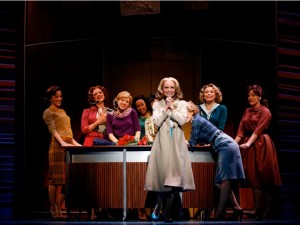
The current "Promises, Promises" stars Kristin Chenoweth of "Wicked" fame and Sean Hayes, aka flamin' Jack from TV's "Will and Grace." The show opens on a musical item. As Hayes' Baxter sits at his desk, lost in his workplace reverie, swarms of men and women employees dance around him. But to say this is dance isn't completely accurate: the movements are so acrobatic, so hyperbolic, as to be laughable. And that's the point. This was the 60s, after all, the early days of the sexual revolution. For women, that didn't just mean reproductive rights (the pill came to market in 1960, the same year as "The Apartment"), it also meant they were entering the workplace in larger numbers, and being exploited in larger numbers. The over-the-top dance moves suggest that this wasn't love or romance, it was merely ridiculous: men and women with very adult passions but childlike restraint.
The idea is repeated elsewhere, namely in a very funny musical number, "Turkey Lurkey Time" which makes explicit the animal side of human hookups. This is what's fun about seeing a musical adaptation of a movie like "The Apartment" -- the chance to see how a core idea is translated from the screen to the stage, at times exuberantly.
Overall, however, "Promises, Promises" can't compete with "The Apartment." Sean Hayes is likeable but his C.C. Baxter is neither as pathetic nor as eager for promotions as is Jack Lemmon. And Kristin Chenoweth, despite a couple great songs that left me wanting more (like the moving "I Say a Little Prayer"), seems underused. She also lacks something that made Shirley MacLaine's performance so memorable: that sense of a young woman who has aged prematurely, who has grown wise because she is being used by someone she can't help but love.
Most disappointing is the role of Mr. J.D. Sheldrake, which is performed by Tony Goldwyn (who's been in lots of productions but whom you might remember as the slimy best friend of Patrick Swayze in "Ghost" -- remember?). Goldwyn seems like boilerplate Wall Street casting, slick and selfish and not much else. In "The Apartment" the role went to Fred MacMurray, one of those classic mid-century actors whose every word or gesture, no matter how gentle, wields a certain strength or menace, depending on the character.
The standout performance of "Promises, Promises," the real revelation for me, was Katie Finneran. She's only in a couple scenes, playing the highly-soused Marge MacDougall, but her sheer bombast, through slurred syllables and over-the-top gyrations, is incredibly funny. For all her come-hither outrageousness, however, Marge simply wants to spend the night with Baxter. When things don't quite work out that way -- no fault of hers -- Marge's swagger drops and she goes meekly away. Just another lonely girl in a big, bad city.

WNYC is funded by sponsors and member donations